Monday, February 7, 2022

In child welfare, where do ethics reviews come from?


KEY POINTS
 

● A “scholar” who insists there is little or no racial bias in child welfare writes a “predictive analytics” algorithm for the State of California.  Somehow, the contract to write a so-called “independent ethics review” of the algorithm is given to another “scholar” who also insists there is little or no racial bias in child welfare.  In fact, they co-authored a screed on this very topic. 

● So we shouldn’t be surprised when the ethics review says it’s just fine if an algorithm says a parent is more likely to abuse a child based solely on the parent’s race. 

● A document from the California Department of Social Services indicates the agency was appropriately appalled by the “ethics review.”  They scrapped the entire algorithm project.  

● But it looks like the same ethics review is about to be used to justify still another algorithm created by the same team as the one the state scrapped.  This latest algorithm already is being rolled out, very quietly, in Los Angeles. 

● This is only the latest in a long line of predictive analytics “ethics reviews” that raise ethical questions.

First of two parts. Read part two here.

In the history of efforts to target families for child abuse investigations or otherwise harass them by using “predictive analytics” algorithms, also called Predictive Risk Modeling (PRM), one of the more spectacular failures was a system called AURA.  A product of a commercial software company, and a pet project of the then head of the Los Angeles family policing agency, Philip Browning, it was stopped during the testing phase after it was found to have one little flaw: 95% of the time, when the algorithm predicted something terrible would happen to a child, it didn’t. 

After that, California decided to try its hand at building a child welfare algorithm which could be used for a variety of purposes by the state and by county family policing agencies. (In California, family police agencies are county-run.)  They gave the job to a team led by Prof. Emily Putnam-Hornstein, the nation’s foremost predictive analytics evangelist.  She is co-author of two algorithms used in Allegheny County, Pa. (metropolitan Pittsburgh). One of those algorithms attempts to stamp an invisible “scarlet number” risk score on every child at birth.  Putnam-Hornstein’s own extremism is well-documented. 

As far as I knew, the California algorithm was still in development. 

It’s not. 

An excellent story in The Imprint reveals that, after extensive consultation with an impressive and diverse group of people, the California Department of Social Services (CDSS) has pulled the plug. 

CDSS concluded that Putnam-Hornstein’s team managed to deliver the worst of both worlds: an algorithm that was overlooking real safety threats and risked worsening racial bias in California child welfare. 

It appears that an “independent ethics review” written in 2018 that claimed there were no ethical problems at all may have backfired.  It may have contributed to alarm in CDSS and contributed to the agency’s wise decision to scrap the algorithm project. 

Unfortunately, the Los Angeles County Board of Supervisors and the county family policing agency, the Department of Children and Family Services, learned nothing from this.  They commissioned Putnam-Hornstein’s group to write an algorithm to, among other things, flag “complex risk” cases.  Then, as the Imprint story makes clear, they sneaked it online for three months in three regional DCFS offices, with no opportunity for the community to object – presumably because the community might point out the track record of predictive analytics and of Putnam-Hornstein. 

When you go to the web page where Hornstein’s group promotes the L.A. algorithm and click on “ethics review” what do you find?  The same appalling ethical review submitted to the state – with a promise that it will be “updated.” 

So let’s take a close look at that document, and who wrote it. 

Race as a risk factor 

Algorithms are not objective.  Human beings decide what factors an algorithm will consider when it coughs up a “risk score” concerning a child or family.  That risk score may determine anything from whether a family receives “preventive services” to whether a child is removed from the home.  Predictive analytics evangelists hate it when critics say “determine” – they say the scores are merely advice to give us humans a little help.  But imagine what would happen if it became known that a human ignored a high risk score and something went tragically wrong.  So while it is usually, though not always, possible for a human to override the algorithm it’s not likely to happen very often. 
Most of the time, designers of predictive analytics algorithms try to duck charges of racism by not explicitly including race as a factor.  Instead, they use lots and lots of criteria related to poverty – is the family on public assistance?  Was the family homeless?  Are they on Medicaid? etc. – that disproportionately include families of color. 

But that wasn’t enough for the authors of the California ethics review.  They went out of their way, apparently without even being asked, to say, in effect: It’s just fine if you want to say children are at higher risk of abuse for no other reason than the race of their parents! 

This is fine, the authors say, because it will make the algorithm more accurate.  But their measure of accuracy is not whether the algorithm predicts actual child abuse, it’s whether the algorithm predicts future involvement in the family policing system: Did the algorithm correctly predict that the family would be labeled “substantiated” child abusers or the child would be placed in foster care?  

But that’s not a prediction, that’s a self-fulfilling prophecy.  For example, in a system permeated with racial bias, Black families are more likely to be reported, more likely to be substantiated and more likely to have their children placed in foster care.  So when the algorithm looks at which families are more likely to be “system involved” the algorithm concludes that being Black makes you more likely to be a “child abuser” – instead of concluding that being Black makes you more likely to be falsely reported, wrongly substantiated and needlessly have your children taken. 


Or, as CDSS put it in a 2019 memo sharply critical of the ethics review 

CDSS does not agree that it is ethical to include race in the algorithm. Removing race from the algorithm does not eliminate bias, since race is correlated with many variables. However, explicitly including race as a variable simply provides an opportunity for more bias to seep into the algorithm’s predictions.

Go ahead: Slap a risk score on every child! 

The section on race only hints at the extremism of the ethics review’s authors. 

California never asked for an algorithm that would be applied to every child at birth – an Orwellian concept known as “universal-level risk stratification.”  It is so extreme one might think no one would ever do that – except that Putnam-Hornstein co-designed an algorithm that attempts to do just that in Pittsburgh. 

But even though this wasn’t on the table, the California “ethics review” went out of its way to say, in effect: By the way, that would be fine, too! 

The California DSS appeared to be appalled, and said so, sending a message that everyone in America, but especially in Pittsburgh, needs to hear: 

The Department believes that “universal-level risk stratification” is unethical and has no intention to use it now or in the future. Identifying and proactively targeting services to families with no [child welfare services] involvement is a violation of families’ privacy and their rights to parent as they see fit. This would be an overreach in the roles and responsibilities of a government agency. 

No wonder California DSS seemed appalled. They were handed a so-called ethics review that says it’s fine to slap a risk score on every child at birth – and fine to label the child at higher risk of abuse just because of the parents’ race. 

The Charge of the White Brigade 

Who in the world would take such an extreme position? Someone who is a charter member of child welfare’s “caucus of denial” – someone who insists that child welfare is magically immune from the racial bias that permeates every other aspect of American life.  Someone who says that the disproportionate rate at which the system intervenes in Black and Native American families is only because past discrimination (racism is so over, have you heard?) and the problems it caused has made Black people more likely to be bad parents.  In short, someone with views just like those of Emily Putnam-Hornstein. 

So now, meet the lead ethics reviewer for Putnam-Hornstein’s California algorithm, Prof. Brett Drake of Washington University. 

Not only does Drake hold the same views on all this as Putnam-Hornstein, something he makes clear in the ethics review itself, he and Putnam-Hornstein co-authored a screed taking the same position on race, and denying even that poverty is confused with neglect.  Another co-author is Sarah Font of Penn State, who issued a report with a graphic labeling everyone accused of child abuse as a “perpetrator” – even after they’ve been vindicated in the courts.  

The lead author of the screed is Naomi Schaefer Riley, who proudly compares her own book attacking family preservation to the work of her fellow American Enterprise Institute “scholar” Charles Murray. Murray wrote The Bell Curve, a book maintaining that Black people are genetically inferior.  The Southern Poverty Law Center labels Murray a “white nationalist extremist.” 

In addition to the four authors, the screed has 13 co-signers.  All of the authors and all but two of the cosigners appear to be white.  And that’s just the beginning.  I recommend taking a minute to Google them all. 

This Charge of the White Brigade is nominally a critique of the movement to abolish the family policing system.  The white authors label this movement led by Black scholars and Black activists “simple and misguided,” [emphasis added]. 

But the screed isn’t only about abolition. It recycles the same old attacks used for decades against any effort to curb the massive, unchecked power of the family police. Their argument, in somewhat more genteel language, boils down to: If you don’t let us do whatever we want, whenever we want to whomever we want, you don’t care if children die!!! 

So to review: An algorithm designed by someone who believes there is little or no racial bias in child welfare gets a seal of approval from an “ethics review” written by someone who believes there is little or no racial bias in child welfare.  

Though California DSS was not fooled, as noted above, Los Angeles County has turned to Putnam-Hornstein to design still another algorithm.  As the Imprint story revealed, it was rolled out on the sly for three months in three locations last year.  Presumably, this was done because the communities in question might object to computerized racial profiling and try to stop it in its tracks.  So even as predictive analytics proponents blather about consultation and transparency their real approach is different.  How ethical is that? 

As noted above, go to the webpage where Putnam-Hornstein and her colleagues try to sell this latest algorithm and click on “ethical review” and guess what turns up? The same review rejected by the California Department of Social Services in 2019, but with a note promising an update. 

If this latest experiment, using Los Angeles children and families as guinea pigs, is allowed to continue, presumably, Putnam-Hornstein, who does not believe there is racial bias in child welfare, will be in charge of determining if this latest algorithm exacerbates racial bias in child welfare. 

All of which raises one question: How was Brett Drake chosen to do the California ethics review in the first place?   It does not appear that he was chosen by California DSS.  They say that the ethics review 

was a required deliverable for a research grant that supported exploration of whether a [predictive risk modeling] tool could successfully assess risk of future [child welfare services] involvement.

If, when it comes to ethics reviewers Putnam-Hornstein has had a remarkable run of luck. 

A co-author of an ethics review of the Allegheny Family Screening Tool (AFST), the first algorithm Putnam-Hornstein co-authored for Pittsburgh is a faculty colleague of Putnam-Hornstein’s partner in creating that algorithm.  They coauthored papers together.  But even those reviewers said that one reason AFST was ethical is that it would not be used on every child at birth. 

Needless to say, this caused a problem when Allegheny County decided it wanted to use another algorithm co-authored by Putnam-Hornstein to do just that.  So they commissioned two more ethics reviews – including one from another ideological soulmate of  Putnam-Hornstein. 

But oddly, the county didn’t rush to publish them.  In 2019, county officials just declared that they’d gotten a seal of approval from the ethics reviewers.  That is true. But the story is a little more complex than that.  It’s a story for part two, which you can read here.

Thursday, February 3, 2022

Maine Child Welfare Advisory Panel charts a better way forward

There's some good stuff in this report.

At last: A group involved in oversight of Maine child welfare that shows a real understanding of the problems.  The Maine Child Welfare Advisory Panel (MCWAP) Citizen Review Panel has produced a report with six recommendations.  None of them is a dud and three have the potential for significant improvement.  The only problem is that the recommendations are too timid, often suggesting pilot programs for ideas that have already been proven all over the country. 

Unfortunately, when it comes to the most important recommendations, the Maine Office of Children and Family Services, while not opposing them outright, showed no enthusiasm. The OCFS response boils down to: Hey Legislature, it’s up to you, we don’t care.  That is to be expected from an agency led by Todd Landry whose callousness was on display back when he was running child welfare in Nebraska - and taking away children at what was then the highest rate in the country. He even made a sick joke at the expense of vulnerable families. 

It speaks volumes about the failure of Maine’s child welfare “ombudsman,” Christine Alberi, that even Landry thinks Alberi goes too far in recommending the removal of children from their homes. 

The existence of this report also calls into question a claim made by Alberi at a recent legislative hearing.  Alberi claimed that all the various oversight organizations concerned with child welfare in Maine are essentially on the same page. 

But even though Alberi is listed as a member of MCWAP, their full report is not on the same page as Alberi – they’re not even using the same playbook.  And while Alberi’s approach will make all Maine children less safe, if the state enacts the MCWAP recommendations it will be a first step toward making all children safer. 

Most important: High-quality legal representation 

The most important recommendation, in keeping with evidence-based best practice across the country, is for Maine to pilot legal representation as soon as OCFS starts to investigate – as opposed to only after a child has been taken away.  The recommendation is too tepid, calling only for some form of legal representation, largely just so families know what OCFS will do to them – as opposed to representation that lets families fight for their children and counter needless removal. 

What is actually needed, and what has been demonstrated to significantly reduce foster care with no compromise of safety is high-quality interdisciplinary representation, in which the family gets a defense team – a lawyer and a social worker, not to get “bad parents” off, but to offer alternatives to the cookie-cutter service plans forced on families by agencies like OCFS, plans that often make everything worse. The team also may include a parent advocate who’s been through the system herself.  This also would free up caseworkers to spend more time investigating cases, increasing the chance that they will find the very few children in real danger.  And, by the way, because foster care is so expensive and because, in many cases, the federal government will pay half the cost, this approach also saves money. Casey Family Programs has some excellent resources on this. 

Note that often these programs have the full support of state or local child welfare agencies.  But then those states and localities don’t have agencies run by Todd Landry. 

Flex-funds 

The term used in the MCWAP report is “discretionary funds” but in Alabama, where the idea came from, they’re called “flex-funds” The idea is that service providers can spend $1,000 per family on pretty much anything that family needs.  It might mean rental assistance, or a security deposit so a family can move to better housing.  It might mean funds for car repairs so a parent can get to a job.  It might mean emergency food aid, or repairs to a furnace or a refrigerator.  This is crucial for preventing families from being torn apart because of poverty.  

In Alabama this was part of a comprehensive approach to keeping families together that, unlikely as it may sound, has made this state – a poor state with serious drug use issues (sound familiar?) a national leader, relatively speaking in keeping children safe by keeping families together. Maine would do well to take a close look at all the Alabama reforms. 

Once again, however, Todd Landry’s response to “flex funds” is the equivalent of shrugging his shoulders. 

Domestic violence 

This recommendation is a fine example of how MCWAP understands concepts Alberi can’t seem to grasp: In this case the issue is the enormous harm done to children when they are taken from parents, usually mothers, accused of “failure to protect” their children from “witnessing domestic violence.”  In other words, they couldn’t get away when a husband or boyfriend started hitting them in front of the children.  When children are taken under these circumstances the trauma of removal is magnified.  One expert described such removals as “tantamount to pouring salt into an open wound.”  

The Western New England Law Review has an excellent – and concise summary of the research in this area, and a response to all the straw-man arguments offered by those who want to continue this barbaric practice. 

Fortunately, unlike Alberi, whose own report seems to encourage this practice, MCWAP recommends that OCFS 

prioritize efforts to decrease children from being removed, or threatened to be removed, from non-offending parents for “failure to protect” the child from exposure to domestic violence committed against the non-offending parent by the offending parent.

 This is the one recommendation of the three that OCFS does not appear to be blowing off, but they still don’t get the urgency.  Their response boils down to: This is one piece of the work of a great big committee that’s working on revising stuff. 

But it’s not that hard.  The right policy concerning tearing children from battered mothers because the children “witnessed domestic violence” can be boiled down to a single word: 

Don’t. 

Wednesday, February 2, 2022

NCCPR news and commentary round-up, week ending Feb. 1, 2022


● I’ve never before led with a review of a novel, but Jessamine Chan’s The School for Good Mothers is no ordinary novel. Some might say it depicts a dystopian future child welfare surveillance state.  Dystopian yes – but it’s only 20 minutes into the future (10 if you live in Pittsburgh). As Kate Knibbs puts it in her review for Wired:
 

“This closeness to reality is what turns the book’s emotional gut punch into a full knockout wallop. A mother reading it doesn’t close the book, sigh, and think, Thank god the world’s not really like this. No, she closes it and knows she must be very careful.” 

Read it and you’ll find yourself thinking about it almost every time you read about how the system functions right now. 

● You might think of The School for Good Mothers when you read this column in The Imprint from Former Juvenile Court Judge  Karen Baynes-Dunning. It’s called “Stop Blaming the Uncooperative Mother.”  It’s part of the special issue of Family Integrity and Justice Quarterly devoted to the harm done by the so-called Adoption and Safe Families Act. 

● You might think of The School for Good Mothers again when a child’s legal, state-approved use of medical marijuana to control seizures leads to the child being dragged from her home screaming by the family police in Oklahoma.   

● There is a right way and a wrong way to cover the release of the federal government's annual Child Maltreatment report.  I have a blog post about how the Associated Press got it wrong. In contrast, The Imprint got it right. 

● There’s also a right way and a wrong way to report on the use of “predictive analytics” in child welfare.  The Imprint offers a careful, nuanced analysis with ample room for all sides of the debate, along with some startling revelations about the work of the nation’s foremost predictive analytics evangelist, Emily Putnam-Hornstein. Compare this to how the Los Angeles Times contributor Garrett Therolf, systematically excluded dissent from Putnam-Hornstein’s point of view when writing about the same topic. (And, yet again, you may find yourself thinking about a certain novel.)

● The American University Law Review is sponsoring this online event on Feb. 4: The Impact of Race on Youth [in]Justice The last panel is on Issues in the Family Regulation/Child Welfare System with an impressive group of speakers. 

● Along similar lines, Prof. Shanta Trivedi of the University of Baltimore School of Law discusses “Why is America so Keen on Separating Families?” on the ACLU At Liberty podcast. The link goes to the recording and a transcript. 

● There’s still another example of the price of foster-care panic in Illinois: The state is warehousing children at one of those awful parking place “shelters” for an average of 107 days.  Oddly, some of the children don’t want to stay there. As Beth Hundsdorfer of Capitol News  Illinois reports: 

There is no public transportation nearby. Its closest neighbor is a business that rents heavy equipment. Children from Cook County … are nearly a five-hour drive away from home. 

“Illinois does not utilize locked residential facilities, and in spite of the best efforts to provide care for children living in these facilities, some youth choose to try to return home to their families and familiar living situations,” McCaffrey, the DCFS spokesman, said in an email. “In these cases, DCFS works with local law enforcement to help return the children to a safe space where they can get the care and services needed.” [Emphasis added]. 

So, instead of thinking: Hey, maybe those young people are trying to tell us something and we should make their own homes “a safe space,” we’ll just bitch and moan about the fact that we can’t lock ‘em up – and, as the story also reports, give this horrible place and extra $647,000 to keep on harming children. 

● Remember that “child abuse pediatrician” who quit her job in Wisconsin under fire, then turned up in Alaska. She just quit her job in Alaska, under fire. 

● It began with needless removal of a child. Everyone stalls and stalls until the foster parents can play the bonding card.  Then the foster parents themselves go to court to try to terminate the child’s rights to his own parents (a more accurate term than “termination of parental rights.”)  Apparently, you can do that in Tennessee, according to this story from the Tennessee Tribune.

Friday, January 28, 2022

NCCPR in the Albuquerque Journal: To fix NM child welfare: listen to the gut, then do the opposite

It’s easy to fix a failing child welfare system like the one in New Mexico: just listen to your gut instinct – and do the opposite.  

Gut instinct says: Children have been dying, as a Journal editorial put it, “seemingly … under the noses” of workers for the Children, Youth and Families Department – so we should rush to tear more children from their parents at the slightest sign of abuse or neglect.  

That is always the knee-jerk response to child abuse tragedies, whether because lawmakers explicitly demand it or because workers are terrified about what will happen to them if the next high-profile tragedy is on their caseload. The result is a foster-care panic, a sudden spike in removals of children from their homes. 

But that never works. … 

Read the full column here.

Thursday, January 27, 2022

Federal report says child abuse deaths DECREASED during the pandemic – but an Associated Press reporter doesn’t seem to want you to notice.

There's some big news in this report.
Unfortunately, the Associated Press buried the lead.

UPDATE: APRIL 29, 2022: Because of the reporting discussed below, I had very low expectations when I learned that the same reporter was examining the use of "predictive analytics" in family policing.  I was wrong.  That story is excellent.


For a far more nuanced take than was offered by AP, check out this story from The Imprint. Their bottom line: 

It all points to the notion that in the early months of the pandemic, as lockdowns began and schools were closed, there was not the kind of unseen surge in abuse and neglect that some feared.


Remember all those scare stories about how, because COVID-19 prevented overwhelmingly white disproportionately middle-class “mandated reporters” from constantly having their “eyes” on children who are neither, their parents would unleash upon their own children a “pandemic of child abuse”?

As with so much bad child welfare journalism, this false narrative only hurt the children it was intended to help.  It risked deterring families from seeking help when they needed it most, encouraged putting even more families under constant, oppressive surveillance, increased the likelihood of needless placement in foster care, reinforced stereotypes about nonwhite families – and, particularly before vaccines, risked spreading COVID-19 among families and caseworkers alike. 

Given that, you’d think it would have been big news when the federal government released its annual estimate of child abuse fatalities and found that, in the year ending Sept. 30, 2020 – including the first six months of the pandemic – child abuse deaths actually decreased. 


The decline in child abuse deaths may add a little bit to a wealth of data and studies, most recently from JAMA Pediatrics, but also much more, showing that there was no “pandemic of child abuse” – and journalists should think about how quickly they bought into stereotypes about nonwhite families when they rushed to write those stories. 

But what if you're as deeply committed to the “pandemic of child abuse” myth as Associated Press reporter Sally Ho seems to be?  She wrote one of the big fearmongering stories last year, a story quoting, unrebutted, an official with an association of school social workers suggesting it’s a good idea to call a child abuse hotline “if a child seems dirty." (No, I won't link to it, but it's still pinned it to the top of her Twitter feed.)  Well, then apparently you don't let data, or studies, or JAMA Pediatrics spoil a good “master narrative.” 

Instead, Ho’s latest story on the topic is headlined: 

Child abuse report: Deaths of Black children up in pandemic 

Then this subhead: 

The latest national child welfare report shows an increase in the number of Black children who died, even though fewer abuse-related fatalities were investigated in the yearlong period that included the first several months of the pandemic 

There is nothing in the story to support that subhead.  There were fewer reports alleging child abuse and therefore fewer investigations, but that does not mean fewer “abuse-related fatalities” were investigated.  The subhead seems to be based on the assumption that, thanks to the pandemic, Black parents were more successfully killing their children without anyone knowing about it.  (Reporters don’t generally write the headlines and subheads, that may well have been some copy editor making an inference – understandable, since that is what the story implies.) 

In the story itself, the decline in total child abuse deaths not only isn’t the lead, it is barely mentioned in the 8th paragraph of a 12-paragraph story. 

Similarly, when family policing agencies were forced to pull back, one of the first stories debunking the "pandemic of child abuse" myth noted that, in poor communities of color, parents say it feels like "the pollution lifting." Note that the comment is attributed, not an editorial position by the reporter.  In contrast, the AP story simply declares that the decline in investigations is "a troubling trend." That's fine (albeit wrong) in an editorial. It has no place in a news story.

But what about that increase in child abuse deaths of Black children? 


Ho cites an estimate of 504 such fatalities in 2020, an increase of 73 compared with 2019.
She neglects to mention that the 2019 figure was a significant decrease from 2018, when there were 470 such deaths. The increase between 2018 and 2020 was 34; less than half the increase than if you choose 2019 as the base year. (On the other hand, the 2018 figure was a significant increase from 2017 – even though there was no pandemic. This very volatility further indicates something discussed in detail below, that fatalities are an unreliable way to draw conclusions of any kind about child welfare systems.)
 

But since that’s what AP has chosen to use without context, here’s the context: 

We’re looking at an increase of 73 (or 34) in a universe of more than 8.5 million Black children.  That means, relative to the total number of Black children in America, between 2019 and 2020 the number said to have died of child abuse increased by 0.0009%. 

And, for reasons discussed below, some of the supposed increase might be an artifact of subjective decision-making – and bias – in determining cause-of-death. 

All this illustrates the primary reason one can draw no sweeping conclusions of any kind from child abuse death numbers.  It is a reason I’ve repeated often on this blog, a reason for which we all should be grateful: Though each is the worst imaginable tragedy, the number is too low to draw sweeping conclusions.  The number can fluctuate easily due to random chance -- or simply errors in reporting statistics as they are passed from police departments (in some cases) to county child welfare offices to state child welfare agencies to the federal government.  

Another key factor is the potential for bias.  One might think that nothing would be more straightforward than determining if a fatality is due to abuse or neglect.  


But what about a case in which, say, a three-year-old wakes up early one Sunday morning.  Mom and Dad are asleep.  They didn’t know how adept their child had become at opening the back door.  He wanders away, falls into a body of water and drowns.  Accident or neglect?  If the body of water is the pool behind the McMansion it will probably be labeled an accident.  If it’s a pond behind a trailer park: Neglect.
 

So, what do you think?  Which racial or ethnic groups are more likely to be involved when a death is mislabeled neglect?  

Selective about “experts” 

The Associated Press story ignores all that. It leaves the impression that the increase is because as soon as mandated reporters turned away, Black parents unleashed savagery on their children.  The story includes the same boilerplate that became standard in stories pushing the pandemic of child abuse myth: 

The federal data confirm a drop by hundreds of thousands in documented cases of child abuse reports, investigations, substantiated allegations and support for at-risk families. But experts say that’s not necessarily good news — children were out of the public eye during the pandemic, and some cases likely weren’t reported until they became more severe, if at all. 

Experts say?  There are plenty of experts who say that is b.s.  But those experts are ignored. 
They don’t even get the usual “to be sure graf” (as in “To be sure, not everyone agrees with the thesis of our story, [insert token quote or statistic here] but, [return to the reporters’ thesis]…”

Two government officials are quoted, but they do nothing to challenge the story’s thesis – in fact, they say pretty much nothing at all. And even then, one of the officials JooYeun Chang, was taken out of context.  The Imprint has what the AP story left out. 

Instead, the story cites just one alleged “expert,” who, in the long, ugly tradition of “health terrorism” offers up the fill-in-the-blanks quote the reporter seemed to want: 

The numbers on fatalities in particular are concerning, because such cases are notoriously underreported, said Amy Harfeld, of the Children’s Advocacy Institute. Social workers often investigate a child’s death only if the family had already been involved with a child welfare agency. 

Even if one assumes that such cases are underreported and, in fairness, given all the failures I’ve just described, it’s reasonable to believe that, this is not a new phenomenon.  There is nothing to indicate that the number of missed cases increased in 2020, so this does nothing to support the “pandemic of child abuse” theory.  In fact, it is no less possible that, without as many false allegations and poverty-confused-with-neglect cases clogging the system, workers found more cases when children were in real danger, and that’s why total child abuse deaths went down.  

But the weirdest part of the quote is the implication that a child abuse death doesn’t make it into federal data unless it’s investigated by social workers.  A death determined to be child abuse is reported and counted whether it’s investigated by social workers or by law enforcement. And I’m sure even Amy Harfeld doesn’t believe that, upon discovering a suspicious death of a child, the cops say “Nah, don’t bother to investigate; they were never reported to child protective services.” 

Yes, this should cut both ways 

But wait: Does that mean we also can’t draw sweeping conclusions from the overall decline in child abuse deaths?  

Yes, it does.  I’ve suggested before that I would be glad to negotiate a mutual moratorium on the use of horror stories to make a point, I also would be glad to negotiate a mutual moratorium on drawing sweeping conclusions from child abuse death statistics.  So far, reporters don’t seem to be interested. 

More important, none of the evidence debunking the pandemic of child abuse myth depends exclusively on fatality numbers.  But none of that evidence, and none of the experts who disagree with the story’s premise got even a word in edgewise.

Wednesday, January 26, 2022

NCCPR news and commentary round-up, week ending January 25, 2022

● We begin this week not just with one story but with an entire magazine.  Family Integrity and Justice Works, the group started by two former top federal child welfare officials, is publishing a quarterly magazine. The first issue is devoted to the enormous harm done by the so-called Adoption and Safe Families Act. 

● One way to reduce the harm of ASFA is, of course, to provide real help to families.  The term “primary prevention” sometimes has been just a euphemism for expanding surveillance.   But given the great panel at this upcoming webinar, I don’t think this event will be one of those times. 

● At long last, it appears America’s racial justice reckoning might be starting to reach child welfare.  That seems to be making a certain former Los Angeles Times reporter, and current contributor, very upset.  So he’s back, scapegoating family preservation – and pushing computerized racial profiling, AKA “predictive analytics.”  I have a two-part blog post about how his work is harming the most vulnerable children in Los Angeles. 

● There’s more about the problems with predictive analytics in this op-ed column for the Connecticut online news site, CT Mirror. 

● The company that makes and sells the particular predictive analytics software that, as the column above documents, failed disastrously, also used to be in charge of foster care in Hillsborough, Pasco and Pinellas County, Florida.  That failed disastrously, too.  Now a mother whose child was taken only to be sexually abused in Pinellas County foster care is suing the agency, Eckerd Connects. But let’s also remember who took the child from his own home in the first place. 

● If you think you know every way in which so-called “child abuse pediatricians” run amok can make children and their parents suffer, think again, and read this story from Wisconsin Watch and the Anchorage Daily News. 

● In New Mexico an Albuquerque Journal editorial declared, children are dying “seemingly … under the noses” of the state family policing agency.  NCCPR has an op-ed in the Journal about what to do about it. 

● When the Supreme Court let religious adoption and foster care agencies discriminate on the basis of sexual orientation, the debate was focused almost entirely on the harm to LGBTQ parents.  In Family Court Review, New York University Law Professor (and NCCPR President) Martin Guggenheim argues that everyone, including the City of Philadelphia, which argued before the Court opposing such discrimination, missed the point.  The real issue is the harm to LGBTQ children.

● Remember when children could walk home from school by themselves or even play in a playground without parents hovering over them?  Let Grow is supporting bills in three states to give children back that freedom – without their parents having to fear being charged with “neglect.” 

● Remember when “brain science” was the big fad when it came to justifying tearing apart families?  Looks like the brain scientists are getting smarter. 

● Of course, families enmeshed in the net of family policing agencies such as New York City’s Administration for Children’s Services have always known what the brain scientists are discovering.  As members of the Parent Legislative Action Network write in NYN Media: 

Low-income communities are saturated with mandated reporters who are obligated to report any inkling of child maltreatment. That means that if a parent is thinking of asking for help, such as HeadStart child care, emergency housing, domestic violence support, substance abuse counseling, or Applied Behavior Analysis therapy funded by the state, they should be prepared to deal with ACS. … Families need real support from trustworthy service providers within their communities. But even more, families need cash.

Tuesday, January 25, 2022

Garrett Therolf and the Magic Algorithm!


He co-authors a “news analysis” for the Los Angeles Times that sounds like a pitch by a company selling “predictive analytics” software for child welfare.  There’s also another cheap shot at family preservation and something that sure sounds like a dog-whistle.

Second of two parts. Read part one here.

Yesterday’s post to this blog reviewed the bad journalism practiced by former Los Angeles Times reporter, and current contributor, Garrett Therolf.  I noted that other journalists have accused him of repeated misrepresentations and, on one occasion, making up a quote.  The post talked about Therolf’s profound discomfort with any suggestion that there is systemic racial bias in child welfare. 

I said I believe this poor journalism contributes to the fact that Los Angeles County tears apart families at the second-highest rate among America’s biggest cities and their surrounding counties.  And I noted how he stacked the deck in a story about racial bias in child welfare. As Therolf portrayed it in a 2017 story, white people “marshal data,” Black people want to rely on anecdote and “folkways.” 

That post discussed what Therolf said during a January 20 “Ask the Reporters” video event presented by the Times.  But Therolf and a current Times reporter, Matt Hamilton, also wrote a “news analysis” for the Times headlined Anthony, Noah, Gabriel and beyond: How to fix L.A. County DCFS. 

Though called a news analysis, it was actually a sales pitch for a child welfare fad that is much beloved by those wedded to a take-the-child-and-run approach to child welfare: predictive analytics.  This is an approach in which a computer algorithm mines vast amounts of data – especially data about poor people – and tells the family policing agency whether a case is high-risk.  It amounts to computerized racial profiling.  

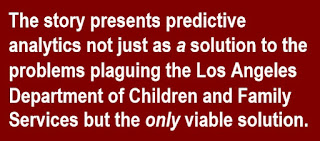
It was tried first in criminal justice – and proven to be racially biased.  Yet Therolf and Hamilton present it not just as a solution to the problems plaguing the Los Angeles Department of Children and Family Services but the only viable solution.  They regurgitate favorite talking points of Emily Putnam-Hornstein, America’s foremost evangelist for predictive analytics in child welfare; someone whose own extremism and penchant for deriding the work of Black people is documented here. 

Analyzing the “analysis” 

The story is a great illustration of Therolf’s general approach. So in this post, I will go through parts of the story paragraph-by-paragraph, (excerpts are in italics) starting with that headline, which references the three horror story cases Therolf focuses on, to the near exclusion of all else: 

News Analysis: Anthony, Noah, Gabriel and beyond: How to fix L.A. County DCFS 

One could as easily have done a story headlined: “Los Angeles tears apart families at one of the highest rates in America’s largest urban areas – but children keep dying: How to fix L.A. County DCFS.”  But Therolf has shown no interest in L.A.’s outlier status.  While he has pointed out that Los Angeles has failed to prevent horror story cases for decades, he has not seen fit to remind readers that the rush to remove more children has done nothing to make them safer. 

In the long, troubled history of L.A. County child abuse cases, certain names stand out as avatars of how the system can go terribly awry. Anthony Avalos. Gabriel Fernandez. Noah Cuatro. 

Viola Vanclief, Joseph Chacón and Andreas F. could just as easily have become such avatars
– but Viola and Joseph died in foster care.  Andreas was allegedly tortured and beaten into a coma by his foster mother.  They didn’t become “avatars” because the way they were hurt doesn’t support Therolf’s “master narrative.” The Love family  (whose story does not appear to have been covered in the Times even once) and the mother who is the subject of this commentary in WitnessLA also would make excellent avatars of system failure. 
 

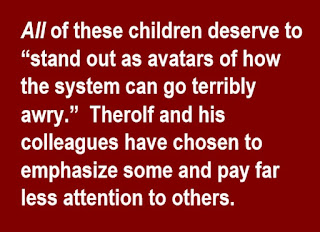
In fact, all of these children deserve to “stand out as avatars of how the system can go terribly awry.”  Therolf and his colleagues have chosen to emphasize some and pay far less attention to others. 

Is the racial justice movement really too influential? 

But since the spring of 2020, another name has wielded outsize influence over national perspectives and policies related to child welfare, and energized activists to push for sweeping reforms: George Floyd. 

Notice the use of “outsize” influence as opposed to “strong influence” or just “influence.”  Outsize can simply mean large, but it also can mean “exaggerated or extravagant in size or degree.” – as in: Beware! People are now way too concerned about not taking away Black children and that is putting them in danger.  

If anything, the impact of America’s racial justice reckoning on child welfare has been undersized, consisting largely of foster care agencies slapping Black Lives Matter statements on their websites while continuing business as usual. 


Indeed, it is a testament to the double standards that so many journalists apply when the issue is child welfare that in the midst of a racial justice reckoning, so many reporters bought into a racially biased, and now widely-debunked myth: the one that claimed that, due to COVID-19, in the absence of all those overwhelmingly middle-class disproportionately white “mandated reporters” keeping their “eyes” constantly on children who are neither, their parents would unleash on their own children a “pandemic of child abuse.”  Garrett Therolf, who in his current job writes for outlets besides the Times, jumped right onto that bandwagon.
 

Similarly, while the Los Angeles Times did a superb job confronting its own racism in many other fields, it neglected to scrutinize its child welfare coverage.  Perhaps the Times’ new editor, Kevin Merida, will remedy that. 

The murder of the Black Minneapolis resident by a police officer in May 2020 set off a national soul-searching over the country’s racist past and the prejudices that still haunt its institutions. In L.A. County, that process has focused intense scrutiny on what a number of racial justice advocates and elected officials say is an implicit bias that may make some Department of Children and Family Services workers more prone to regard poor families and parents of color as unfit to raise their children. 

Watch out for those bad apples 

Notice the “few bad apples”-type framing here.  Some workers may be biased.  As opposed to the idea that systemic racism poisons the entire system.  Therolf isn’t required to agree with that, but he has an ethical obligation to note the existence of that critique and explore it.  But as we’ve seen, Therolf has a record of dismissing that idea. 

In 2020, three-quarters of children removed from their homes in L.A. County were Latino or Black, according to a motion — authored by Supervisor Holly Mitchell and passed in July by the Board of Supervisors — to begin implementing a controversial pilot project called “blind removal.” 

The program, first adopted in Nassau County on Long Island in New York, redacts all race and race-related factors from the dossiers used by social workers and supervisors in determining child welfare cases. And it is gaining popularity, despite critics who say that it has shown insufficient evidence of its efficacy and that it adds one more task to an overtaxed workforce. 

Let’s take the last point first. What overtaxes the workforce is a flood of false reports, trivial cases, cases in which family poverty is confused with neglect and needless removals of children by workers terrified of being the Los Angeles Times’ next target if they leave a child in a home and something goes wrong.  So the notion that one small step to try to curb racial bias should be abandoned because the workforce is overtaxed is one more indication of Therolf’s own bias. 

Therolf is partly right about criticism of the program’s efficacy – criticism from his pal Putnam-Hornstein.  (He does not mention other criticism, that the change doesn’t go far enough in uprooting institutional racism.)  But that hardly makes the whole program “controversial.”  Even the revisionist critique shows an overall decline in removals of Black children.  In fact, the data may indicate that the process contributes to a decline in removals of all children – perhaps because the process also eliminates data suggesting whether or not a family is poor. 

But the best way to find answers is to create a pilot project to test the practice.  That is exactly what the Board of Supervisors has ordered. 

But while officials scramble to address these race-related concerns, other child welfare experts assert that another, relatively new methodology using machine learning and algorithms is more likely to yield race-neutral and reliable results that, among other benefits, will enable social workers to accurately identify incidents of child abuse at an early stage and move swiftly to intervene.  

Notice that this method gets a much friendlier introduction. A method widely criticized as magnifying racial bias is presented as the magic cure. 

Rather than relying on caseworkers’ limited ability to weigh a family’s full recorded case history — due to limited time and cumbersome technology — experts had urged the county to partially automate risk analysis with a new generation of predictive analytics tools to scan and evaluate hundreds of known variables regarding families, including prior hotline calls and the child’s age when the first hotline call was received. 

Stop and ask yourself: If you were writing promotional copy for a company selling predictive analytics software, would it have been any different from that?  

Better solutions 

One could, in fact, solve the limited time problem by curbing the deluge of false reports, trivial cases and poverty cases.  This could be done by things like eliminating mandatory reporting  -which has been found, in studies Therolf is unlikely to tell you about, to overload the system and drive families away from seeking help.  

The deluge of false reports is due in part to CYA referrals by mandated reporters terrified of what will happen to them - including what the Times will do to them – if they don’t report and something goes wrong.  As for cumbersome technology, how about fixing it, instead of building a whole new technology on top of it? 

The use of such tools to predict which children are at greatest risk has attracted controversy because of the chance that they might exacerbate racial disparities in child welfare. That’s because Black and Latino families tend to interact more frequently with entities such as public hospitals and mandated reporters who generate the data that are used to train the algorithm on how to detect risk. 

Actually, there’s far more reason than that. The algorithm in Pittsburgh, for example, which was co-authored by Putnam-Hornstein and for which Therolf has shown particular fondness, relies heavily on databases that sweep up data only on poor people. It also relies heavily on past involvement in the family regulation system itself. (By the way, Putnam-Hornstein hates the phrase “family regulation system.”) That makes the computer-generated risk score more like a self-fulfilling prophecy than an actual prediction.  Then there’s the fact that, as noted earlier, the same approach has been proven to be biased when applied in criminal justice. 

Those pesky civil libertarians! 

Pushback from the American Civil Liberties Union and others had stalled the development of the program for years, contributing to the decision by Cagle’s predecessor, Philip Browning, to retire in frustration. 

Darn those pesky civil libertarians!  But, wait, what did the ACLU actually say?   You don’t suppose they have an in-depth critique that they presented at a recent virtual conference, do they? Isn’t this where real journalists quote the ACLU in order to explain why there might be a problem?  But no; a hallmark of Therolf’s “reporting” is to minimize dissent from his own point of view, confining it to a brief paraphrase or not mentioning it at all. 

Oh, one other thing Therolf neglects to mention: Los Angeles County tried a predictive analytics algorithm during Browning’s tenure – and it failed spectacularly. The “false positive” rate was more than 95%. Much the same happened in Illinois.  What L.A. is trying now is supposedly a new, improved algorithm.  But it’s co-authored by Putnam-Hornstein – and her Pittsburgh algorithm has much the same problem. 

But [Browning’s successor, Bobby] Cagle gained the majority support of L.A. County’s supervisors that had eluded Browning, and the tool was piloted last summer to help flag children like Noah who may be at the highest risk. (Cagle resigned in November, as DCFS faced mounting criticism over a series of fatalities and abuse of children under the agency’s care.) 

A lead designer of predictive analytics, Emily Putnam-Hornstein at the University of North Carolina, emphasizes that the tool is designed to be advisory and can be easily set aside by caseworkers if their investigation verifies that no significant safety threats exist. 

Easily set aside? You’re kidding, right?  Again, imagine what would happen to the caseworker who overrides the algorithm and something goes wrong.  Here’s what would happen: A Los Angeles Times  headline that would say something like: “Caseworker ignored ‘high risk’ warning about [name of child] weeks before he died." 


Also, as Therolf describes it, the override would come only after the incredibly intrusive, traumatic investigation called for by the algorithm – and algorithm which, when it comes to predicting the kind of horror stories on which Therolf’s reporting thrives, will almost always be wrong.
 

Unfortunately, it seems that the chair of the Board of Supervisors, Holly Mitchell, buys this.  During a Times-sponsored video presentation, she actually said she knows there is an inherent potential bias in the algorithm but she was counting on caseworkers to both overcome their own biases and counter any bias in the algorithm. 

In a slide show presentation explaining the need for tools like L.A. County’s, Putnam-Hornstein wrote that her work stems from a “growing appreciation that current tools are inadequate, clinicians are poor at weighting factors (and time is scarce!).” An independent evaluation team will ultimately decide whether the tool helps. 

I’ve already addressed the “time is scarce” argument.  The “current tools are inadequate” argument is a Putnam-Hornstein favorite.  The problem isn’t that she’s wrong, it’s that she’s setting up a false choice: Either use the cruddy system you have now or the cruddy alternative I’m proposing. That’s something I’ve addressed before in the context of Los Angeles.  

There are other ways to go: Abolish mandatory reporting, allowing mandatory reporters to become mandatory supporters (Putnam-Hornstein hates that phrase, too), narrow neglect laws to reduce the confusion of poverty with neglect, and provide high-quality defense for families, just for starters.  All that would allow human caseworkers plenty of time to learn how to do the job better and with less bias. 

As for the claim about an independent evaluation, that needs to be checked closely, in light of the way a so-called independent ethics review was handled for Putnam-Hornstein’s Pittsburgh algorithm. 

Scapegoating family preservation 

And now, behold how, once again as he has so many times before, Therolf attempts to scapegoat any effort to keep families together: 

One near-universal assumption among social workers is that children belong with their own families in the absence of serious safety threats. 

That is near-universal rhetoric – but the data show that caseworkers in Los Angeles are far more prone to tear apart families than their counterparts in other large metropolitan areas.  

But critics contend that this can lead caseworkers to reflexively declare success whenever a child remains with their parents, without taking full account of whether the child could be at risk. 

Which critics – besides you, Garrett?  That sounds a lot like Donald Trump, who was fond of saying “many people are saying” or “a lot of people are saying” when he meant himself.  Also: 

● As is so common with Therolf’s stories, this implies that holding children in foster care is safe and only returning a child home can place a child “at risk.”  That is at odds with study after study showing high rates of abuse in foster care. 

● And where are the data to support the claim about placing children at risk?  Oh, wait, there’s one line by one lawyer in one report - from 2012: 

“DCFS should change its messaging from Do Not Detain/Keep The Numbers Down,” wrote the Board of Supervisors’ special counsel in a secret internal 2012 report. 

But then, as now, the numbers weren’t down. Los Angeles was, and remains, an outlier in child removal.  Therolf provides no link to the “secret internal 2012 report” and no documentation that any such messaging existed.  If there has ever been such messaging, the data show that the rank-and-file sure didn’t get the message. 

Yet workers in the cases of Noah Cuatro, Gabriel Fernandez and others went on to finalize decisions to leave children in dangerous homes without even reading their own agency’s case file. 

Note the leap here: The logical assumption when workers make decisions without reading the file is that they didn’t have time to read the file – as Therolf himself suggests earlier in this same story.  But if you’re pushing a particular point-of-view, you simply leap to the conclusion that they didn’t read the file because of some fanatical devotion to keeping families together. 

Research has shown that people who are not trained to assess and investigate child abuse are more successful than DCFS workers at predicting the most serious harms to children. Researchers have found that the number of calls made by the public to child protection hotlines was a better indicator of deadly risk than the conclusions of caseworker investigations. 

Inference peddling 

Here, as throughout the story, Therolf wants us to take his word for whatever inferences he chooses to make.  There are no links to actual documents, much less to research.  No way to see the context or to fact-check his claims. 

In fact, it appears that Therolf may be making a leap from a study – by Putnam-Hornstein, of course, showing that children reported to child abuse hotlines are more likely to die than children not reported to hotlines.  

But, as noted in yesterday’s post, of all children who are, in fact, the subject of hotline calls in the course of a year 99.998% do not die.  That makes the horror stories no less horrible and no less a cause for action.  But they are needles in a huge haystack.  

So Putnam-Hornstein’s findings tell us only that while the risk of child abuse death among children who are subjects of hotline calls is infinitesimal, the risk to children who are not subjects of such calls is even smaller.  If you then make the number of hotline calls a huge red flag in an algorithm, you will traumatize vast numbers of children in innocent families, encourage malicious false reports, and further inundate caseworkers, leaving them even less time to find children in real danger and less time to “read their own agency’s case file” – because, remember, “time is scarce!” 

Indeed, it is precisely because the horror stories we think of when we hear the words “child abuse” are so rare that predictive analytics experiments crashed and burned in Illinois – and Los Angeles. 

Over the last decade of relative paralysis by the Board of Supervisors to implement effective reforms, hundreds of children whose cases cried out for help have died at the hands of their caregivers. 

Actually, it wasn’t paralysis.  The constant outcry from the Board of Supervisors – and Therolf’s stories -- led Los Angeles County to take far too many children and overload the system – so of course child abuse deaths did not stop. 

Can’t you hear the whistle blowing? 

Therolf goes on to list a series of factors he says explain why child abuse deaths occur disproportionately in one part of the county, the Antelope Valley.  Then comes something that sure sounds like a dog-whistle: 

Complicating matters further is that the region has one of the highest shares of Black residents, so any misstep exacerbates concerns about racial justice. 

That sounds like a more genteel version of what you’d hear on Fox News: They won’t take Black kids in danger because the politically correct woke mob will get them! 

Now, as the county prepares to select its next DCFS director, that person will have to confront a central problem that has undermined … so many …  initiatives of the past: trust. 

At a recent forum held by Fordham’s School of Law to discuss Los Angeles County’s use of machine learning, Ron Richter, the former director of New York City’s child welfare system, said that even “when we talk about a tool that may help reduce disproportionality and family regulation, sincere issues of trust surface, especially for those of us who have witnessed firsthand what child welfare looks like on the ground.” 

That’s also true, Richter added, for “those who have been historically judged by this system and feel strongly that many children and families have been misjudged.” 

But Richter, who now runs a large private foster care agency, wasn’t the only speaker at the forum.  One of the others was Aaron Horowitz, chief data scientist for the American Civil Liberties Union.  So you see, Therolf knows full well why the ACLU disagrees with Richter and does not see this as “a tool that may help reduce disproportionality and family regulation” – but he doesn’t seem to want L.A. Times readers to know it.  He allows no one to actually make the case that predictive analytics can magnify racial bias.  Though Therolf won’t tell you, you can watch Horowitz’s presentation, and the entire Fordham event here. 

Note also the condescension.  What Richter is really saying is much like what Therolf himself suggested in that 2017 article: That we white people are using science, and those Black people are just scared because they rely on anecdote and “folkways.” 

As long as this is how the Los Angeles Times continues to cover child welfare, the commendable reckoning it undertook last September, when it looked at its own track record covering race, is incomplete.