News and commentary from the National Coalition for Child Protection Reform
concerning child abuse, child welfare, foster care, and family preservation.
_x_Take away
children at a rate far higher than the national average, creating an artificial
“shortage” of foster homes.
_x_Due to
“shortage,” use group homes and institutions, the worst form of “care,” at a
rate that’s also well above the national average, creating conditions for
rampant abuse of children in group homes.
_x_People most
responsible for, over decades, creating the climate of fear and demonization of
families leading to the state’s high rate of removal, are quoted extensively
condemning the abuse, while taking no responsibility for creating those
conditions.
__Lawmakers
express shock and outrage and promise sweeping reforms and/or hearings (all
duly noted in the traditional follow-up story).
__Reforms
consist entirely of increasing inspections, and screening and training, the
same promises made the last time this sort of abuse was exposed, and the time
before, and the time before that. This time, they might throw in closing the
“age of consent” loophole.
__Attention
fades, and the state continues to take away children at a rate well above the
national average. The new training, screening and inspections change nothing.
It turns out this agency has an enormous amount of money to spend on institutionalizing children
That’s how much the state is likely to spend over the next five years institutionalizing kids, instead of helping their families
The tragic death of Kanaiyah Ward, a foster youth filed away
and forgotten in a hotel, called attention to the fact that Maryland was
dumping scores of children in similar makeshift placements.
Kanaiyah was not in the system because her mother abused or
neglected her. Her mother was desperate to get her help with her mental health
problems. But because she was poor, she couldn’t go out and buy therapy the way
affluent parents do. So her mother had to surrender Kanaiyah to the family
police agency – a more accurate term than “child welfare” agency.
Kanaiyah’s death could have been a wake-up call; a chance to
rethink the state’s entire failed “child welfare” system. Instead, the state
has come up with the worst possible response: A $1.2 billion blunder that’s bad
for taxpayers, and far, far worse for children.
The state has
signed contracts with a plethora of “providers” to spend $744 million over
three years to buy 637 beds for foster children, an expansion of 37 over the
current number. There’s an option to spend another $496 million to extend the
contracts two more years, for a total of $1.24 billion.
The financial cost is high:
I’m a tax-and-spend liberal and proud of it. I have no
problem with the mind-boggling sum of money. But we all should have a problem
with spending that money on what is almost certain to be, by far, the worst
form of placement – institutionalizing children at an average cost of $675,749
per bed per year.
That’s the financial price of institutionalizing children in
group homes and so-called “residential treatment centers.” Here’s the state’s
breakdown of exactly what type of beds they are:
Source: Maryland Dept. of Human Services
And here’s how much the state is paying, per day, per child,
to warehouse children in these places:
Source: Maryland Dept. of Human Services
The human cost is much higher:
Now consider the much greater human cost. These are places that have
been shown to be rife
with abuse in state after state; places where a
U.S. Senate investigation found “The risk of harm to children … is endemic
to the operating model.”
Even when there is no physical or sexual abuse, they are the
kinds of places that have been found to be inherently harmful to children. Study
after study has found the entire approach is a failure. As the Senate
investigation put it:
[Residential treatment facilities] are costly, not as
effective as community-based behavioral health treatment options, and often
harmful to youth in their care.
So what could Maryland do with all that money instead? In
2024, Maryland authorities took
1,268 children from their families and consigned them to the chaos of
foster care. For that same $744 million, it could spend $195,583 per year per
child on every one of those children.
How might one spend all that money?
Consider who these children and families really are: Of all
the children torn from their families and thrown into foster care in Maryland
in 2024, 87%
did not involve even an allegation of sexual abuse or any form of physical
abuse. In 60%, there was no allegation of any form of drug abuse -- not just no
allegation of opioids or meth, no allegation of any abuse of any drug or
alcohol. Far more common are cases in which family
poverty is confused with “neglect.” You could go a long way to solving
those poverty problems with $195,583 per child per year.
But what about all those cases in which, the providers love
to tell us, the children have such complex needs that no family could possibly
handle them? In fact, there is nothing an institution can do that can’t be done
better by bringing intensive Wraparound services right into a family home or,
when placement really is necessary, a foster home. Once again, here’s a video
offering a classic example.
That intervention almost certainly cost a lot less than
$195,583. So imagine what the full $195,583 could do. It might not be quite
enough to provide a live-in therapist for every child 24/7, but it comes pretty
close – and it sure can buy a lot of intensive therapy for children and
families.
Had Kanaiyah Ward’s mother been given that kind of help, she
never would have become so overwhelmed that she felt she had no choice but to
surrender her daughter to the system that let her die.
Maryland has shown it has a whole lot of money to spend on
child welfare. But when it comes to guts, vision and imagination, the system is
bankrupt.
Bipartisanship in action! In Arizona both parties have failed the state's children
(This post is adapted from NCCPR’s press release to
Arizona media.)
NCCPR has updated its Big CityRate-of-Removal Index, comparing the propensity of America’s ten largest
cities and their surrounding counties, to tear apart families. Once again, the champion for big-city family destruction, metropolitan Phoenix, Arizona.
Children are at greater risk of being torn from everyone
they know and love and consigned to the chaos of foster care in Phoenix than in
any other of America’s largest cities. It’s a long, ugly tradition.
Year after year, the Department of Child Safety, Arizona’s
family police agency (a more accurate term than ‘child welfare’ agency), cuts a
swath of destruction through poor families in Phoenix at a vastly higher rate
than any other such agency does in any other of America’s ten largest cities
and their surrounding counties.
And while it’s all done in the name of ‘child safety,’ of
course, the DCS take-the-child-and-run mentality makes all children less safe. The
mentality was revealed to the nation in 2020 when workers in a DCS office
thought it would be a laugh riot to wear matching t-shirts emblazoned with the
words ‘Professional
Kidnapper.’ The workers were fired, but the data show the mentality
remains.
NCCPR’s Big City Rate-of-Removal Index compares the number of children thrown into foster
care to the impoverished child population in America’s ten largest cities and
their surrounding counties. Maricopa County (metropolitan Phoenix) is an
extreme outlier. Children are taken from their parents in Maricopa County at a
rate:
● 50% percent higher than the second-worst region – Santa
Clara County.
● More than 60% higher than the third worst, Los Angeles
County.
● Nearly two-and-a-half times the national average for big
cities.
● More than triple the rate of New York City.
● Nearly six times the rate of Chicago.
There is no evidence that Phoenix is a cesspool of depravity
with vastly more child abuse than any other big city in America. Rather, this
is evidence of a take-the-child-and-run mentality, rooted in racial and class
bias, that has plagued child welfare in Arizona for decades.
The problem is compounded by Arizona’s overreliance on the
worst, and most dangerous, form of care – group homes and institutions. Arizona
institutionalizes
41% of children entering foster care, a rate more than two-and-a-half times
the national average.
You may be sure that DCS will respond to the facts about its
abysmal performance with the Big Lie of American child welfare: the false claim
that child removal equals child safety.
But the Big Lie ignores:
● The mass of research showing that, in typical cases, not the horror
stories, children left in their own homes typically fare better even than
comparably-maltreated children thrown into foster care. That research includes a
stunning recent study showing that, under these circumstances, by age 20, the
foster children were more than four times more likely to die.
● The mass of research showing high rates of abuse in foster homes and
even higher rates of abuse in group homes and institutions – all those news
accounts about the horrors of Arizona group homes and institutions are not
aberrations.
● The mass of research showing that poverty is routinely
confused with neglect. The research is confirmed by data from Arizona, where, in 87% of cases in which
children were thrown into foster care, there was not even an accusation of
sexual abuse or any form of physical abuse. In fact, Arizona took away more
children because of inadequate housing than for physical and sexual abuse
combined. In 62% there was not even an accusation of any form of drug or
alcohol abuse – not just no accusation of meth or fentanyl, no accusation of
any drug or alcohol abuse of any kind.
All this does enormous harm to the children needlessly taken – and also
to those who might be spared foster care but still face the enormous trauma of
a child abuse investigation – which involves a traumatic interrogation and, sometimes,
a stripsearch. Almost always, this trauma is inflicted as a result
of a false report or a poverty case. Nationwide, more than half of all Black
children will be forced to endure this trauma at some point in their
childhoods. But Arizona is different. In Arizona, it’s two-thirds.
But these aren’t the only children harmed. All the time, money and
effort wasted harming children in these cases is, in effect, stolen from
finding the relatively few children in real danger. That’s almost always the
real reason such children are overlooked, leading to the horror stories that,
rightly, make headlines. That’s how the Arizona approach makes all children
less safe.
Actions by Gov. Katie Hobbs have compounded the problems. These actions
include:
● Giving a giant rate increase to a politically-connected group home
operator.
● Taking away support for the least harmful form of foster
care, kinship foster care, in which children are placed with extended family.
But the governor’s political opponents have no cause to gloat. In a rare
example of bipartisanship, governors and legislators from both parties have
been failing Arizona’s vulnerable children for decades, something we documented
in a report we released on Arizona child welfare in 2007.
It doesn’t have to be that way. In other states, lawmakers and state
leaders have worked across party lines to curb needless removal and make all
children safer. In Texas, for example, with strong bipartisan support,
lawmakers raised the threshold for coercive intervention into families. In New
York and New Jersey, governments bolstered high-quality legal defense for
families – not to get “bad parents” off but to craft alternatives to the
cookie-cutter ‘service plans’ churned out by agencies like DCS. For more
solutions, see NCCPR’s Due
Process Agenda and for more examples of strong legislation see the NCCPR Good Bill Bank. Together,
these bills and other solutions create a true blueprint for child safety.
They represent ways Arizona could turn its system around and make all
children safer. All it needs is the will to finally renounce the
take-the-child-and-run mentality that has made all of the state’s children less
safe.
Part one of NCCPR’s news and commentary year in review for 2025
Part two, on this blog tomorrow, looks
at some of 2025’s finest journalism exploring wrongful removal and other harms
to children caused by our current system of family policing.
America’s massive child
welfare surveillance state was built on horror stories. Stories
about children murdered or tortured in their own homes stampeded us into
building a gigantic system that destroys children in the name of saving them.
This approach has torn apart millions of families needlessly. It’s also so
overloaded the system that workers have no time to find the few children in
real danger.
A system that attempts
to make policy-by-horror-story makes all children less safe. That’s why
we’ve long extended an offer to the fearmongers in the child welfare
establishment: a mutual moratorium on using horror stories to "prove” anything.
We can do that because
we have actual evidence that, in the overwhelming majority of cases, family
preservation is not only more humane than foster care or massive
surveillance, it’s also safer. But
the fearmongers will never give up their horror stories because horror stories
are all they’ve got.
That’s why we’ve taken
to reminding people that the horror stories go in all directions. And
when it comes to the high rate of abuse in foster homes, group homes, and
institutions, the horror stories are backed up by study after study showing the rates of abuse in those settings are
appalling.
Here’s what the
Child Advocate in Kansas, Kerrie Lonard, says goes on in the group homes and
institutions in which Kansas warehouses foster children, according to this story in The Beacon:
These facilities
have drug use, violence between kids, excessive force among staff and property
damage, Lonard said. There’s also lax oversight that makes it easier for
children to run away.
Hard to believe
that could happen considering the way the Kansas Department of Children and
Families keeps an eagle eye on them – just kidding! Actually, they’re inspected
once a year, and the group homes are told in advance when the inspectors are
coming.
Lonard is proposing
a radical solution – just kidding again. She recommends that they be inspected
more often, and that the inspectors don’t let the institutions know when
they’re coming.
But why would DCF
even need anyone to tell them that? Why would they make it a point never to do
the kind of inspection likely to turn up the most serious problems?Because DCF doesn’t dare.
DCF is begging for
beds, and beggars can’t be choosers. They don’t do inspections likely to turn
up problems because they don’t want to see the problems.
This also is why
even switching to unannounced inspections won’t do much good. You can bet the
inspectors will still turn a blind eye to all but the most egregious abuse –
and maybe even that. In addition, when an agency investigates abuse or
miserable conditions in group homes and institutions, it is, in effect,
investigating itself, since they put the children there in the first place.
It all creates huge
incentives to see no evil, hear no evil, speak no evil and write no evil in the
casefile.
All this helps
explain why the official figures agencies publish about abuse in foster care
are vastly lower than what is found by independent studies.
But demanding
unannounced inspections would solve a problem for one group: Kansas
legislators. They then can issue chest-thumping press releases about the bold
step they’ve taken to protect children, how “ensuring the safety and well-being
in these settings must remain a top priority,” blah, blah, blah.
Oh, wait, one
lawmaker already has said the “top priority” part – while not even committing
to demanding unannounced inspections.
Private foster care
agencies in New York tell victims of abuse on their watch: If we don´t get a
taxpayer bailout, you might not get compensation for what was done to you.A lawyer for survivors apparently agrees.
Last month, I
wrote a column for the New York Daily
News about the attempt by New Yorks´s private foster care, group home and
residential treatment agencies to get a taxpayer bailout of up to $200 million.
Why do they say they need it?To pay settlements in some of the hundreds of
lawsuits filed by survivors of abuse in their foster homes, group homes and institutions,
going back decades. Otherwise, the agencies say, the could go out of business.
They say the going-out-of-business part as if it´s a bad thing.On the contrary. The group homes and institutions
are harmful even when they´re not rife with physical and sexual abuse.The whole
model is a proven failure and there are far better alternatives.But these giant, greedy, well-connected agencies
are scarfing up all the money for such alternatives. (And when I say greedy: Have
you seen Ron Richter´s salary for running one of them?)
Losing a few of these places would be a net plus, something
I discuss in detail (along with Richter´s salary) in the Daily News column.
Fortunately, New York State lawmakers rejected the bailout.
They didn´t buy the agencies’ b.s. – though, unfortunately, some media that
should know better did.
And, it seems, the agencies have at least one lawyer for the
survivors on their side. According to the
child welfare trade journal, The
Imprint:
“These victims’ lives
have been ruined forever. They deserve justice,” Helene Weiss, a lawyer whose
firm is representing dozens of survivors suing under the Child Victims Act,
said in an email. “It is incredibly disappointing that New York State decided
not to prioritize the needs of survivors of sexual abuse — survivors who were
harmed under the State’s watch.”
No, Ms. Weiss.The
state decided not to prioritize the very agencies on whose watch these
survivors were abused. It would be perfectly reasonable to create a bailout
fund that would apply to survivors of a given agency only after that agency had gone out of business – but not one to keep
the agencies alive.
The story also claims that “All sides of the lawsuit [sic]
had urged passage” of the bailout.It´s
not clear if this means all survivors bringing all the lawsuits, those
represented by Ms. Weiss or something else.
No survivor is quoted. But certainly for those who haved
endured the unendurable, if presented by their lawyers with a claim amounting
to something like: “look, if the agencies´ claims about going broke are true, this
may well be the only way you´ll see any compensation for what was done to you”
no one could begrudge them supporting it.
But what if it were presented a different way?What if it were presented like this:
If the agencies´claims about bankruptcy are true and if
bailout fails, your payment will be delayed: it´s possible you´ll never see a
dime.But if the bailout passes, the
message to the agencies will be: You can let this keep happening to children on
your watch over and over and over, for decade after decade after decade.The agencies will get the message that
they´re too big to fail and they can get away with anything.”
In that scenario, the survivors get payment – but would they
view that as justice?
I hope no survivor ever has to make such a choice. But if it came to that, I would begrudge no survivor any answer they chose to that
question.I just hope someone asks.
Two girls ran from a group home in Arizona. Their bodies were found here.
On Jan. 7, two girls, one age 17, the other 15, ran away
from a group home in Mesa Arizona. Two weeks later their
bodies were found in a nearby pond.
The only solution the operator of the group home can offer
is to imply that such places should be able to be more like jails.The lawyer for the group home said there was
nothing they could do because they’re not allowed to lock young people in, but
as soon as they left they called Arizona’s family police agency, the Department
of Child Safety, to report them missing.We don’t know what, if anything, DCS did.
It never seems to occur to the industry that if children
keep running to the point where the only way to keep them in your institution
is to lock them in, maybe the problem isn’t with the children but with the fact
that you are institutionalizing them.Or
maybe it does occur to residential treatment “providers,” but to mention it
would encourage people to draw the logical conclusion: that such places should be
shut down.
There are no allegations of abuse at the group home in
Arizona, which opened about three months ago.But the problem with institutionalizing children is that it is
inherently abusive, inherently dehumanizing.And an
overwhelming body of research shows such places are not necessary. Of course children want to run.
And of course you’ll hear the usual excuses: There supposedly
aren’t enough foster homes, or, to use the industry’s own offensive phrase,
these children “blow out” of foster homes.That’s just industry b.s.
Arizona, Colorado, and Kentucky all tear apart children at
rates well above the national average.Stop doing that and there will be plenty of room in good, safe foster
homes for the few children who really do need to be taken from their
parents.Then provide wraparound
services, in which birth families or foster families get all the help they need
to care for children with behavioral problems.There is nothing residential treatment can do that can’t be done better
with wraparound programs.
That’s what the residential treatment industry doesn’t want
you to know.
An “advocate for foster families” is no better
Perhaps even more offensive are the comments from someone described
as an advocate for foster families.(I’ve
yet to see a story that quotes an advocate for birth families.)
The only solution she can come up with is, well, it’s not
clear exactly what it is, but it seems to involve telling authorities that,
after children run away, they have to start looking for them sooner.She told Phoenix television station KNXV:
“I do feel like there needs to be legislative changes,
with some teeth behind it, some deliverables behind it, to ensure that for each
and every child that goes missing that there are procedures that are being
followed and adhered to. … This is the perfect opportunity to show that these
girls did not die in vain.
But if all the state of Arizona can come up with is some
cruddy little piece of feel-good legislation (even if it does have “deliverables
behind it”) it won’t just mean these girls died in vain.It will be like spitting on their graves.
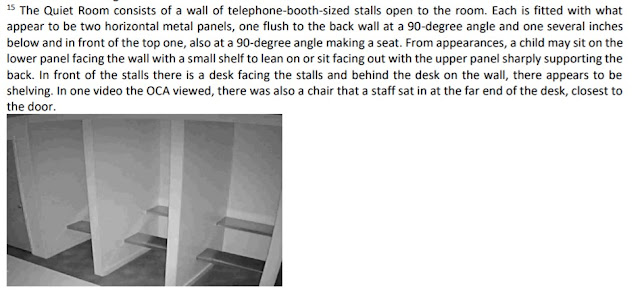
This excerpt from a report by the New Hampshire "Office of Child Advocate" describes, and illustrates, the "quiet room" at the Nashua Children's Home.
On the surface, this story from New Hampshire may seem like
just another example of children institutionalized in a place that has been the
subject of multiple allegations of abuse.
In fact, it’s much more.
● It’s a story about the willingness of regulators to bend
over backwards to dismiss complaints against such places.
● It’s a story of how a state “child advocate,” even as she
wrote a report that offered tepid criticism of serious alleged abuses at the
place, suggested changes that are almost meaningless.
● It’s a story about how the same “child advocate”
unintentionally pushed the state to rely on such institutions.
● It’s a story about how institutional providers dismiss the
overwhelming evidence that, even when there is no abuse, institutionalization
harms children.
● It’s a story about how the limits on such places
supposedly imposed by the Family First Prevention Services Act are as toothless
as some of us predicted.
● It’s a story about an institution that says it’s going to
change its practices to conform to a new contract but denies that there is
anything wrong with the way it did things under the old contract.As a
report from the “Office of Child Advocate” (OCA) puts it:
[T]he [institution] expressed skepticism of the provision
of evidence-based care now included in contract expectations. They questioned
the value of evidence-based practices and noted conversations … in which they
suggest [their] “practice-based evidence” informed their own development of a
practice model
Yet the Office of Child Advocate seems to believe the new
contract will be enough.
● Most of all, it’s a story about foster-care panic – about
what happens when a state family policing agency, in this case, the Division for Children, Youth and Families, responds
to a high-profile tragedy with a sharp sudden increase in removals of children
from their homes.New Hampshire now tears
away children at a rate double the national average - in part because of the “Child
Advocate” herself. DCYF created an
artificial “shortage” of foster homes.So DCYF institutionalizes
children as young as seven, responds to allegations of abuse with bureaucratic
gobbledygook and agrees to pay the institution $71,050 per year per child!
All of this (except the part about the foster-care panic) is
made clear in the report noted above from New Hampshire’s “child advocate,”
Moira O’Neill, and a subsequent
news story from WMUR-TV.
So let’s take a close look at the case of the Nashua
Children’s Home
The first thing to know about the Nashua Children’s Home is
it’s not a home.It has 37 residents and
is licensed for 55. That makes it an institution.Children as young as seven have been stuck
there.So let’s be clear: The state of
New Hampshire is willing to institutionalize seven-year-olds.
The second thing to know about the Nashua Children’s Home is
that even had there never been an allegation of abuse, the place would be bad
for children of any age.That’s because
institutions are inherently the most harmful form of care – and
they are unnecessary.As is
discussed below, there is nothing an institution can do that can’t be done
better with Wraparound programs.Institutions are especially bad for young children, which is what makes
New Hampshire’s willingness to institutionalize seven-year-olds particularly
horrifying.
The third thing to know is that between March, 2019 and October,
2020 this one institution, the Nashua Children’s Home, was the subject of what
O’Neill describes as “a cascade of complaints” to her office, 17 in all. Below
I discuss two of them.(I only hope that
readers who probably have read many accounts of institutional brutality that are
even worse than anything alleged concerning the Nashua Children’s Home have not
become jaded to the trauma allegedly inflicted by this institution’s staff.)
● Anthony was older, he was all of 16.When he tried to leave the “quiet room” he
wound up restrained, prone, on the floor, by three adult male staff – for an
hour and 20 minutes.A complaint to the
division of DCYF that investigates alleged abuse in foster homes and
institutions said that these actions “inhibited [anthony’s] breathing.”
But DCYF concluded there was no abuse because Anthony
suffered no actual injury (after all, it’s not like he actually stopped
breathing) and the restraint was being used for “behavior management
purposes.”They did refer the matter to
a separate unit that handles licensing of institutions.
The licensing unit initially thought there was a
problem.But then the institution explained
how the whole thing was just a result of their deep concern for Anthony’s
safety.You see it was very cold outside
that night, and if Anthony had left not only the quiet room but also the entire
institution, he’d be really, really cold.
Although the OCA reports no evidence of anyone at the
institution making any such claim at the time, the licensing unit accepted the
institution’s explanation.
You would think that the institution wouldn’t be having so
much trouble since it also appears to engage in a common industry practice
known as “creaming” – as in skimming the cream.They get to pick and choose who they’ll accept – and they get to kick
them out when things get tough.
Consider the case of 16-year-old Jake, also the subject of
an allegation of excessive use of restraint.Jake apparently was a juvenile justice placement.(We should pause here to note that the OCA
report expresses no concern – indeed, does not even mention, that 16-year-olds
placed through the juvenile justice system are in the same institution as seven
and eight-year-olds placed through the “child welfare system.”) Jake was
restrained in a prone position for a mere 15 minutes – because he’d been
sitting in the doorway of his room and yelling after his DVD player was
confiscated.That happened because his
mother had given him R-rated videos.Yes, really.
The day after the incident, the director of the institution
made clear he’d had it up to here with Jake.He sent a slew of emails to Jake’s juvenile probation and parole
officer, one of which said:
Oh, and in case you’re wondering what SYSC is – it’s the
Sununu Youth Services Center, which as one
news account last year put it, has seen
recent abuse allegations made by more than 300 men and
women who say they were physically or sexually abused as children by 150
staffers at the state’s facility from 1960 to 2018. Eleven former workers have
been arrested since April …
Family First won’t fix this
Back when the Family First Prevention Services Act first was
introduced in Congress in 2016 we wrote that no one should believe the hype
about how it would curb institutionalization.On the contrary, we said, it
institutionalizes institutions.As
we said at the time:
If the bill becomes law, the federal government would
stop reimbursing states for part of the cost of group home and institutional
placement after two weeks. But it creates a giant loophole: funding would
continue for something called a “Qualified Residential Treatment Program.”
What does it take to become a QRTP?Very little:
● Write lots and lots of plans filled with appropriate
buzzwords. (Drop the word “trauma-informed” into every third paragraph and you
should be fine.)
● Hire nurses during working hours and have them on call
the rest of the time.
● Get a rubber-stamp seal-of-approval from an accrediting
agency.
Now flash forward to 2022, and the case of the Nashua
Children’s Home.
The Office of Child Advocate recommendations all boil down
to: blah blah blah trauma-informed, blah, blah, blah, trauma-informed.So basically, everything should be fine if
the institution follows through on a new contract with the state that is filled
with all the buzzwords needed for the state to keep collecting federal aid for
institutionalizing children at the Nashua Children’s Home.The contract is for $9.8 million over three
years for 46 beds – or $71,050 per child per year.
I suppose we’ll never know if
children would be better off if the state just gave the $71,050 to the
children’s families so they could buy whatever help they or their children need
– but I think we can guess.
As for accreditation, accrediting agencies are generally dominated
by providers and make their money by accrediting fellow providers.That’s not exactly an incentive to get tough.The institution gets to choose its accreditor
from a list of several.
And sure enough, in its response to the Child Advocate, the
Nashua Children’s Home reprinted nearly two single-spaced pages of gushing
praise from the accreditor they chose.
This behavior by the institution is crucial for another
reason.The Child Advocate is counting
on the institution to obey all the terms, and all the blah-blah-blah trauma-informed
in the new contract from the state.But
the institution has made abundantly clear it doesn’t really believe in all that
blah-blah-blah.Again, as the Office of
Child Advocate report notes:
[T]he [institution] expressed skepticism of the provision
of evidence-based care now included in contract expectations. They questioned
the value of evidence-based practices and noted conversations … in which they
suggest [their] “practice-based evidence” informed their own development of a
practice model.
The institution’s rebuttal to OCA makes clear they think
there is absolutely nothing wrong with the way they did things before the new
contract – and they know better than a bunch of ivory-tower regulators anyway!Indeed, the institution’s director, David Villiotti,
told WMUR:
“We think our staff should get a lot more kudos and recognition
and congratulations than they do, rather than be criticized by somebody sitting
up on Pleasant Street in an office or sitting at home.”
Perhaps all this explains why, even though staff at the institution
began getting “trauma-informed care training” in September, 2020, the OCA
report concluded the training has had “no demonstrated effect yet.”
As for the quiet room, Villiotti said:
“Our response is most of the people critical of it have
never been in the position of having to deal with an out-of-control child.”
But the gentleman in the video below has. His name is Karl
Dennis.He’s a pioneer in replacing not
just “quiet rooms” but entire institutions with Wraparound programs that bring
whatever help a child needs into the child’s own home or foster home.Listen as Dennis describes how Wraparound
deals with youth who are far more out-of-control than an eight-year-old hiding
under a bed.
Once again, the price of panic
The other problem with the new contract is that, as a
practical matter, it’s unenforceable.DCYF wasn’t exactly aggressive about problems under the old
contract.Why should anyone think that
would change?
In fact, it can’t change.That’s thanks to DCYF -- and the “Child Advocate” herself.
Because right now in New Hampshire, it’s a sellers’ market
for residential treatment “providers.”
The video version of WMUR’s story ends with the statement
that the state has 662 family foster homes but says it “needs” 1,000 such homes.The implication is that this is why DCYF has
no choice but to institutionalize young children.
But the “shortage” is only because New Hampshire tears apart
families at one
of the highest rates in America, double the national average even when
rates of family poverty are factored in.
It wasn’t always so.Entries into care in New Hampshire began to skyrocket in 2015.And though, of course, DCYF and other foster
care apologists will blame opioids, plenty of states with serious opioid abuse
problems don’t tear apart families at such an obscene rate.More important, as has been documented over
and over, the problem isn’t opioids as much as it is child welfare’s knee-jerk
take-the-child-and-run response to opioids.
No, what happened in New Hampshire was a classic foster-care
panic – a rush to tear apart more families in the wake of high-profile child
abuse tragedies, such as one that occurred in New Hampshire at the end of 2014.Such tragedies often lead to bad “solutions”
including creating “child advocate” offices which almost always throw gasoline
on the fire.Maine
is a recent case in point, there have been many
others.
That includes New Hampshire, where the panicky response to
tragedy included creation of O’Neill’s office. O’Neill’s very first report annual report, in
2018, in the midst of skyrocketing removals, embraced the Big Lie of American
child welfare – that children are endangered because lawmakers and courts
supposedly are making the “best interests of the child” subordinate to “parents
rights.” The data, of course, tell a different story.
So O’Neill herself helped create an artificial “shortage” of
foster parents which, in turn, means the state will keep on relying on
institutionalizing children as young as age seven.(It doesn’t help that, according to O’Neill’s
report, on at least two occasions, the Nashua Children’s Home allegedly behaved
in ways that helped undermine the transition of children into family foster
homes – charges the institution denies.)
All this is why all O’Neill’s blah-blah-blah about
“trauma-informed” this and “trauma-informed,” that has such a hollow ring.The problem isn’t that it’s wrong to be
“trauma-informed” the problem is that people like O’Neill effectively stip the
concept of all meaning.Because, like so
many others who invoke the phrase, O’Neill seems to be startlingly ill-informed
about one of the worst traumas one can inflict on a child: Taking that child needlessly
from her or his parents.
But a judge finds
that, in one particularly egregious case, the city's Administration for Children's Services couldn’t even get the buck-passing
right.
In New York State, individual counties and New York City run
child welfare, but services for the mentally ill and the developmentally
disabled are provided by state agencies.
So I suppose no one should be surprised at what happened
when a New York City Council committee tried to call David Hansell, the
commissioner of the city’s Administration for Children’s Services to account
for the horrible conditions at the Bill de Blasio / David Hansell Children’s
Center. (That’s not the center’s real
name, but, as I explained in a
previous post to this blog, the more often we call it that, the more likely
it is that the worst of the problems will be fixed.)
Hansell
blamed the state.Since some of the
problems involve older youth with mental health and developmental disability
issues his response to the chaos at the center boiled down to: Hey, not my job!
There is actually a lawsuit over this. Perhaps in the end it
will turn out the state really does share responsibility (though it’s important
to note that many of the longstanding problems at the de Blasio / Hansell
Center involve children and youth for whom Hansell’s agency has unambiguous responsibility).
But even if part of the fault rests with the state – in fact,
even if all of the fault rests with
the state, a few things should be obvious:
● As long as the youth are in your custody you do not allow children,
youth and young adults to be jammed together in an overcrowded shelter.
● As long as they are in your custody, you don’t allow them
to bully and terrorize each other.
● And as long as they’re in your custody you do not allow a
youth who suffered brain and spinal injuries to be stuck there for a year, with
no therapy, without even a working wheelchair, sometimes left sitting in his
own urine.
You don’t let the horrors continue until the jurisdictional
niceties are worked out.You fix it
first, then fight over who foots the
bill.
The case of the brain-injured youth was so bad that a judge
ultimately held Hansell in contempt.She
found that ACS couldn’t even get the buck-passing right: Hansell’s agency
repeatedly missed deadlines for submitting applications to the relevant state
agency.
Is ACS angling to
open more group home / institution beds?
But it gets worse. Hansell also blames the problems at the
center in part on the closing of some beds in group homes and institutions – which
suggests he might want to reopen some of them.
But the reason they were closed in the first place is that
they’re so bad for children, and because many of them were at the center of
scandal after scandal over abuse and exploitation – (here’s
a case in point) – just like the Bill de Blasio / David Hansell Children’s
Center.
So let’s recall, again, the history of the shelter.An earlier shelter had been shut down as a
hellhole in 1977.But when the new one
opened, in 2001, Nicholas Scoppetta, the ACS commissioner at the time, promised
that this time it would be different.Of
course it wasn’t.
So consider: The old shelter became a hellhole and was shut
down.Then a new shelter is opened amid
promises that this time it will be different.Then the new shelter becomes a hellhole.So now Hansell hints that maybe the solution is to open some other institution. Really?
If he’s allowed to get away with it, I’m sure he’ll be at
the dedication ceremony, explaining why this institution will be different.
● Their public face is all about how they
don’t even think about money (except
that they wish they had more of it to help those poor, helpless children, of
course.) But when they think we’re not listening the talk is all about
“capital” “revenue” and “equity portfolios.”
● And when they think we’re not listening
they admit that tens of thousands of children warehoused in institutions don’t
need to be institutionalized.
No, the people who run residential treatment centers are not like Montgomery Burns on The Simpsons. But financial incentives for needlessly institutionalizing children are very real.
Discussions about
financial incentives in child welfare usually revolve around incentives for
governments. Sometimes that discussion
is oversimplified with claims that governments “make money on foster care.”
Actually they
don’t.But the reality is almost as bad.
A series of perverse incentives
lead to a situation in which governments sometimes lose more money by helping a family than they lose by just consigning
the children to foster care – even though the help for the family costs less in
total dollars.So even though
governments don’t literally make money on foster care, there are financial
incentives to misuse it and overuse it.
Another set of perverse incentives encourages quick-and-dirty slipshod adoptive placements, by paying
bounties for every finalized adoption over a baseline number.Even when the adoptions fail, the states
still get to keep their bounties. There
is no similar incentive for reunifying a family.
Incentives for private agencies
But there is another
set of even worse incentives that gets far less attention: incentives for
private agencies. Such agencies typically provide most of the worst, and most
expensive forms of “care” – group homes and institutions. In some states and
localities they also oversee foster homes.
These agencies
typically are paid for each day they hold a child in their care.So of course, they have a profound incentive
to encourage needless removal of children and then hold them in foster care for
a long, long time.
This does not mean
that your typical private agency leader is like Montgomery Burns on The Simpsons, gleefully rubbing his
hands each time another child is placed in his group home or institution.Rationalization is powerful. So the group
home industry, (a term that encompasses all forms of “congregate care” from
your basic group home to your “residential treatment center,”) convinces itself
that, contrary to a massive amount of evidence, the children really, truly benefit from
being institutionalized and really, truly have to be in their care for a long,
long time.
(The term group home
industry itself was coined by the director of a residential treatment center
who had a crisis of conscience and had to fight the industry when he sought
to vastly reduce institutionalization and emphasize services to children in
their homes or foster homes.)
Nonprofits can be greedy, too
The various components
of the group home industry are typically, though not always, nonprofit
organizations.That’s a big blind spot
for journalists.Reporters are trained
to be skeptical of government and of big corporations. But there is surprising naiveté
about the so-called “independent sector.”But the will to survive can induce in nonprofits a form of greed that is
as corrosive of common decency as the worst corporate behavior.
And that brings me
to a column written by Jennifer Jones and Theresa Covington, two leaders of the
so-called Alliance for Strong
Families and Communities.That’s one of
those Orwellian names so-beloved in child welfare. It’s actually a trade
association for human services agencies, including many that run group homes
and residential treatment centers.
Writing in what they
apparently consider their safe space, the Chronicle
of Social Change, they effectively admitted that what really concerns many
of their members is: Money, money, money.
The column deals
with the so called Family First Prevention Services Act. They claim that “One
of the areas that will be most impacted [sic] by the bill is residential care.”
(In fact, that part of the law is so strewn with loopholes that, unfortunately, the “residential care”
industry is unlikely to be impacted – or even affected – much at all.) They go on to write about how they’re
conducting “a series of cohort initiatives to help inform and advance a
transformational shift …”
True confessions, part 1:
But two elements of
the column are striking. First, this trade association that includes so many
residential treatment providers admits, in writing, that a huge proportion of
the children their members have institutionalized don’t need to be in institutions.
They write:
“Therapeutic Residential Care,” as it is
known, focuses specifically on providing treatment for youth who have a mental
health diagnosis or have experienced trauma and need help regulating their
emotions. … However, according to recent
data, more than 4 in 10 children who are currently in residential care have no
mental health diagnosis, medical disability or behavioral problem that would
warrant such a setting. [Emphasis
added.]
… Recent research suggests that young
children living in residential programs are at a higher risk for developing
physical, emotional and behavioral problems. These young children are also less
likely to be placed in a permanent home than those who live in foster care.
The “recent research”
comes on top of the vast store of research that has told us as much for a long, long
time. Back in 2005, Shay Bilchik, who then was running another trade
association for agencies that has an Orwellian name, the Child Welfare League
of America, admitted that they lack “good research” showing residential
treatment’s effectiveness and “we find it hard to demonstrate success...”
What’s new is that
now the so-called “Alliance” is admitting it as well, and suggesting that tens
of thousands of institutionalized children should not, in fact, be
institutionalized. (The 4 in 10 number is an underestimate. There is no
evidence that residential treatment is successful for any population – but, hey, it’s a start.)
True confessions, Part 2:
So, what is it that
is stopping the Alliance’s member agencies from abandoning this largely worthless
endeavor?After all, these agencies tell
us over and over that their only
concern is the best interests of the children, and they don’t even think about
what the agencies themselves need.
But now Jones and
Covington tell a different story:
This shift requires residential providers to
make significant changes in policy, practice, budget, historical programming
and organizational culture. The growing evidence base continues to point to
this change movement as being in children’s best interests and necessary, yet
providers continue to seek out clearer and more efficient pathways to
understand this new reality and make this transformation a reality.
Translation: We
might be willing to do this, but only if we don’t lose any money, or, God
forbid, go out of business.Money first,
kids second.
Jones and Covington
cite figures from one of their member agencies indicating that residential
treatment brings in a disproportionate share of its revenue. And, they write,
Many child welfare providers and operators of
residential treatment facilities have a tremendous amount of equity and capital
in their physical structures and campuses and a large portion of their
organizational identity is encompassed in their role as residential providers.
Translation: If we
do what’s best for the kids, where will we get our money?We’ve got all that equity and capital to
think about!
Jones and Covington
continue:
It can be challenging for leaders and board
members of these organizations to still deliver on their stated mission when
such a large part of that mission is being transformed.
But if the stated
mission is institutionalizing children, then the mission is crap and it should
be scrapped.
Jones and Covington
again:
Child welfare providers are among the oldest
community-based nonprofits in the country, with a significant number of them
owning and operating facilities that began as orphanages more than a century
ago.
Actually, they’re
still orphanages.“Residential treatment”
is largely an exercise in rebranding.
And finally, Jones
and Covington tell us:
These physical campuses make up a large part
of their equity portfolio and many organizations are hesitant to make the leap
to repurpose or divest these resources.
But why?
If all they care
about is what’s best for the children, as they keep telling us, they should be
thrilled to follow pioneers such as Children’s Village, EMQ Child and Family Services and Youth Villages which all have dramatically altered their
mission to put far more emphasis on services in children’s own homes, in foster
homes.
Unless of course, what
they really care about is self-preservation.
Meanwhile, back at the whine cellar …
And, of course, no
column by a trade association of providers would be complete without whining
about how they don’t get enough money for whatever it is they provide. So,
Jones and Covington write:
The theory of change represented within the
[Family First] bill requires a robust array of home- and community-based
services, yet there was no federal funding put in the bill to help states build
up that part of the system. So, state legislatures and local governments are
going to need to make further investments into developing this part of the
system in order to keep children in the least restrictive, most family-like
settings.
Actually, that’s not
quite true. As the authors note in the same column, Family First does include
some funding for reforms. It allows money once limited to substitute care to be
spent on better options – though the options are severely limited, so very little money actually is likely to be available.
But more important,
you get the money for alternatives to institutionalizing children by not institutionalizing children.
Institutions are not
just the worst form of care, they’re also the most expensive.So pretty much anything else you do for a
particular child will cost less than institutionalizing the child. So all you
need to do to “make further investments” in better alternatives is to take the
state and local money you would have spent to institutionalize children and
spend it on those better alternatives.
That is, if all
those concerns from agencies about “capital” “revenue” and “equity portfolios”
don’t get in the way.