Showing posts with label DCYF. Show all posts

Wednesday, February 12, 2025

Drenched in trendy psychobabble, legislation in New Hampshire proposes to fight trauma with trauma.

A bill in New Hampshire effectively equates strong emotion with abuse.
The sponsors seem to have been inspired by the wrong Spock.

UPDATE, AUGUST 17, 2025: Fortunately, in this session, at least, the bill did not pass.

After decades of expanding the child welfare surveillance state to the point that more than one in three children – and a majority of Black children – will be forced to endure the trauma of a child abuse investigation by the time they turn 18, some states have noticed: They’ve been doing the same thing over and over and getting the same lousy results. 

A few places have realized that prevention and policing are incompatible. No matter how often you say you only want vast police power so you can be kindly helpers, you just want to prevent small problems from becoming big problems, blah, blah, blah – that doesn’t work. It fails because even when you really mean it, under this system, the prerequisite for “prevention” is inflicting trauma on children and families by interrogating and stripsearching children in the middle of the night, at best, and hauling them off to the chaos of foster care at worst. 

Realizing that doing the same thing over and over and expecting a different result is the definition of insanity, some states are trying something different. Texas dialed back the power of its family police agency (a more accurate term than child welfare agency). So did Washington State.  Kansas lawmakers are considering doing the same. Other states are revising the training for mandatory reporters and even considering reducing the number of professionals who must report. (It’s not nearly enough, but until recently the only thing lawmakers did with mandatory reporting requirements was to expand them.) 

And then there are the states that still haven’t gotten the message – most notably, at the moment,  New Hampshire.  This is a state that already tears apart families at a rate nearly double the national average.  It is a state that uses the worst form of care – institutionalization – at a shockingly high rate.  More than one-quarter of New Hampshire foster children are institutionalized – triple the national average.  Clearly, the New Hampshire family police have all the power they need to intervene when they need to and already are intervening on a massive scale when they don’t. 

But some lawmakers think that power should be expanded even further.  They’ve introduced a bill, drenched in trendy psychobabble, that could, at some point, define every child in New Hampshire as abused or neglected. 


The sponsors don’t even seem to understand their own psychobabble.  They’re in love with that ever-popular buzzphrase “trauma-informed.”  But it’s hard to imagine a piece of legislation that is less informed about trauma and more likely to inflict it. Because this bill proposes to fight trauma with trauma.  It should be obvious that the results will be -- traumatic. 

Even if one assumes everything this bill labels as child abuse really is child abuse – and that’s a real stretch since the bill seems to encompass everything from genuine, serious abuse all the way to the normal vicissitudes of life – this bill will only make everything worse. 

That’s because few experiences in life are more traumatic for a child than a child abuse investigation.  Imagine you’re a small child.  In the middle of the night a stranger, perhaps more than one, pounds on the door and demands entry.  Your mother, knowing what could happen if she says no, lets them in.  They demand that your mother awaken you and bring you to the living room.  The strangers open every drawer, every cabinet, the refrigerator and the cupboards.  You’re scared because you can’t understand why these strangers are in your house rifling your possessions. Then they pull you aside and interrogate you about every aspect of your family life.  And finally, they stripsearch you looking for bruises. 

This is the norm – and this trauma is the minimum. The trauma is of course compounded if it leads to one of the worst “adverse childhood experiences” of all: being taken into the night, sometimes literally kicking and screaming, by the strangers and consigned to the chaos of foster care either in a home or, especially in New Hampshire, an institution.  Under this bill, all this trauma could be inflicted anytime a caseworker concludes that a child’s “physical, emotional or psychological welfare” is  “at risk.” 

There are times when inflicting all this trauma is necessary: when, for example, there is a credible allegation that a child is being beaten, tortured, raped or locked in a closet and starved.  That is, of course, a tiny fraction of the cases workers see.

Of all the New Hampshire children torn from their families and thrown into foster care in 2022, 88%
did not
involve even an allegation of sexual abuse or any form of physical abuse.  Eighty-six percent did not involve even an allegation of any form of drug abuse.  Far more common are cases in which family poverty is confused with “neglect.” 

But the process I described applies in every case -- even if you say all you want to do is provide help.  Few things put a child’s “emotional or psychological welfare” more “at risk” than being the subject of a child abuse investigation.  Almost nothing puts it more at risk than foster care.  No, you can’t fight trauma with trauma. 

Invasion of the well-being police

This bill is a classic example of the terrible consequences that have cascaded down upon children ever since the family policing establishment took it upon itself to do exactly what this bill explicitly demands: expand its mandate from safety and permanence to include policing children’s “well-being.” 

I am a tax-and-spend liberal and proud of it.  There are an enormous number of things government can and should do to improve children’s well-being.  Project Head Start improves children’s well-being.  Free school meals improve children’s well-being. So does affordable health care, and access to decent housing, and good child care.  Yes, these are aimed at children’s and families' material well-being – but that often does wonders for their emotional well-being. 

Where more targeted help is needed, government absolutely should make available quality mental health care – on a voluntary basis, from practitioners who families don’t have to fear will turn them in to agencies like New Hampshire’s Division for Children and Youth Services.  Mandatory reporting already scares families away from seeking help – this bill only will drive families further away. 

But this bill provides not one iota of additional help.  It simply turns DCYF into the well-being police.  

DCYF is not a benevolent helping agency – it is a police force; indeed it has more power than the police in blue uniforms. That’s why we call these agencies the family police.  There is a legitimate role for government in improving children’s well-being, but not for police. 

The trauma of family policing compromises the very well-being that the sponsors of this bill say they want to improve.  That’s why my last presentation at a Kempe Center conference was called “Attn: Family Police: Children’s Well-being is None of Your Damn Business!” 

Every coercive government intervention into family life should have to pass a “balance of harms” test. That is, the harm you will inflict through coercive intervention must be less than the harm that prompts you to intervene.  This bill massively flunks that test. 

Consider the specifics

If this bill becomes law, any child in New Hampshire could, at some point, be deemed abused or neglected if a DCYF caseworker so chooses.  And if by some chance there is a child who would never be included in these definitions of abuse and neglect then that is a child smothered in so much emotional bubble wrap that s/he is likely to emerge as an adult incapable of dealing with the world – a true example of emotional harm. 

What is striking about this bill is the fear of emotion that pervades it.  It’s as if the sponsors, instead of being guided by the wisdom of Doctor Spock, the famous pediatrician, looked instead for guidance to Mister Spock, the Star Trek character who seeks to suppress all his emotions. 


At first one might be reassured that the expanded definition of neglect only includes things that cause “serious impairment.”  But “serious impairment” then is defined as any “adverse impact” on a child’s “psychological … well-being” resulting even from a “single event [that] …may be currently observed or predicted.”  In other words: Someone thinks you might at some point say or do something that at some point will have an “adverse impact” on a child’s psyche.  Among the circumstances to be considered in determining if there has been such impact: “Any single incident or occurrence of serious injury or illness.” 

The definition of psychological maltreatment includes “coercing, which shall include …  compelling to action using threat or force.”  In other words, under this bill, it would be child abuse to say to a child: “Clean up your room or you won’t get any TV tonight.” 

And it’s not just what parents themselves do that can get them labeled abusive. This also is neglect: 

Entrustment of the care of a child by a parent, guardian, or custodian to an individual who presents a risk of inability to provide safe care, and as a result of such entrustment, the child's physical, mental, emotional, or psychological wellbeing has suffered, or is likely to suffer serious physical or psychological impairment. 

The bill provides examples of those “presumed to present such risk” but you’re not off the hook if you entrust the child to someone not on the list.  You’re just going to have to be psychic. 

As for the specific categories, some make sense.  But others include “individuals convicted of violent crime,…” Yes, that makes sense too -- if it’s Cousin Fred who was just paroled after serving 20 years for murder.  But this definition would also include 70-year-old Grandpa Sam, who was convicted of punching a man 50 years ago.  It also includes “individuals with recent instances [that’s instances, not convictions] of substance abuse…” in a state where recreational marijuana is still illegal. 

Conditions that would create a rebuttable presumption that a child's “emotional, physical, psychological, or mental well-being has suffered or is likely to suffer serious impairment” include 

“exposure of a child to verbal abuse, or psychological maltreatment directed at the child, a sibling, the other parent or significant other or another person living in the home.”  

So for starters, if mom and dad ever lose their temper with each other, that creates a rebuttable presumption the child has suffered harm to their “emotional, physical, psychological, or mental well-being.”  

And, though the phrase “other parent” implies this clause is directed at parents, that’s never explicitly
stated. So given how gym coaches have been known to behave, if this becomes law it clearly will be irresponsible for any New Hampshire parent to let their child attend phys ed class.  Come to think of it, the bill doesn’t say the verbal abuse has to come from an adult, so it might be child abuse to send the child to school at all. 

But it’s striking that it isn’t just negative emotions that can be off-limits: 

Still another factor to be considered in determining “serious impairment” is 

Parentification of a child, which occurs when a child is regularly expected to take on parental responsibilities, including but not limited to providing emotional or practical support for a parent or another individual, beyond what would be reasonably expected for the child’s age and circumstances, instead of receiving that care and support themselves.

Yes, it’s possible for parents to demand too much of their children. But how does one define “reasonably expected” – and what are the qualifications and biases of those who would be empowered to decide? 

But also, I’m struck by the notion that emotional support is portrayed as an either/or proposition.  Right now across America, families of those who died in two recent plane crashes almost certainly are coming together to grieve. Parents are comforting their children and yes, children also are comforting parents and grandparents.  Emotional support is not a zero-sum game, it’s a way we all gain strength from each other.  No doubt, Mr. Spock would disapprove.  And speaking of fictional characters, if this bill passes, anyone like the Gilmore Girls probably should stay out of New Hampshire.*

Class and cultural bias 

Biases pervade this bill.  Let’s return to the “entrustment” clause. Remember that long list of people to whom, if you entrust them with watching your child it’s a rebuttable presumption of abuse or neglect?  Who has the fewest options when it comes to entrusting their child if there’s an emergency?  And who is more likely to encounter an emergency? 

And then there’s that “parentification” clause.  

As Lenore Skenazy writes in Reason, what the bill defines as “parentification” 

happens in incredibly dysfunctional families as well as in incredibly functional ones—say, when a child of immigrants proudly translates for their parents at the doctor's office or the auto repair shop.
And there are, of course, any number of chores a poor child might have to do that a rich child won’t. So this clause is one more way to target poor families.  The solution to this kind of “parentification” is, of course, the material support I suggested earlier. 

Another clause in the bill lists among evidence for a rebuttable presumption of abuse or neglect “frequent illnesses that are not being adequately addressed or controlled.” Which families are going to have the most difficulty addressing or controlling children’s frequent illnesses? The ones who are more likely to live in environments that breed illness and less likely to have consistent medical care. 

There also is cultural bias at play.  In some cultures everything is loud: The laughter, the tears, the joy and also the anger.  So those parents may yell. They might even say things for which they later have to apologize.  (The children might say things for which they feel a need to apologize, too, but the sponsors of this bill might consider that “parentification.”)  This bill implies that the yelling in anger causes emotional harm.  Other cultures might express anger through stony silence.  But, for some reason, on that the bill is - silent. 

With that much bias built into the bill on top of the racial and class bias we know permeates family policing already, what happens if this bill becomes law and caseworkers get to decide what is usual, or reasonable, or whatever other vague term is in the legislation?

Two other dangerous clauses 

● The drive pregnant women away from prenatal care and hospitals clause: While other states move to narrow the grounds for intervention when substance abuse is alleged – because of the growing realization that any and all substance abuse does not, in fact, always endanger a child, the New Hampshire bill proposes to move in the opposite direction. 

Section after section of this bill ratchets up suspicion of anyone using drugs – but of course, it’s not really anyone.  It isn’t going to be applied to parents like the New Hampshire counterparts of the cannamoms next door in Massachusetts who were celebrated in Boston Magazine as they smoked pot during their kids’ play dates.  Nor is it targeting the drug of choice for affluent “wine moms” – street name “mommy juice” -- who do the same. 

Sometimes parental drug abuse really does put children at risk of serious harm – and sometimes it doesn’t. Any clause concerning child abuse and drug use should require that the particular drug use in question by the particular user in question is a genuine threat to their children. Because the greater danger is things like pregnant women being too scared to get prenatal care or too scared to tell their doctor they’re using drugs – for fear of being investigated and having their children taken away. 

● The full employment for child abuse pediatricians clause:  That’s the clause in the bill about how if your child is injured and you can’t explain why, it must be child abuse.  The stunning amount of harm that can cause to innocent families has been documented over and over.  

Skenazy also points out that the bill isn’t all bad.  There are a couple of provisions that attempt to expedite reunification for example. 

So the bill is only 95% bad.  That’s more than enough reason for New Hampshire lawmakers to take a truly “trauma-informed” approach and vote the bill down.

*-When I first wrote that, I thought it was a joke, but it turns out pop psychology blogs are full of condemnation of Lorelai.

Thursday, February 8, 2024

Residential treatment: Can the scent of Pine Sol cover up the stench of abuse?

Rhode Island State Rep. Patricia Serpa says she can tell things are soooo much better
at a residential treatment center because "I could smell the Pine-Sol"

Ever wonder why “residential treatment centers” almost always look so good?  It’s amazing how much these places, which always claim to need even more money, lavish on making sure the grounds are gorgeous the “cottages” are nicely painted and the lawns are mowed.  Then they invite public officials on a carefully guided tour.  

The amazing thing isn’t that these places keep pulling this stunt, the amazing thing is that it works! 

The latest to be snookered is Rhode Island State Rep. Patricia Serpa, who chairs that state’s House of Representatives Oversight Committee.  She and other officials got the full guided tour of St. Mary’s Home for Children in North Providence. 

Here’s what’s been happening at the place they are so anxious to save, according to news accounts summarizing a 119-page report from the state’s child advocate. 

“Staff-on-child physical assault, youth stealing the program van, overdoses, a high number of AWOLs, neglect and an overwhelming number of responses by the North Providence Police Department.” 

From just the beginning of April through May 8, 2023: 

There were more than 20 calls to the CPS hotline, they found, including allegations of drug overdoses, sexual contact among the children, staff assaulting children, runaway children, and an overwhelming amount of police responses, the [Office of Child Advocate] said. 

That’s just the start.  The Boston Globe did its own investigation and found that, at an institution with only 39 beds: 

The North Providence police were called to St. Mary's more than 300 times in the past two years, mainly for children as young as 8 running away, according to 317 pages of police call logs obtained by the Globe through a public records request. … 

North Providence Police Chief Alfredo Ruggiero Jr. told the Globe things are so bad that when runaways are found by police “there’s a part of us that our hearts are breaking” as they bring them back.

Neighbors such as Andrew Marsalli and his partner Ken Richey said they would often hear children screaming.  Marsalli recalled 

the boy with cuts and bruises who showed up at his door asking for help. 

"The boy would say, 'Please don't let me go with them. Don't let them find me,' " Marsalli said. "He would just come knock on my door to talk. But . . . they would know where to find him." … One time, Marsalli and Richey said, they watched in horror when two staff members tackled the boy in their yard and hauled him away. They said an ambulance was called because the boy's arm had been yanked back. 

Then there was the girl placed at St. Mary’s by Rhode Island’s family police agency, the Department of Children, Youth and Families (DCYF), because she’d been sexually assaulted and was at high risk of being sexually exploited.  She ran away several times.  Twice she was raped.  When her mother sued, St. Mary’s said the child “had assumed the risk of injury.” (The suit was settled.)  St. Mary’s is not the only residential treatment center to make that horrifying claim. 

And then there was the whole matter of the institution bringing in a bunch of bikers to help patrol the place. 

The head of DCYF, Ashley Deckert, admitted St. Mary’s was awful, but in a comment stunning for both its callousness and its candor, she said that because Rhode Island doesn’t have enough places to put kids, St. Mary’s is a “too big to fail situation.” 

As I pointed out when I wrote about St. Mary’s for Rhode Island Current, what she did not say is that the lack of places to put kids is because Rhode Island tears apart so many families needlessly – at a rate 80% above the national average. 

Pine-Sol to the rescue! 

But great news everyone!  After her definitely-not-a-surprise inspection, Rep. Serpa says things are soooooo much better now!  How does she know?  She told WPRI-TV: 

“What I saw today was encouraging.  The facility is clean. I could smell the Pine-Sol, I could smell the fresh paint. The kids’ rooms were kids’ rooms — they were messy, but an organized messy.” 

Of course!  Everyone knows children are never abused in rooms that smell of Pine-Sol!  And who would ever want to run from a room that was freshly painted?   (Where was Serpa expecting to see kids stay – in dungeons?)  

Deckert took the tour too.  Deckert, more than any other individual, has a vested interest in downplaying any problems at the places where her agency institutionalizes children.  And sure enough, she called the progress “tremendous.” She, too, made a point of saying the place “smells nice.”

 No wonder DCYF is moving full speed ahead on a plan to spend $11 million in taxpayer funds to expand St. Mary’s.

Fool me once … 

This isn’t even the first group of Rhode Island officials to buy into this routine.  As we discussed in our 2010 report on Rhode Island child welfare, the chief family court judge for many years, Jeremiah S. Jeremiah, fell in love with an institution in Pennsylvania; the Glen Mills School.  As we explained in our report: 

[I]n late January of this year, Jeremiah suggested that Andrew J. Johnson, a lawyer and director of the Rhode Island Court Appointed Special Advocate’s office, visit Glen Mills to see what their program has to offer. Johnson flew to Philadelphia, at the school’s expense, where a school van drove him the 22 miles to the school in Concordville, Pa. He met with admissions officials, toured the campus and talked to students.  “It’s a remarkable place,” Johnson said after he returned. “Step on the campus and it’s like a prep school or a university ... .” 

Again, that was 2010. 

It will probably not surprise readers who have gotten this far to know that the Glen Mills School was closed.  After the Philadelphia Inquirer exposed rampant, horrific abuse, the state of Pennsylvania shut the place down.  Unfortunately, they’ve now allowed the place to reopen on a (for now) much smaller scale.  The place has a brand new name.  It’s run by a new corporation headed by a former Glen Mills executive.  

And presumably, it has a good supply of Pine-Sol.

Monday, February 21, 2022

What do you do when you’ve institutionalized children as young as age 7 in a place that was the subject of a “cascade of complaints” alleging abuse? If you’re New Hampshire, you give ‘em a $9.8 million contract, of course!

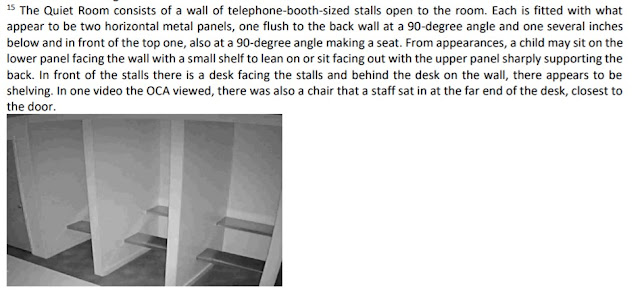
This excerpt from a report by the New Hampshire "Office of Child Advocate" describes, and illustrates,
the "quiet room" at the Nashua Children's Home.


On the surface, this story from New Hampshire may seem like just another example of children institutionalized in a place that has been the subject of multiple allegations of abuse.  In fact, it’s much more. 

● It’s a story about the willingness of regulators to bend over backwards to dismiss complaints against such places. 

● It’s a story of how a state “child advocate,” even as she wrote a report that offered tepid criticism of serious alleged abuses at the place, suggested changes that are almost meaningless. 

● It’s a story about how the same “child advocate” unintentionally pushed the state to rely on such institutions. 

● It’s a story about how institutional providers dismiss the overwhelming evidence that, even when there is no abuse, institutionalization harms children. 

● It’s a story about how the limits on such places supposedly imposed by the Family First Prevention Services Act are as toothless as some of us predicted. 

● It’s a story about an institution that says it’s going to change its practices to conform to a new contract but denies that there is anything wrong with the way it did things under the old contract.  As a report from the “Office of Child Advocate” (OCA) puts it: 

[T]he [institution] expressed skepticism of the provision of evidence-based care now included in contract expectations. They questioned the value of evidence-based practices and noted conversations … in which they suggest [their] “practice-based evidence” informed their own development of a practice model 

Yet the Office of Child Advocate seems to believe the new contract will be enough. 

● Most of all, it’s a story about foster-care panic – about what happens when a state family policing agency, in this case, the Division for Children, Youth and Families, responds to a high-profile tragedy with a sharp sudden increase in removals of children from their homes.  New Hampshire now tears away children at a rate double the national average - in part because of the “Child Advocate” herself.  DCYF created an artificial “shortage” of foster homes.  So DCYF  institutionalizes children as young as seven, responds to allegations of abuse with bureaucratic gobbledygook and agrees to pay the institution $71,050 per year per child! 


All of this (except the part about the foster-care panic) is made clear in the report noted above from New Hampshire’s “child advocate,” Moira O’Neill, and a subsequent news story from WMUR-TV. 

So let’s take a close look at the case of the Nashua Children’s Home 

The first thing to know about the Nashua Children’s Home is it’s not a home.  It has 37 residents and is licensed for 55. That makes it an institution.  Children as young as seven have been stuck there.  So let’s be clear: The state of New Hampshire is willing to institutionalize seven-year-olds. 

The second thing to know about the Nashua Children’s Home is that even had there never been an allegation of abuse, the place would be bad for children of any age.  That’s because institutions are inherently the most harmful form of care – and they are unnecessary.  As is discussed below, there is nothing an institution can do that can’t be done better with Wraparound programs.  Institutions are especially bad for young children, which is what makes New Hampshire’s willingness to institutionalize seven-year-olds particularly horrifying.  

The third thing to know is that between March, 2019 and October, 2020 this one institution, the Nashua Children’s Home, was the subject of what O’Neill describes as “a cascade of complaints” to her office, 17 in all. Below I discuss two of them.  (I only hope that readers who probably have read many accounts of institutional brutality that are even worse than anything alleged concerning the Nashua Children’s Home have not become jaded to the trauma allegedly inflicted by this institution’s staff.) 

● Dennis was subjected to 27 “restraints” and removal to what the institution calls its “quiet room” – which looks more like a cell.  Under state law, restraints are only supposed to be used when there is a “substantial and imminent risk of serious bodily harm” to the child or to others.   But Dennis was restrained and/or hauled off to the quiet room for things like hiding in a closet or under his bed.  Dennis was eight years old. 

● Anthony was older, he was all of 16.  When he tried to leave the “quiet room” he wound up restrained, prone, on the floor, by three adult male staff – for an hour and 20 minutes.  A complaint to the division of DCYF that investigates alleged abuse in foster homes and institutions said that these actions “inhibited [anthony’s] breathing.” 

But DCYF concluded there was no abuse because Anthony suffered no actual injury (after all, it’s not like he actually stopped breathing) and the restraint was being used for “behavior management purposes.”  They did refer the matter to a separate unit that handles licensing of institutions.  

The licensing unit initially thought there was a problem.  But then the institution explained how the whole thing was just a result of their deep concern for Anthony’s safety.  You see it was very cold outside that night, and if Anthony had left not only the quiet room but also the entire institution, he’d be really, really cold. 

Although the OCA reports no evidence of anyone at the institution making any such claim at the time, the licensing unit accepted the institution’s explanation. 

I’m sure all readers would agree that all of these various authorities would have reached exactly the same conclusion had birth parents “restrained” their own children that way. 

Are they “creaming”? 

You would think that the institution wouldn’t be having so much trouble since it also appears to engage in a common industry practice known as “creaming” – as in skimming the cream.  They get to pick and choose who they’ll accept – and they get to kick them out when things get tough. 


Consider the case of 16-year-old Jake, also the subject of an allegation of excessive use of restraint.  Jake apparently was a juvenile justice placement.  (We should pause here to note that the OCA report expresses no concern – indeed, does not even mention, that 16-year-olds placed through the juvenile justice system are in the same institution as seven and eight-year-olds placed through the “child welfare system.”) Jake was restrained in a prone position for a mere 15 minutes – because he’d been sitting in the doorway of his room and yelling after his DVD player was confiscated.  That happened because his mother had given him R-rated videos.  Yes, really. 

The day after the incident, the director of the institution made clear he’d had it up to here with Jake.  He sent a slew of emails to Jake’s juvenile probation and parole officer, one of which said: 

"...I want this kid OUT on Monday...send him back to SYSC...convince a judge to make it happen. You know our reluctance in taking him. Especially during this time, can't have this kid endangering my staff like this.” 

Oh, and in case you’re wondering what SYSC is – it’s the Sununu Youth Services Center, which as one news account last year put it, has seen 

recent abuse allegations made by more than 300 men and women who say they were physically or sexually abused as children by 150 staffers at the state’s facility from 1960 to 2018. Eleven former workers have been arrested since April …   

Family First won’t fix this 

Back when the Family First Prevention Services Act first was introduced in Congress in 2016 we wrote that no one should believe the hype about how it would curb institutionalization.  On the contrary, we said, it institutionalizes institutions.  As we said at the time: 

If the bill becomes law, the federal government would stop reimbursing states for part of the cost of group home and institutional placement after two weeks. But it creates a giant loophole: funding would continue for something called a “Qualified Residential Treatment Program.” 

What does it take to become a QRTP?  Very little: 

● Write lots and lots of plans filled with appropriate buzzwords. (Drop the word “trauma-informed” into every third paragraph and you should be fine.)

● Hire nurses during working hours and have them on call the rest of the time.

● Get a rubber-stamp seal-of-approval from an accrediting agency.

Now flash forward to 2022, and the case of the Nashua Children’s Home. 

The Office of Child Advocate recommendations all boil down to: blah blah blah trauma-informed, blah, blah, blah, trauma-informed.  So basically, everything should be fine if the institution follows through on a new contract with the state that is filled with all the buzzwords needed for the state to keep collecting federal aid for institutionalizing children at the Nashua Children’s Home.  The contract is for $9.8 million over three years for 46 beds – or $71,050 per child per year. 

I suppose we’ll never know if children would be better off if the state just gave the $71,050 to the children’s families so they could buy whatever help they or their children need – but I think we can guess. 

As for accreditation, accrediting agencies are generally dominated by providers and make their money by accrediting fellow providers.  That’s not exactly an incentive to get tough.  The institution gets to choose its accreditor from a list of several. 

And sure enough, in its response to the Child Advocate, the Nashua Children’s Home reprinted nearly two single-spaced pages of gushing praise from the accreditor they chose. 

This behavior by the institution is crucial for another reason.  The Child Advocate is counting on the institution to obey all the terms, and all the blah-blah-blah trauma-informed in the new contract from the state.  But the institution has made abundantly clear it doesn’t really believe in all that blah-blah-blah.  Again, as the Office of Child Advocate report notes: 

[T]he [institution] expressed skepticism of the provision of evidence-based care now included in contract expectations. They questioned the value of evidence-based practices and noted conversations … in which they suggest [their] “practice-based evidence” informed their own development of a practice model. 

The institution’s rebuttal to OCA makes clear they think there is absolutely nothing wrong with the way they did things before the new contract – and they know better than a bunch of ivory-tower regulators anyway!  Indeed, the institution’s director, David Villiotti, told WMUR: 

“We think our staff should get a lot more kudos and recognition and congratulations than they do, rather than be criticized by somebody sitting up on Pleasant Street in an office or sitting at home.” 

Perhaps all this explains why, even though staff at the institution began getting “trauma-informed care training” in September, 2020, the OCA report concluded the training has had “no demonstrated effect yet.”

As for the quiet room, Villiotti said: 

“Our response is most of the people critical of it have never been in the position of having to deal with an out-of-control child.” 

But the gentleman in the video below has. His name is Karl Dennis.  He’s a pioneer in replacing not just “quiet rooms” but entire institutions with Wraparound programs that bring whatever help a child needs into the child’s own home or foster home.  Listen as Dennis describes how Wraparound deals with youth who are far more out-of-control than an eight-year-old hiding under a bed. 


Once again, the price of panic 

The other problem with the new contract is that, as a practical matter, it’s unenforceable.  DCYF wasn’t exactly aggressive about problems under the old contract.  Why should anyone think that would change? 

In fact, it can’t change.  That’s thanks to DCYF -- and the “Child Advocate” herself. 

Because right now in New Hampshire, it’s a sellers’ market for residential treatment “providers.” 

The video version of WMUR’s story ends with the statement that the state has 662 family foster homes but says it “needs” 1,000 such homes.  The implication is that this is why DCYF has no choice but to institutionalize young children. 

But the “shortage” is only because New Hampshire tears apart families at one of the highest rates in America, double the national average even when rates of family poverty are factored in. 

It wasn’t always so.  Entries into care in New Hampshire began to skyrocket in 2015.  And though, of course, DCYF and other foster care apologists will blame opioids, plenty of states with serious opioid abuse problems don’t tear apart families at such an obscene rate.  More important, as has been documented over and over, the problem isn’t opioids as much as it is child welfare’s knee-jerk take-the-child-and-run response to opioids. 

No, what happened in New Hampshire was a classic foster-care panic – a rush to tear apart more families in the wake of high-profile child abuse tragedies, such as one that occurred in New Hampshire at the end of 2014.  Such tragedies often lead to bad “solutions” including creating “child advocate” offices which almost always throw gasoline on the fire.  Maine is a recent case in point, there have been many others. 

That includes New Hampshire, where the panicky response to tragedy included creation of O’Neill’s office.  O’Neill’s very first report annual report, in 2018, in the midst of skyrocketing removals, embraced the Big Lie of American child welfare – that children are endangered because lawmakers and courts supposedly are making the “best interests of the child” subordinate to “parents rights.” The data, of course, tell a different story. 

So O’Neill herself helped create an artificial “shortage” of foster parents which, in turn, means the state will keep on relying on institutionalizing children as young as age seven.  (It doesn’t help that, according to O’Neill’s report, on at least two occasions, the Nashua Children’s Home allegedly behaved in ways that helped undermine the transition of children into family foster homes – charges the institution denies.) 

All this is why all O’Neill’s blah-blah-blah about “trauma-informed” this and “trauma-informed,” that has such a hollow ring.  The problem isn’t that it’s wrong to be “trauma-informed” the problem is that people like O’Neill effectively stip the concept of all meaning.  Because, like so many others who invoke the phrase, O’Neill seems to be startlingly ill-informed about one of the worst traumas one can inflict on a child: Taking that child needlessly from her or his parents.

Thursday, October 1, 2020

How many best practices can a child welfare agency ignore in a single case?


New Hampshire may have set a record – all to be sure a Black couple can’t adopt their grandchildren.


UPDATE, OCT. 4, 2020: The New Hampshire Union Leader has uncovered another, disturbingly similar case. This time, Black children were denied placement with their aunt and her husband. They were placed with white strangers instead.  Among DCYF's objections to the aunt: Her house and her car supposedly were too small.


          The story in the New Hampshire Union Leader begins this way: 

          When their three young grandchildren came up for adoption, Clyde and Sandra Lunsford believed they would make the ideal adoptive parents.

           They are blood relatives. They are retired professionals with the time and financial resources to raise all three. And they live in the outskirts of Durham, N.C., a racially diverse community they believe would be supportive of their biracial grandchildren.

          New Hampshire child protection officials saw it differently. In January, they finalized the adoption of the three siblings by two separate families in the Claremont region, an overwhelmingly White area of New Hampshire.

           Much of the story focuses on the issue of transracial adoption and why the state preferred to split the biracial children between two white families, one a relative the other a friend of the relative, instead of placing them in a loving, stable, secure home with their Black grandparents.

           But it’s actually even worse. So I’m going to retell the story in order of the blunders by the New Hampshire Division for Children, Youth and Families – an agency which, by the way, tears apart families at one of the highest rates in the nation.

 The cascade of blunders

           Blunder #1.  The mother lost her parental rights because of drug abuse. Sometimes that’s appropriate, often it is not.  But that’s not the clear blunder. This is:  According to Clyde Lunsford, the grandfather, the father of the children lost his parental rights because he “was living with a roommate and did not have the resources to take care of the three [children].”


  An agency that truly wanted to act in the best interests of the children (and was not racially biased) would have provided the resources instead of terminating the children’s rights to their father (which is what termination of parental rights really means).

           Blunder #2: After DCYF contacted the Lunsfords, they said they couldn’t take the three children right that minute because at the time they were living in a one-bedroom home.  An agency that truly wanted to act in the best interests of the children (and was not racially biased) would work with their North Carolina counterparts to help them move to a larger home. 

          Within just four months, the grandparents said they wanted to adopt – and they moved to a bigger place on their own. 

 Blunder #3: Best practice in child welfare is to keep siblings together – because of overwhelming research showing sibling connections help cushion the blow for children when they have their parents taken from them.  Instead, DCYF separated the oldest child, age 6, from her twin siblings, age 4, and placed them in separate homes. 

Blunder #4: When children really must be taken from their parents, best practice in child welfare is, to place them with relatives because, again, that cushions the blow. Multiple studies have found that kinship care typically is better for children’s well-being, more stable, and safer than what should properly be called stranger care.  But in this case, the oldest child was placed with a relative, an aunt, while the twins were placed with a friend of the aunt. 

Notice how blunders 3 and 4 compound each other: All three children could have had the best possible out-of-home placement and stayed together; instead they were placed separately and two of them were denied placement with a relative. 

So yes, one does have to ask if DCYF simply dismissed the grandparents because they’re Black.  There doesn’t seem to be any other reason. 

Federal law on transracial adoption 

What is, in fact, a very good Union Leader story does err on the matter of trans-racial adoption.  The story states that Congress passed a law to “encourage” such placements.  It didn’t. Congress passed a law saying states can’t delay or deny a foster or adoptive placement solely because the foster or adoptive parents are a different race.  It does not express a preference for such placements and, indeed, any such preference would be contrary to research showing that same-race placements typically are better for children. 


In fact, the same federal law also requires agencies to “diligently recruit a diverse base of foster and adoptive parents to better reflect the racial and ethnic makeup of children in out-of-home care.” 

The law was passed based on the idea that a transracial placement was better than no placement at all.  If anything, a case can be made that DCYF may have violated the “diligent efforts” provision by denying placement in this case to readily available Black relatives. 

And even if they didn’t violate the law, the well-meaning but nonetheless cringeworthy comments of the white adoptive aunt illustrate why same-race placements are should be preferred.  According to the story: 

“Pretty much anywhere in New England is not as diverse as it should be, but they’re not being raised in racist homes,” said [the aunt]. Every night, she tells her daughter that her skin and hair are beautiful, she said.

 Well, that fixes everything.

 Meanwhile, according to the Union-Leader story, the adoptive aunt and the adoptive nonrelative have cut off the grandparents’ access to photos of their children on social media and the nonrelative who adopted the twins is refusing even to communicate with the grandparents. It’s hard to see how that is in the best interests of the children.

 The grandparents call this “by far the worst period of our lives, and it’s just because we’re Black.”

 Sure looks that way.

Friday, May 22, 2020

Washington State warehousing COVID-19 positive foster youth in makeshift institution

This office building is being used by the Washington State
Department of Children, Youth and Families to warehouse
four foster youth who have tested positive for COVID-19.
(Photo: Google Street View)

UPDATE, MAY 23: The Chronicle of Social Change has grim new details: Family defender S. Annie Chung told the Chronicle that the office building "has no laundry facilities, no full kitchen, no full bathrooms." The youth are sleeping on cots and sleeping bags in the building basement, which had been used for supervised vists.

   Four Washington State foster youth who tested positive for COVID-19 were yanked out of their placements and institutionalized in a makeshift shelter, apparently in a child welfare agency office building, the NCCPR Child Welfare Blog has learned.  Like all Washington State foster children, they are not allowed in-person visits with their families.

            It happened just days after the Washington State Department of Children, Youth and Families said such facilities were merely being contemplated.

            Word of the plans leaked out, via a job posting on May 8. Three days later, DCYF issued a “clarification”, declaring that the sites mentioned in the job posting were merely “potential locations in the community where we could house children in our legal care and authority who’ve tested positive for COVID-19 in the event a placement home was not available.”  

But things moved quickly from consideration to reality.  In response to emailed questions, DCYF Communications Director Debra Johnson confirmed to NCCPR that, as of May 21, four young people were institutionalized in such a facility.  UPDATE: But, as of that date, we could find nothing on the DCYF website updating the earlier "clarification." 

            The job posting listed three possible sites for institutionalizing COVID-19 positive foster youth: a summer camp, a church and one of DCYF’s own office buildings in Seattle. Johnson did not say which facility is being used, but the summer camp said it has no intention of being used for that purpose. The church says it is willing, but no such placements have been made yet. So that leaves the office building. UPDATE: The Chronicle of Social Change story confirms it's the office building.


It never had to happen


            The move is still another example of the cruelty of Washington State DCYF.  In a previous post we discussed how DCYF cut off all in-person visits between foster children and their parents in order to pander to some of the state’s worst foster parents.

            Now, consider what DCYF has done to these four children and may do to many more:


First, the children are torn from their birth families. Then all in-person visits are cut off. Then they come down with a terrifying disease. And now DCYF transfers them – and eventually, perhaps many more - into what amounts to a holding pen, where they are cared for by rotating shift staff. 

            And it’s not even a licensed holding pen.  In the email, Johnson said that “children are temporarily being supervised by agency staff and therefore the facility does not require licensure.”

Unable or unwilling?


            The children were institutionalized because, Johnson says:

In all cases, DCYF follows recommendations about sheltering in place procedures for children who are COVID-19 positive. If children can be sheltered in place in their current out-of-home placement, we do so at the direction of health care authorities.  In some circumstances, caregivers may be unable to continue to care for children placed with them. This is the reason the four COVID-19 positive children are currently receiving care at the identified site.  [Emphasis added]
             
            Perhaps for now the operative word is “unable.” But what about when foster parents are simply unwilling? Given the cruelty of some Washington State foster parents, and DCYF’s willingness to do handstands to pander to them, will these makeshift institutions become dumping grounds for foster parents who decide to get rid of their foster children because the children have COVID-19?

            And why is the only option for these children a holding pen?  Oh, wait, I know: because of the “shortage” of foster parents.  But Washington State doesn’t have too few foster parents. Washington State has too many foster children.  Year after year it takes away children at a rate well above the national average when rates of child poverty are factored in.

            Ideally, of course, DCYF would have determined that these four COVID-19 positive children could simply go home. But let’s give DCYF the benefit of the doubt and assume that, in these particular cases, that really would be unsafe.  That still doesn’t mean a holding pen was necessary.

Somewhere in Washington State, you may be sure, there are four foster children who can go home. In fact, there are many, many more than that.  And you may be sure that once all those children went home, at least some of those foster parents would be loving and caring enough to take in those four youth with COVID-19.

            But Washington State child welfare doesn’t work that way. They don’t even think that way.

A note about terminology

            You may be sure that DCYF will be oh, so upset about terms such as “holding pen” and and “warehousing.”  But when you temporarily confine children in an office building from which they cannot leave for weeks because they have an illness, and leave them to be cared for by shift staff instead of a family, that is warehousing. And while the place where they are kept may turn out to be a very pretty holding pen, it’s still a holding pen.