News and commentary from the National Coalition for Child Protection Reform
concerning child abuse, child welfare, foster care, and family preservation.
In
the beginning, the builders of what would become a system of massive intrusion into families, and, ultimately, the
separation of millions of children from their parents, all in the name of
“child welfare,” insisted that poverty had nothing at all to do with what they
labeled “child abuse” and “child neglect.”
“Child
abuse crosses class lines” was the mantra in the 1970s and 1980s. In the effort
to pass the federal Child Abuse Prevention and Treatment Act (CAPTA),
discussion of poverty was suppressed. Unless parents — and not economic
inequality — could be blamed, there was no way CAPTA was going to pass. Not
surprisingly, the result was a law that has led us in the wrong direction for decades.
But
then, when people noticed that nonwhite families were surveilled and had their
children removed at vastly disproportionate rates, the child welfare
establishment had a problem. There was no way they were going to admit to
racial bias, so they said: It’s because those families are poor! (Spoiler
alert: it’s actuallyboth.)
● As almost everyone
reading this probably knows, the Supreme Court has agreed to hear arguments on
the constitutionality of the Indian Child Welfare Act which The Imprint calls
“a bedrock law passed in the 1970s to combat cultural genocide committed
against Indigenous families.”
● With ICWA in
danger, states, which haven’t done nearly enough even with ICWA, are going to
have to step up. Alaska Public Media reports
on a study suggesting better approaches in Alaska – where two-thirds of foster
children are Alaska Native or American Indian.
● As almost everyone
reading this probably also knows, Texas Gov. Greg Abbott has unleashed the
state family policing agency against transgender children and their parents.But in a letter to The Washington Post,
Prof. Shanta Trivedi points out that there’s nothing really new here:
Vague definitions
of abuse and neglect open the door to state-approved discrimination. These laws
have historically been used to control Black and Native families, and these
parents live in constant fear that their children could be removed. … What’s
happening in Texas simply shines a light on a much larger problem: Child
welfare laws invite discrimination and have been used to regulate marginalized
communities.
We know that many
people had more time on their hands due to work disruptions or remote work.
They were less rushed; their kids were less rushed. During that period, state,
local, federal government and neighbors stepped in. So while unemployment
skyrocketed, there was eviction protection, stimulus checks, direct supports
for food and utility services, and increased unemployment insurance. … We think
that during the pandemic families were given enough support that they never got
to that edge [of lashing out at their children].
Also: You know all
those stories claiming there was an increase in hospital admissions for abusive
head trauma? That wasn’t true either.
● Every state has one: The grandstanding state legislator
quick to exploit a child abuse tragedy and demand that more children be taken
away. Soon, no story is considered complete without the obligatory quote from
that lawmaker. But things have taken a
strange turn in Maine. I
have a blog post about it.
● Among the most
dangerous words in the child welfare lexicon – for children – are “best
interests of the child.”They are an
invitation for a largely white, middle-class power structure to impose its
vision of “best” on children and families who, disproportionately are
neither.So it was encouraging to see
the Washington State Supreme Court warn of “the danger of improper biases about
‘best interests’ contaminating the decision-making process.”Those words came in a decision reversing a lower
court which allowed a Black child to be taken from his loving extended family
and placed with white strangers who tried to adopt him.The Imprint has a story about it all.
Three different
stories from across the country focus on the enormous trauma inflicted on
children misdiagnosed by doctors as abused.
● In Arizona, KNXV-TV links a tragic case
to a system so racially biased that, in Phoenix, 63% of Black children will
have to endure a child abuse investigation.
● In Missouri, after
seeing stories like this from KSHB-TV,
a legislator is introducing a bill to bolster protections for the falsely
accused.
● And in Illinois, a family is suing
after their children were thrown into foster care for more than a year, all
because of a false allegation from a doctor who allegedly was retaliating
because she felt offended and embarrassed by the father.
● New Mexico is moving
to do a better job providing representation for families in child welfare
cases.Youth Today reports
on creation of an independent Office of Family Representation and Advocacy.
● In Virginia,
write Valerie L’Herrou of the Virginia Poverty Law Center and consultant Esther Sherrard are urging the
state and county-run child welfare systems to adopt a high-quality
interdisciplinary defense model.In a column for the Richmond
Times-Dispatch they write that under the current system
Usually, parents
are assigned an attorney who has little or no training in parent defense, has
no support to manage the case and is paid a flat fee of $120 — equal to a
half-hour for most attorneys. In court, they face well-paid and well-resourced
agency attorneys.
Please keep that in
mind whenever a family policing agency says they must be right because “a judge
has to approve everything we do.”
● After decades,
people finally realize that family policing systems confuse poverty with “neglect.”But how much of that can actually be seen in
state laws.Child Trends set out to find
out “To what degree do child welfare agencies include income-related factors in
their definitions of child maltreatment?”They’ve produced a handy chart.Of course in some states family policing
agencies point to some provision of the law that makes an exception if, say,
the lack of adequate food clothing and shelter is “only” due to poverty.But this is largely ignored – the exception
exists only on paper.And, as Child
Trends points out in a second chart, nearly half the states don’t even make the
exception on paper.
State Sen. Bill Diamond says he thought any problems at
the Elan School were resolved before he got there. Some survivors
disagree.
Maine State Sen. Bill Diamond
Every state legislature has one: the lawmaker who rushes to
“blast” the state or local “child welfare” agency after a child “known to the
system” dies.Either overtly or by
implication the attacks demand that the state move more quickly to take away
children and move more slowly, if at all, to reunite foster children with their
families.
Local media love it.Soon no story is complete without the obligatory quote from Senator
Soundbite. But while they’re making
themselves media stars, their statements fan the flames of foster-care
panic, encouraging more needless removal, doing enormous harm to the
children needlessly removed, and overloading the system – making it even more
likely that the next child in real danger will be missed.
That’s not their intent.Senator Soundbite typically believes what s/he says will “save” children.
But these crusades have a way of backfiring.Nevertheless, if you’re good enough at it, you can become a national
media star – as happened in
Oregon.
But I’ve never seen anything quite like what’s happening now
in Maine.
In part, this is, once again, a function of the loss of
institutional memory in Maine.It is
likely that most of the reporters who now rush to quote Maine’s Senator
Soundbite – Bill Diamond – don’t know that he once worked for a notorious institution
known as Elan School.More important,
they may never have heard of the Elan School – it closed in 2011.If they knew, would they be as eager to
anoint him their “Godsource”? (That’s the term I use for that one public
official or “child advocate” who is quoted in almost every news story and whose
words are treated as holy writ.)
So let’s talk about what many Maine journalists may not
know.
A brief recap
For most of the past 25 years, Maine embraced a
take-the-child-and-run approach to child welfare. That changed for a few years
after a little girl named Logan
Marr was taken from her mother because the family’s poverty was confused
with neglect and killed by her foster mother, who also was a caseworker for the
state “child welfare” agency. A new governor, John Baldacci, demanded a new
approach. Maine embraced family preservation and became a national leader in
keeping children together safely.
But it was all undermined by another governor - the state’s
Trump-before-Trump governor, Paul LePage.He demanded a return to the take-the-child-and-run approach.And when two children died in rapid
succession at the end of 2017 and the beginning of 2018, he doubled down.Removals of children into foster care
skyrocketed.Of course, that didn’t stop
the deaths.On the contrary, there were
more, again in rapid succession, in 2021.
But that’s not enough for Alberi - or for Maine’s Senator
Soundbite, Bill Diamond.
For example, while proposing to give the
take-the-child-and-run crowd everything it wanted – more money and power for
Alberi’s office and still another caseworker hiring binge, the state’s current governor,
Janet Mills, also proposed spending a few million dollars on programs to help
families stay together.Diamond
responded by invoking the false claim that family preservation and child safety
are at odds.He
said the state Office of Children and Family Services – which, again,
already is tearing apart families in record numbers
“should be placing the child in the safest place, not
necessarily pushing the envelope so it ends up being a reunification.The first priority, it’s been proven time and
time again, needs to be where the child will at least be safe.”
This is the mentality that contributed to the death of Logan
Marr.It’s been “proven time and time
again” to make all children less safe.
Diamond says he’s been in the fight to change Maine’s child
welfare system for decades.Maine media
have accepted this without question.Story
after story has some version of “Sen. Bill Diamond has
pushed for reforms to the child welfare agency for the past 20 years.” Or “Diamond
has worked on child welfare problems for years, under
four different governors.”
Diamond did write what is apparently a lurid self-published
book about child sexual abuse, in which he courageously took a stand firmly
against adults raping two-year-olds.The
blurb for the book repeatedly emphasizes that he’s going to tell you all
the details:
The book may startle and sicken you because of the cold,
hard, facts that until now have been hidden from you. Why? to protect you. Real
life suffering must be brought to the light of day so the collective
"you" demands that it stop - no matter the cost.
But that does not qualify one as an expert in a system in
which, in
Maine, 96% of children thrown into foster care are placed there in cases
where there is no allegation of sexual abuse of any kind.
But perhaps Diamond’s absence from the larger debate all
these years is because, for much of the time, he had two other jobs – jobs
which you won’t find mentioned in his official biography:
Director of Government Relations and Superintendent of Schools for the Elan
School.
One might think that someone claiming expertise in child
welfare would brag about holding jobs like that.Unless, that is, you know about the Elan
School.
Not your average hellhole
There have been a lot of news stories lately about the “troubled
teen industry,” the collection of barely-regulated private institutions for
children who are supposedly too difficult to handle any other way.Sometimes desperate parents send their
children voluntarily, other times they may be sent by state or local juvenile
justice or child welfare agencies.
Most of the stories deal with undertrained underprepared
overwhelmed staff using excessive force on residents – sometimes with fatal
results.Occasionally, there are stories
about “fight clubs” in which staff force residents to beat each other up.
Elan started out as a drug treatment facility – modeled on
the notorious Synanon (Google
it.)Elan adapted the program to the
troubled teen market.
Former residents – a better term would be inmates, since
there was no escape - repeatedly describe a “Lord of the Flies culture” in
which bullying students of lower “rank” was part of the program. Young people
would be surrounded by peers and screamed at for hours at a time. Or, as a New
York Times story explained: “At Elan, smiling without permission can
lead to a session of cleaning urinals with a toothbrush that can last for
hours.”
When inmates acted "like babies" they were made to
wear a diaper and bonnet and carry around a rattle.One girl was forced to wear a ring of tampons
around her head.Other inmates were
forced to live in a dumpster for two weeks.
Or consider what happened to the youth who simply said it
would be a good idea if the unit where he lived could have a dog.For some reason, this was an offense. The
punishment: He would be the dog. For days he was forced to wear a dog costume,
walk on all fours, eat from a dog dish and speak only by barking - one bark for
yes, two for no.
But you have to see Elan to believe it.And you can.Because over the years its co-founder, the late Joe Ricci, welcomed
documentary crews. Some of their film is interwoven into a 2017 documentary, The
Last Stop, in which survivors tell their stories.It’s available on
Amazon Prime, including a free version.Here’s the trailer:
What Elan called “treatment” looks more like emotional
waterboarding.
The torment wasn’t only emotional.Ricci admitted that therapy included
requiring inmates to beat rule violators with paddles.Ricci called it spanking.The documentary suggests that was an
understatement.One survivor says that,
over and over, she was spanked until she was black and blue and couldn’t sit
down.
Oh, and yes, Elan had its own version of a fight club – but
only in the name of therapy. It may have contributed to one
resident’s death, though authorities ultimately decided not to press
charges.
The fight club, known at Elan as “the ring,” reportedly
ended in 2000.But survivors of the
program say the emotional torments and punishments continued right up until Elan
closed in 2011.
If you’re wondering why parents didn’t simply pull children
out – they didn’t know.All mail and all
phone calls were censored.Inmates even were
forced to write letters telling their parents they were having a wonderful
time.
Diamond’s employment at Elan
Maura Curley once worked for Ricci and went on to write a scathing
biography of the man – and a scathing expose of Elan.Curley writes that from 1997 until the school
closed in 2011 its “Director of Governmental Relations” was Bill Diamond.Its “Superintendent of Schools” also was Bill
Diamond. The Lewiston Sun Journalalso
reports that he held those jobs at Elan. A website that apparently hasn’t
been updated for a while still
lists Elan and stilllists Diamond
as its “superintendent of schools.”
Just before taking these jobs, Diamond had been Maine’s
Secretary of State.Then, in 2004, he
was elected to the State Senate.He’s
been there ever since, except for 2012-2014 when term limits prevented him from
seeking re-election.
For at least six years while he served in the State Senate, from
2006 through 2011, Diamond’s financial disclosure forms list the Elan School as
one of his employers. (The forms don’t require legislators to disclose much,
they don’t state his job titles or his salary.)
As far as I can tell, the only journalist who’s ever asked
Diamond about this is Curley.
[A]ccording to Diamond, he “never had an office at Elan”
and was “never on campus.”
Diamond characterized his decade and a half working for
Elan as being a liaison with the Department of Education regarding Elan’s
licensing.
As to how one can be Superintendent of Schools and never be
on campus, Diamond told Curley it was
…primarily a title. “They needed a superintendent and I
was certified as a superintendent.” Diamond said he dealt with [Ricci’s widow
and successor] Sharon Terry and Elan’s lawyer, Robert MacColl via the
phone.He said they’d ask for his help
with the Department of Education and he would “put them in touch with the right
officials so they could talk with them.”
Curley also asked Diamond about a passage in his book
in which Diamond says that book
“is about courage and determination, how kids learned to
survive, even under the most terrible of conditions.Facts need to be known, so there will be
outrage. If not nothing will change.”
Curley then writes:
I observed … that the same … could be written about the residents
of Elan and the school’s abusive practices.I asked if he had any misgivings about promoting Elan…Diamond said he
believed Elan’s problems were in the past, before he became involved in
1997.He cited how Maine’s Department of
Education actually produced some favorable reports about Elan…
The Last Stop explained how that came about: According
to author and journalist Maia Szalavitz, Maine
officials always gave advance warning about their inspections.In contrast,in 2007, even as Diamond was getting paychecks from Elan, New York
authorities, who had been sending youth to Elan, took a different approach.
They had read a
disturbing op-ed column by Szalavitz in The New York Times that
included a discussion of Elan.So they
didn’t tell Elan they were coming.Their
inspection was a surprise. They were appalled. Their report
was damning – and they stopped sending young people to Elan.
A page from Maine State Sen. Bill Diamond's financial disclosure statement for 2007, the year New York decided to stop sending youth to Elan.
Curley asked Diamond about that:
Diamond told me he heard from Sharon Terry and attorney
Ed MacColl that ‘there was another whole side other than what was reported’
concerning New York’s allegations.He
recalled that Ed MacColl talked with the Elan Staff and seemed comfortable
because Elan was meeting the guidelines from the state Department of Education.
When I noted that New York’s Department of Education
didn’t agree it was meeting its guidelines, Diamond again commented that he was
not on site, had no knowledge of Elan’s daily operations.
In the end, it wasn’t the state of Maine that shut down Elan
– it was the internet.Accounts of
survivors went viral and that made it harder to get parents to voluntarily fork
over the $54,000 in tuition to send their children to Elan.
Again from Curley’s book:
When I asked Diamond what he thought, reading negative
comments by former Elan inmates on the Internet, he said: “I haven’t read any
of them. Ed MacColl told me about them, Sharon as well, but they indicated it
was about problems primarily in the past."
Diamond made that comment in December, 2012.Should Diamond watch The Last Stop he
will hear at least three survivors recount the torment they endured during the
years Diamond was employed by Elan.
UPDATE: After reading this post, Maia Szalavitz shared her thoughts on Twitter:
& btw, how can you lobby for an organization that has been known to be abusive for many decades & not even visit to see for yourself? If you didn't visit unannounced, it's negligent; if you did & didn't report it, it's condoning abuse & also illegal.
As I said at the outset, though I believe Bill Diamond’s
approach to fixing child welfare is wrong- dangerously wrong, in fact - I believe he sincerely wants to help abused
children.
At a minimum, instead of preceding every quote with some
version of “Diamond has worked on child welfare problems for years, under four
different governors” how about “Diamond was the former governmental relations
manager and superintendent of schools for the notorious Elan School, but he
maintains he was unaware of the abuses former residents say they endured
there.”
I used to say that any reporter covering child welfare in
Maine has a moral obligation to watch one documentary: The PBS Frontline documentary,
“The Taking of
Logan Marr.”Now I would add that
anyone who wants to quote Bill Diamond should watch two.
Because, as Bill Diamond might say:
Facts need to be known, so there will be outrage. If not,
nothing will change.
The previous
round-up began by comparing a real-life case to the depiction of a dystopian child
welfare surveillance state portrayed inJessamine
Chan’s novel The School for Good Mothers Now,
Let Grow has a comprehensive comparison between the novel and the real
world of family policing. It is not
reassuring.
● One of the cases Let Grow cites is among
the two discussed in
this NCCPR Blog Post:
Two almost identical “child welfare” cases. Same state. One mother’s treatment
is “respectful and understanding” the other is arrested, hogtied and jailed.
You’ll never guess the difference. (OK, you probably will.)
● Often families are harassed when they
have to go to work or to an urgent appointment, don’t have child care and so
leave the children alone or with a sibling deemed by the family police to be
insufficiently old to watch them. That’s what happened to Keyna Franklin, who wrote
about it in Rise.
● In North Carolina, an eight-year-old
boy is taken, probably needlessly, from his mother.He is institutionalized in a “group home” and
sexually assaulted.He discloses the
assault to his mother during a visit, but then no one will even have the decency
to tell her anything – until she reached out to Charlotte television station
WBTV. They reported
on the endless buck-passing in January and followed up
last week.
● Speaking of problematic institutions:
There is no concept so good that the family policing system can’t mess it
up.Case in point, requiring that
providers of services be “trauma-informed.”It’s quickly turned into nothing but a hyphenated buzzword that allows “providers”
to avoid real accountability.
Case in point: A New Hampshire
institution that holds children as young as seven – yes, even younger than the
one in North Carolina. The New Hampshire institution was the subject of a
“cascade of complaints.”Their
punishment: A brand new three-year $9.8 million contract – that’s $71,050 per
child per year.But the new contract
says “trauma-informed” a lot.I have a blog
post about it.
● The abuses aren’t
limited to the United States either.For
decades governments in the United Kingdom, both Labor and Conservative,
imported some of America’s wost ideas and practices.In this BBC interview, Taliah Drayak of
the Parents, Families and Allies Network describes what it’s done to children
and families – including her own.The
report she discusses is available here:
● Speaking of really awful laws and
policies, The Imprinthas an
overview of efforts to repeal, or at least amend,
one of the worst: the so-called Adoption and Safe Families Act.Of course, the story includes some of the
myths used by proponents to justify the horrors ASFA has inflicted on children
and families – including the claim that ASFA reduced the time children
typically spend in foster care.In fact,
as I wrote for
The Imprint last year, it probably did nothing of the kind,
and may actually have impeded any such decrease.
● Canada’s CTV Network newsmagazine, W5,
examined the harm done by some so-called “child abuse pediatricians.”The good news: W5 found that a Texas law
passed last year that requires second opinions in disputed cases already may be
deterring such doctors from jumping to conclusions that destroy families.The bad news: 49 other states (and Canada)
still need such laws.
● Among the many failings of the vastly
overhyped Family First Act: A law meant to help counter the racial bias that
causes so much needless destruction of families has racial bias built into it –
in the way programs are evaluated to determine if they qualify for funding
under the law.The Imprint explains the impact on Native Americans.
● ProPublica
summarizes its series on the failings of TANF
– the program that ended welfare as we knew it, including what happens in
Arizona, which diverts a large portion of its TANF funds to child abuse
investigations and foster care.
● And New
Mexico may take a small step toward improving legal representation
for families.
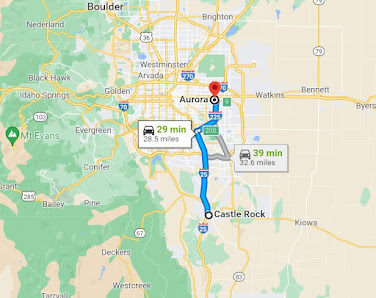
Geographically, Castle Rock and Aurora are less than 30 miles away. But when it comes to what happens to those investigated for "child neglect" they can be worlds apart.
All over the country, there are efforts to pass what should
be called “right to childhood laws” – that is, very good laws specifying that,
no, it is not “neglect” if you use your common sense to decide when your child is
old enough play by himself in a playground, or walk to or from school by
herself, or watch younger siblings while you work late on evening, etc. – in other
words, all the things children did routinely before the days of fearmongering,
helicopter parenting and endless messages to call child protective services
about anything and everything.
In Colorado, news
accounts have focused on the story of Brinley Sheffield, who took a solo run
around her neighborhood in the affluent community of Castle Rock when she was
seven years old. She’d previously run the
same route with her mother, Christa. Brinley did have a scary experience -- she
thought she was being followed.And she
was.But not by a kidnapper.She was being tailed by a local busybody who was
apparently horrified by the sight of a child getting some exercise in the neighborhood,
and then walking into her own home – by herself!!!
But that was only the first scare for Brinley.The busybody, no doubt proud to be performing
her civic duty, called the police.That,
of course, was even scarier.The
prospect of being under police investigation is enough to scare any
seven-year-old – and to make any parent second-guess her or his every move.Both are inherently harmful to children.As
Brinley said: “I started to cry because I was scared. I thought I was going
to get in big trouble.”
But that is as bad as it got.
Christa Sheffield said the police officer was “respectful
and understanding.”So the case was
closed – in fact, no case was ever even opened.
Meanwhile, in Aurora…
Now, let's go less than 30 miles north of Castle Rock, to
Aurora.Vanessa Peoples was at a family
gathering in a park when her two-year-old son wandered away.He was gone for all of a minute, but by then
another woman and found him – and called the police.
One month later, police entered Peoples’ home – guns drawn –
along with child protective services caseworkers.As family defense attorney Diane Redleaf writes
in Reason magazine, (I’ll link to it below) by the time they were done
But you don’t have to take Ms. Peoples’ word for it.Watch the bodycam footage – but don’t watch
it quite yet, since it might prompt you to jump to a conclusion that some of
America’s leading child welfare “scholars” want you to know couldn’t possibly
correct.
It concerns what could possibly account for why these two families,
living in towns less than 30 miles apart in the same state facing remarkably similar
allegations, were treated so differently.
Because, you see, if you do look at the photo of Brinley Sheffield
and her mother in one of the news stories, and then if you watch
the bodycam footage in the Reason story about Ms. Peoples, (OK, you
can look now) you might be tempted to conclude that there is racial bias in
child welfare.
But of course, that can’t possibly be.Notwithstanding cases such as these, and
notwithstanding a
wealth of data, we have been assured by everyone from Emily Putnam-Hornstein,
America’s foremost evangelist for using “predictive analytics” – or, as it
should be called, computerized racial profiling -- in child welfare, to Dean
Richard Barth of the University of Maryland School of Social Work, that
child welfare practitioners are so vastly superior to their counterparts in
every other walk of life that they have eradicated racial bias in their field.
So I guess we’ll never know why Christa Sheffield and Vanessa
Peoples were treated so differently.
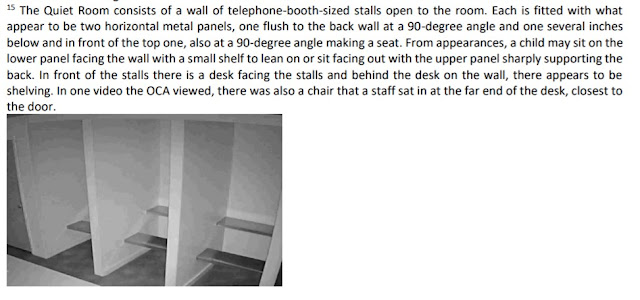
This excerpt from a report by the New Hampshire "Office of Child Advocate" describes, and illustrates, the "quiet room" at the Nashua Children's Home.
On the surface, this story from New Hampshire may seem like
just another example of children institutionalized in a place that has been the
subject of multiple allegations of abuse.
In fact, it’s much more.
● It’s a story about the willingness of regulators to bend
over backwards to dismiss complaints against such places.
● It’s a story of how a state “child advocate,” even as she
wrote a report that offered tepid criticism of serious alleged abuses at the
place, suggested changes that are almost meaningless.
● It’s a story about how the same “child advocate”
unintentionally pushed the state to rely on such institutions.
● It’s a story about how institutional providers dismiss the
overwhelming evidence that, even when there is no abuse, institutionalization
harms children.
● It’s a story about how the limits on such places
supposedly imposed by the Family First Prevention Services Act are as toothless
as some of us predicted.
● It’s a story about an institution that says it’s going to
change its practices to conform to a new contract but denies that there is
anything wrong with the way it did things under the old contract.As a
report from the “Office of Child Advocate” (OCA) puts it:
[T]he [institution] expressed skepticism of the provision
of evidence-based care now included in contract expectations. They questioned
the value of evidence-based practices and noted conversations … in which they
suggest [their] “practice-based evidence” informed their own development of a
practice model
Yet the Office of Child Advocate seems to believe the new
contract will be enough.
● Most of all, it’s a story about foster-care panic – about
what happens when a state family policing agency, in this case, the Division for Children, Youth and Families, responds
to a high-profile tragedy with a sharp sudden increase in removals of children
from their homes.New Hampshire now tears
away children at a rate double the national average - in part because of the “Child
Advocate” herself. DCYF created an
artificial “shortage” of foster homes.So DCYF institutionalizes
children as young as seven, responds to allegations of abuse with bureaucratic
gobbledygook and agrees to pay the institution $71,050 per year per child!
All of this (except the part about the foster-care panic) is
made clear in the report noted above from New Hampshire’s “child advocate,”
Moira O’Neill, and a subsequent
news story from WMUR-TV.
So let’s take a close look at the case of the Nashua
Children’s Home
The first thing to know about the Nashua Children’s Home is
it’s not a home.It has 37 residents and
is licensed for 55. That makes it an institution.Children as young as seven have been stuck
there.So let’s be clear: The state of
New Hampshire is willing to institutionalize seven-year-olds.
The second thing to know about the Nashua Children’s Home is
that even had there never been an allegation of abuse, the place would be bad
for children of any age.That’s because
institutions are inherently the most harmful form of care – and
they are unnecessary.As is
discussed below, there is nothing an institution can do that can’t be done
better with Wraparound programs.Institutions are especially bad for young children, which is what makes
New Hampshire’s willingness to institutionalize seven-year-olds particularly
horrifying.
The third thing to know is that between March, 2019 and October,
2020 this one institution, the Nashua Children’s Home, was the subject of what
O’Neill describes as “a cascade of complaints” to her office, 17 in all. Below
I discuss two of them.(I only hope that
readers who probably have read many accounts of institutional brutality that are
even worse than anything alleged concerning the Nashua Children’s Home have not
become jaded to the trauma allegedly inflicted by this institution’s staff.)
● Anthony was older, he was all of 16.When he tried to leave the “quiet room” he
wound up restrained, prone, on the floor, by three adult male staff – for an
hour and 20 minutes.A complaint to the
division of DCYF that investigates alleged abuse in foster homes and
institutions said that these actions “inhibited [anthony’s] breathing.”
But DCYF concluded there was no abuse because Anthony
suffered no actual injury (after all, it’s not like he actually stopped
breathing) and the restraint was being used for “behavior management
purposes.”They did refer the matter to
a separate unit that handles licensing of institutions.
The licensing unit initially thought there was a
problem.But then the institution explained
how the whole thing was just a result of their deep concern for Anthony’s
safety.You see it was very cold outside
that night, and if Anthony had left not only the quiet room but also the entire
institution, he’d be really, really cold.
Although the OCA reports no evidence of anyone at the
institution making any such claim at the time, the licensing unit accepted the
institution’s explanation.
You would think that the institution wouldn’t be having so
much trouble since it also appears to engage in a common industry practice
known as “creaming” – as in skimming the cream.They get to pick and choose who they’ll accept – and they get to kick
them out when things get tough.
Consider the case of 16-year-old Jake, also the subject of
an allegation of excessive use of restraint.Jake apparently was a juvenile justice placement.(We should pause here to note that the OCA
report expresses no concern – indeed, does not even mention, that 16-year-olds
placed through the juvenile justice system are in the same institution as seven
and eight-year-olds placed through the “child welfare system.”) Jake was
restrained in a prone position for a mere 15 minutes – because he’d been
sitting in the doorway of his room and yelling after his DVD player was
confiscated.That happened because his
mother had given him R-rated videos.Yes, really.
The day after the incident, the director of the institution
made clear he’d had it up to here with Jake.He sent a slew of emails to Jake’s juvenile probation and parole
officer, one of which said:
Oh, and in case you’re wondering what SYSC is – it’s the
Sununu Youth Services Center, which as one
news account last year put it, has seen
recent abuse allegations made by more than 300 men and
women who say they were physically or sexually abused as children by 150
staffers at the state’s facility from 1960 to 2018. Eleven former workers have
been arrested since April …
Family First won’t fix this
Back when the Family First Prevention Services Act first was
introduced in Congress in 2016 we wrote that no one should believe the hype
about how it would curb institutionalization.On the contrary, we said, it
institutionalizes institutions.As
we said at the time:
If the bill becomes law, the federal government would
stop reimbursing states for part of the cost of group home and institutional
placement after two weeks. But it creates a giant loophole: funding would
continue for something called a “Qualified Residential Treatment Program.”
What does it take to become a QRTP?Very little:
● Write lots and lots of plans filled with appropriate
buzzwords. (Drop the word “trauma-informed” into every third paragraph and you
should be fine.)
● Hire nurses during working hours and have them on call
the rest of the time.
● Get a rubber-stamp seal-of-approval from an accrediting
agency.
Now flash forward to 2022, and the case of the Nashua
Children’s Home.
The Office of Child Advocate recommendations all boil down
to: blah blah blah trauma-informed, blah, blah, blah, trauma-informed.So basically, everything should be fine if
the institution follows through on a new contract with the state that is filled
with all the buzzwords needed for the state to keep collecting federal aid for
institutionalizing children at the Nashua Children’s Home.The contract is for $9.8 million over three
years for 46 beds – or $71,050 per child per year.
I suppose we’ll never know if
children would be better off if the state just gave the $71,050 to the
children’s families so they could buy whatever help they or their children need
– but I think we can guess.
As for accreditation, accrediting agencies are generally dominated
by providers and make their money by accrediting fellow providers.That’s not exactly an incentive to get tough.The institution gets to choose its accreditor
from a list of several.
And sure enough, in its response to the Child Advocate, the
Nashua Children’s Home reprinted nearly two single-spaced pages of gushing
praise from the accreditor they chose.
This behavior by the institution is crucial for another
reason.The Child Advocate is counting
on the institution to obey all the terms, and all the blah-blah-blah trauma-informed
in the new contract from the state.But
the institution has made abundantly clear it doesn’t really believe in all that
blah-blah-blah.Again, as the Office of
Child Advocate report notes:
[T]he [institution] expressed skepticism of the provision
of evidence-based care now included in contract expectations. They questioned
the value of evidence-based practices and noted conversations … in which they
suggest [their] “practice-based evidence” informed their own development of a
practice model.
The institution’s rebuttal to OCA makes clear they think
there is absolutely nothing wrong with the way they did things before the new
contract – and they know better than a bunch of ivory-tower regulators anyway!Indeed, the institution’s director, David Villiotti,
told WMUR:
“We think our staff should get a lot more kudos and recognition
and congratulations than they do, rather than be criticized by somebody sitting
up on Pleasant Street in an office or sitting at home.”
Perhaps all this explains why, even though staff at the institution
began getting “trauma-informed care training” in September, 2020, the OCA
report concluded the training has had “no demonstrated effect yet.”
As for the quiet room, Villiotti said:
“Our response is most of the people critical of it have
never been in the position of having to deal with an out-of-control child.”
But the gentleman in the video below has. His name is Karl
Dennis.He’s a pioneer in replacing not
just “quiet rooms” but entire institutions with Wraparound programs that bring
whatever help a child needs into the child’s own home or foster home.Listen as Dennis describes how Wraparound
deals with youth who are far more out-of-control than an eight-year-old hiding
under a bed.
Once again, the price of panic
The other problem with the new contract is that, as a
practical matter, it’s unenforceable.DCYF wasn’t exactly aggressive about problems under the old
contract.Why should anyone think that
would change?
In fact, it can’t change.That’s thanks to DCYF -- and the “Child Advocate” herself.
Because right now in New Hampshire, it’s a sellers’ market
for residential treatment “providers.”
The video version of WMUR’s story ends with the statement
that the state has 662 family foster homes but says it “needs” 1,000 such homes.The implication is that this is why DCYF has
no choice but to institutionalize young children.
But the “shortage” is only because New Hampshire tears apart
families at one
of the highest rates in America, double the national average even when
rates of family poverty are factored in.
It wasn’t always so.Entries into care in New Hampshire began to skyrocket in 2015.And though, of course, DCYF and other foster
care apologists will blame opioids, plenty of states with serious opioid abuse
problems don’t tear apart families at such an obscene rate.More important, as has been documented over
and over, the problem isn’t opioids as much as it is child welfare’s knee-jerk
take-the-child-and-run response to opioids.
No, what happened in New Hampshire was a classic foster-care
panic – a rush to tear apart more families in the wake of high-profile child
abuse tragedies, such as one that occurred in New Hampshire at the end of 2014.Such tragedies often lead to bad “solutions”
including creating “child advocate” offices which almost always throw gasoline
on the fire.Maine
is a recent case in point, there have been many
others.
That includes New Hampshire, where the panicky response to
tragedy included creation of O’Neill’s office. O’Neill’s very first report annual report, in
2018, in the midst of skyrocketing removals, embraced the Big Lie of American
child welfare – that children are endangered because lawmakers and courts
supposedly are making the “best interests of the child” subordinate to “parents
rights.” The data, of course, tell a different story.
So O’Neill herself helped create an artificial “shortage” of
foster parents which, in turn, means the state will keep on relying on
institutionalizing children as young as age seven.(It doesn’t help that, according to O’Neill’s
report, on at least two occasions, the Nashua Children’s Home allegedly behaved
in ways that helped undermine the transition of children into family foster
homes – charges the institution denies.)
All this is why all O’Neill’s blah-blah-blah about
“trauma-informed” this and “trauma-informed,” that has such a hollow ring.The problem isn’t that it’s wrong to be
“trauma-informed” the problem is that people like O’Neill effectively stip the
concept of all meaning.Because, like so
many others who invoke the phrase, O’Neill seems to be startlingly ill-informed
about one of the worst traumas one can inflict on a child: Taking that child needlessly
from her or his parents.