Thursday, January 20, 2022

NCCPR news and commentary round-up, week ending January 19, 2022

Writing in The Imprint, Vivek Sankaran looks at the implications of a Pennsylvania Supreme Court decision that never should have been necessary. It should have been obvious all along that, when the family police knock at the door, families have Fourth Amendment rights.  He also shows that, apparently, there are some pretty awful judges in his own state of Michigan. 

● It also should be obvious that caseworkers do not have a constitutional right to falsify documents in the course of their investigations.  But there’s been still another right-to-lie case in the federal courts.  I have a blog post on both cases which, together, reveal that “child welfare” is a field so arrogant it can assert the right to violate everything from the Fourth Amendment to the Ninth Commandment. 

● A great family defender, Kathleen Creamer of Community Legal Services of Philadelphia, discusses that Pennsylvania Supreme Court decision, another Pennsylvania case, and other crucial child welfare issues, including the harm done by the so-called Adoption and Safe Families Act (ASFA) on The Imprint podcast. 

● Another great family defender, Jey Rajaraman will be joining the new national effort to transform child welfare led by the former head of the federal Children’s Bureau, Jerry Milner and his special assistant there David Kelly. 

● No state needs such a transformation more than Montana.  NCCPR has a column in the Daily Montanan about an audit by the State Legislature which proves what we’ve said all along: Montana is the child removal capital of America. 

● Meanwhile, in Florida, there’s been a miracle!  Apparently, in Pinellas County Florida child abuse suddenly plummeted by 50%.  After all, what else could possibly explain the fact that all of a sudden Sheriff Bob Gualtieri reduced child removals by that amount.  Well, I do have a theory

● Also in Florida, in spite of a massive fear and smear campaign by the state’s CASA program, WFSU Public Radio reports that a bill is advancing that would give children actual lawyers who will fight for what the children want, not what the overwhelmingly middle-class disproportionately white CASAs happen to think should happen to children who are neither. 

● Although it’s not directly about child welfare, NPR has an important story about recovery from substance use disorder. Contrary to the common stereotype – a stereotype often used to justify the draconian timelines in ASFA -- most people recover and maintain their recovery.

● Nor does drug use necessarily impede parenting.  In fact, as Ericka Brewington writes in Black Health “My children never felt the impact of my drug use until they were removed from my home.” 

● Ignoring testimony from family defenders, family advocates and other experts, New York State is going to allow another backdoor way to increase the separation of children from their families.  Officially, The Imprint reports, it’s called “host families” but, as NCCPR has said since this program began, a better term is sugar-frosted foster care

● And in Maine, a group dominated by “providers” has released what it calls a “Framework for Child Welfare Reform.”  Unfortunately, it’s more like a framework for false consensus.

Wednesday, January 19, 2022

Maine’s child welfare providers produce a "framework" for false consensus

If the recommendations are enacted, the biggest beneficiaries might be 
Maine's paper mills, what with all the 
“theories of change” “logic models”
and “strategies” that will have to be turned out.

Multiple organizations in Maine – but with the lead organizations dominated by private “providers” have put out a document they’re calling “A Framework for Child Welfare Reform” in that state.  Yes, there are some good things in it, but in general it's really a framework for false consensus.  

The document is the latest to be released in Maine in the wake of what newspapers love to call a “spate” of child abuse deaths.  But instead of rethinking the take-the-child-and-run approach that contributed to these tragedies, and similar cases in 2018, the state has been doubling down.  They’ve been led, or rather misled, by the state’s child welfare “ombudsman,” Christine Alberi.  I describe the enormous harm she is doing in this previous blog post. 

This new document isn’t anywhere near as bad as what the ombudsman has been doing – or what some state legislators have been proposing.  One section of the document would actually make things better. 

But it also calls for a further expansion of the state’s family policing bureaucracy (including a whole bunch of new middle managers reporting to one of America’s worst child welfare agency leaders, Todd Landry) more power for the ombudsman and, to the extent that it endorses prevention, it is only as an add-on to the existing system.  There is nothing that would provide due process for families or in any way require a supremely powerful, unaccountable system to give up any of that power. 

And that’s the key problem. In child welfare, we all say the same things, but we all mean different things by what we say: Nobody ever says: “I think foster care should be the first resort!”  Everyone says it should be the last resort.  Nobody ever says “Boy, do I hate prevention; if there’s one thing I can’t stand, it’s prevention!”  By and large, the people who say they support “prevention” are sincere. But the fact that rates of child removal vary enormously from state to state and sometimes even county to county – or, as in Maine, they can shoot upwards with no evidence of an actual increase in child abuse -  shows that we all mean different things by “prevention” and have very different definitions of  “last resort.” 


So when a document like the Framework comes out – which talks about prevention but says nothing about due process or anything else to curb the power of the family police - e
veryone can then congratulate themselves, lots of new bureaucrats are hired and nothing really changes.  The biggest beneficiaries might be Maine’s paper mills – because so much paper will be needed for all those “theories of change” “logic models” “strategies” (which will require “strategic plans”) coordinating committee agendas and all the other gobbledygook included in the Framework document – all of which would delay actually doing anything. 

Reducing what we call child abuse is a problem that does not require any of those documents.  Nor does it require more time, paperwork and meetings, meetings, meetings, to enhance “cross-systems collaboration,” and it certainly doesn’t need more middle-managers reporting to Todd Landry.  What’s needed is this: 

● Find the poor people.

● Send money (it doesn’t have to be a lot).

● Let them buy the help they need.

● Provide meaningful due process for families, especially high-quality family defense, something not mentioned at all in the Framework. 

I suspect one reason we don’t see anything like this in the Framework is that the “lead organizations” behind it include far too many “providers” who live off the system as it exists today.  So the recommendations are structured in a way that they add on to the existing system, but don’t challenge it. 

Meaningful due process is the most important change the system can make – and the one providers would hate most.  Because even if Maine had all the help families need, in the current climate of foster-care panic, caseworkers are going to be afraid to use it.  That’s the nature of foster-care panic; every worker is afraid of having the next tragedy on their caseload, and every judge is even more afraid than before to let a child go home.  This is why it’s so important that the legislature send a strong message to Landry, Alberi et. al. that foster-care panic is making things worse and they need to stop encouraging it or enabling it. 


The one useful piece of paperwork 

That leads me to the one piece of paperwork recommended in the document that would be useful: outcome measures.  Typically, what agencies call outcome measures actually are process measures: How many families were visited once a month, how low is the caseload in what percentage of cases, etc.  

What is needed are agreed-upon measures that tell us if children are safer.  Ideally, the Legislature will commit to this right away.  

Because right now the de-facto outcome measure is: No child will die.  I know of no statewide system anywhere that has ever achieved that.  But as long as that is the outcome measure, sooner or later, when a child dies, certain players will say this “proves” that the prevention measures failed, and the cycle will start all over again.  

There needs to be a reaffirming of no child deaths as a goal, but a simultaneous repudiation of it as an outcome measure.  Outcome measures should be based primarily on something I recommended in the post about Alberi’s failures: Readings of a representative random sample of cases by unbiased experts (so not Alberi) supplemented by statewide data on overall reabuse and foster-care recidivism (the proportion of children sent home from foster care who are placed again).  Other measures can include reduction in placements in group homes and institutions and increases in the proportion of placements with relatives instead of strangers.


The good news 

The good news in this document is entirely in one section, “Invest in Supportive Services.”  In particular, the recommendations on family resource centers run by agencies other than Landry’s agency, the Office of Child and Family Services, increasing the availability in rural areas of buprenorphine, a treatment for opioid addiction, and, especially, more affordable housing. (There’s also a glaring omission: childcare.)  But while we’re waiting for the family resource centers and the new housing to be built, what about direct cash assistance so families can seek better housing in the existing market and buy the kinds of help the resource centers might offer?  

Also, while it’s important that family resource centers are not run by OCFS, it isn’t much better if they’re run by groups like some of the “providers” who signed onto the Framework – in particular those that oversee foster care and institutionalize children in residential treatment centers. Would you go to a family resource center staffed by “mandatory reporters” of child abuse whose institution could gain financially if your children were taken?  Rather the centers should be run by community organizations unconnected to the family policing system.


The bad news 

The Framework buys into the idea that Maine needs even more caseworkers.  That tacitly assumes the current level of investigations and removals is correct.  To the extent that there is a need for more caseworkers it is solely to restore the capacity of Alternative Response agencies – not OCFS.  And the idea that OCFS needs more middle managers again assumes that the issues are far more complex than they really are.  

As for all the talk about training, that always makes my skin crawl. That’s because for decades that’s been the knee-jerk all-purpose response to anything wrong in child welfare.  It never works, because training is no substitute for due process. 

Improving “cross-system collaboration” is more meaningless boilerplate that allows everyone to nod their heads and pretend to be doing something.  Do you know anyone who’s against cross-system collaboration? 

When it comes to oversight, the fact that they want to give the ombudsman more power is a de facto contradiction of everything else in the Framework.  But the Legislature itself should be providing ongoing oversight - and that also is recommended in the Framework.  Lawmakers should pass any laws needed for this and repeal any that get in the way.


And finally ... 

Beware of people who declare themselves advocates of prevention but constantly talk about the need for a “public health” approach.  That’s because child abuse isn’t a public health problem. It’s a social justice problem.

Lessons from two child welfare court decisions


Update, May 7, 2021: To his credit, during a virtual hearing of the Philadelphia City Council Special Committee on Child Separations on May 6 a top lawyer for the city's Department of Human Services says that, when it comes to the Philadelphia case discussed below, "we might have gotten it wrong" and "The Supreme Court came down in the right way."

1. Yes, families DO have Fourth Amendment rights when the family police are at the door.

2. No, caseworkers cannot evade accountability by claiming they were too stupid to know they’re not allowed to lie in documents used in court.

 The Pennsylvania Supreme Court has issued a scathing rebuke to Philadelphia’s family police agency, the Department of Human Services, rejecting the idea that its caseworkers are effectively exempt from the Fourth Amendment to the United States Constitution and a similar clause in Pennsylvania’s constitution.  On the contrary, said the court: 

We expressly hold that there is no ‘social worker exception’ to compliance with constitutional limitations on an entry into a home without consent or exigent circumstances. 

Across the country in Colorado, a federal court has rejected still another claim by family police caseworkers that somehow they have what amounts to a right to lie. 


The two cases have something in common: Both reflect the arrogance of a system with near-absolute power and no real accountability, a system in which people see their cause as so noble that it can justify violating everything from the Fourth Amendment to the Ninth Commandment.*
 

The Philadelphia story 

On May 22, 2019, Philadelphia’s family policing agency, the Department of Human Services, received a call, apparently anonymous, from someone alleging that three weeks earlier a family had been sleeping outside the offices of the Philadelphia Housing Authority – suggesting that the family was homeless.  Then, on May 21, the caller said, the mother was back allegedly with one of her two children, outside the authority’s offices for eight hours and it was “unknown” if the child was fed during that time. 

A Philadelphia agency that helps homeless families contacted the mother who said no, she is not homeless.  She is, however, an activist who regularly protested outside the Housing Authority offices.  Further suggesting the family was not homeless: The caller who made the neglect report gave the family police the family’s home address. 

The mother says her children were not with her during her protest on May 21, and the call to DHS was retaliation for her political activity.  But even had the children been with her, does DHS think families should be required to notify family police and/or the general public whenever they feed their children?  Had mom had her child with her, would she have been expected to yell “Hey, look everyone!  I’m feeding my child!  Don’t call the family police on me!” – or face an allegation that it was “unknown” if a child was fed?  Does DHS think any time a child decides the food in the school cafeteria is too “gross” and decides to skip lunch – which might mean he doesn’t eat for eight hours – the school and/or the parents are guilty of neglect? 

Based solely on these allegations, DHS demanded to enter and inspect the family home (a somewhat odd demand when the allegation is homelessness). When the parents refused, DHS came back with police.  The parents still refused.  

The good news: DHS didn’t simply cry “emergency!” and tell the cops to break down the door and take the kids – you know, the way they do it in Arizona. 

The bad news: They didn’t do the right thing: apologize and just go away. Instead, they dragged the family into court and sought an order forcing them to let DHS in.  Despite the fact that the only witness to testify at the hearing, a DHS caseworker, contradicted some of the allegations in the case, the court readily agreed; illustrating once again that judges in family policing cases are far more prone to wield rubber-stamps than gavels. 

The court’s decision was based on the allegations and the mother’s “demeanor” when she testified (I’ll get back to that). The court order not only allowed the family police to poke and pry all over the house but also specifically barred the mother from recording the interaction. 

The inspection took place and found nothing wrong.  The allegations were false.  The family had endured the trauma for no reason and a family police caseworker wasted time that could have been spent on a case in which children really were in danger. 

The mother appealed the decision allowing the family police to barge into the family home.  A mid-level appeals court overturned the ban on recording interviews but upheld everything else.  The Pennsylvania Supreme Court strongly disagreed. 


DHS’ argument was the argument family policing agencies always make. It boils down to: We’re not like those other police, we’re just kindly caseworkers who are here to help – and besides our cause is so noble that if you interfere with us in any way children might be hurt!  So we should be able to do what we want when we want to whomever we want.
 

The Pennsylvania Supreme Court pointed out, however, that by this reasoning someone accused of mass murder would have more Fourth Amendment protection than a family in which a mother is accused of maybe, possibly not feeding her child for eight hours.  The Supreme Court cited with approval an earlier Pennsylvania case deriding similar claims.  In that decision, the court noted that the sweeping claims of family police agencies 

Would give the state unfettered and absolute authority to enter private homes and disrupt the tranquility of family life on nothing more than an anonymous rumor that something might be amiss.   Despite their exaggerated view of their powers, the Fourth Amendment applies to them, as it does to all other officers or agents of the state whose requests to enter, however benign or well-intentioned, are met with a closed door. 

The Supreme Court also rejected DHS’ claim that being allowed to force their way into a
home and search anywhere and everywhere, through children’s rooms and into closets and cupboards is just, as the agency actually claimed, “a minimally-invasive spot check.”  (Indeed, were that so, one would think DHS would have welcomed a recording documenting their kindness, benevolence and the minimal nature of their intrusion.  Instead, they got the court to specifically prohibit the mother from recording the search.)
 

In short, even the family police need “probable cause.”  And, the Pennsylvania Supreme Court decision makes clear they sure didn’t have it in this case. 

Recall the allegations: Homelessness and the child may or may not have been fed for one eight-hour period.  As the court explained: 

Having located the family’s home and repeatedly finding Mother and Father there, any allegation of homelessness was rendered moot. If all of this was not sufficient evidence of a lack of homelessness, by the end of the evidentiary hearing DHS unmistakably confirmed that it no longer considered the family to be homeless, as it requested an order to conduct a home visit at the very house where caseworker Richardson had visited twice on the day in question. At that juncture, the only remaining allegation … was that the anonymous reporter had not observed Mother feed one of the children on a single day for approximately eight hours. The DHS caseworker’s characterization of this allegation as “inadequate basic care” was hyperbole. 

As for the mother’s demeanor, the Supreme Court pointed out the obvious: 

[W]e note that Mother’s demeanor may well have been, in whole or in part, a reflection of her frustration based on her view that the entire episode was in retaliation for her  protesting  activities.

Writing in The Imprint, Prof. Vivek Sankaran, director of the Child Advocacy Law Clinic and the Child Welfare Appellate Clinic at the University Michigan Law School summed it up perfectly: 

In many ways, the decision was unexceptional. The Court simply applied decades of Fourth Amendment law to the facts of the case, and ruled that the government had no basis to enter the parents’ home. … None of us would want a social worker to be able to search our home based on such flimsy evidence provided by an anonymous report. 

But this decision is a significant win because all too often, well-established legal rules and principles are discarded by family court judges in the name of protecting children. … In any proceeding involving litigants with power, we would never tolerate this. Think about a medical malpractice claim involving a rich doctor, or a criminal case involving a high-profile defendant. Fraud allegations against a Fortune 500 company. We wouldn’t even allow a slight deviation from the rules. Lawyers would scream. Appellate courts would intervene. The system would move quickly to protect the powerful.     

But in child welfare, not only do we tolerate this, attorneys are often chastised when they demand that well-established processes be followed. … 

Thanks to pressure from family defenders, grassroots family advocacy groups and two members of the Philadelphia City Council, David Oh and Cindy Bass, though it’s still worse than its counterparts in most big cities, DHS is not as bad as it once was.  It is showing a little more self-restraint.  

But this case illustrates why counting on family police to restrain themselves will never work.  DHS’ claim of vast powers to effectively ignore the Fourth Amendment combined with a claim about how this intrusion is no big deal illustrates the urgent need for accountability.  And the fact that a trial court actually bought DHS’ b.s. is one more indication of the urgent need to open court hearings in Philadelphia (and everywhere else they now are closed) to the press and the public. 

The Colorado case 

Family police caseworkers have what is known as “qualified immunity” from civil lawsuits.  In layman’s terms that means you can’t win a suit against them unless their behavior was flagrantly malicious or flagrantly stupid.  In particular, they had to be clearly on notice that what they were doing was illegal and/or unconstitutional. 

So, for example, in the Philadelphia case discussed above, it’s possible that the judges put in the statement “We expressly hold that there is no ‘social worker exception’ to compliance with constitutional limitations on an entry into a home without consent or exigent circumstances”  [emphasis added] in order to put caseworkers on notice that they can’t claim qualified immunity if they fail to comply. 


Some readers may recall a California case in which a caseworker actually tried to claim what amounted to a constitutional right to lie.  If, in fact, she lied under oath and provided false evidence to a court (she did not admit it) then it still was o.k., she claimed, because there was nothing explicitly telling her that’s a violation of the rights of the parent who was suing her.
 

In a decision aptly characterized as an “Epic Dis,” the Ninth Circuit U.S. Court of Appeals soundly rejected this claim, saying, in effect that the worker could be sued under what should probably be called the stupidity exemption to qualified immunity.  

Now the issue has arisen in another federal court. Once again, the immunity claim was dismissed, but this time the “dis” wasn’t quite as epic as it should have been. 

This time the case involved Krystal O’Connell, a Colorado mother convicted of killing her child, in part based on a confession she says was coerced and notes from a caseworker, Marcia Tuggle, in which she claimed O’Connell confessed.  O’Connell served ten years in prison before a new trial was ordered.  Prosecutors declined to try her again.  Her case is now listed in the National Registry of Exonerations. She is now suing a police officer who conducted the criminal investigation and Tuggle, who was conducting a child abuse investigation.  Full details are in this excellent account from Colorado Politics. 

This time, Tuggle, now a former caseworker, argues that if she, in fact, fabricated a confession (she does not admit to doing so) she’s still entitled to qualified immunity because courts have only explicitly said this is prohibited in a criminal investigation or if it’s done during a child abuse investigation then it’s prohibited only if the false statements were used to advance that specific investigation.  

Tuggle argues that in this case she was just there on behalf of child protective services and any alleged fabrication was not used to advance that particular investigation.  As for the fact that her allegedly falsified notes were a factor in a criminal prosecution, well, how could she possibly know that would happen?  Apparently, the fact that the notes she wrote allegedly fabricating a confession were from a joint interview in which the police officer conducting the criminal investigation was asking the questions did not clue her in. 

A federal district court did not buy this.  The judge noted that two prior court rulings in very similar cases “and, frankly common sense” should have made it clear to the caseworker that what she allegedly did was unconstitutional. 

When Tuggle appealed, the Tenth Circuit Court of Appeals noted that caselaw specifies that, in addition to specific court precedent “a right can be clearly established when it is obvious.”  The appellate court decision quotes from a prior decision from the same circuit which declared: 

“After all, some things are so obviously unlawful that they don’t require detailed explanation and sometimes the most obviously unlawful things happen so rarely that a case on point is itself an unusual thing.” 

But here’s the scary part.  The decision of the three-judge appellate court panel was not unanimous.  One judge actually bought the caseworker’s claims.  As the dissenter put it: 

As the district court observed, “common sense” should have informed Defendant that “a social worker, like any other public official, cannot knowingly create false information in furtherance of an investigation.” Yet, neither common sense nor our prior case law would have informed Defendant that she could not do so for constitutional reasons, as opposed to some general, moral reason. 

Even if one buys that, it raises another question: 

Why would any “child welfare” agency hire someone who, if, in fact she did what is alleged, didn’t know that fabricating evidence for any kind of investigation is unconstitutional, and/or is so lacking in morality that she would hide behind legal hairsplitting to commit an act even the dissenting judge could not justify on moral grounds?  Unless of course, that is the essence of the culture of the agency itself. 

At a minimum, it would be prudent for Colorado and every other state passed laws explicitly stating that it is illegal to lie in a legal proceeding and illegal to create false evidence – even in a child abuse investigation.  Because clearly, this is a field that has trouble grasping the obvious. 

*-In some faiths it’s the Eighth Commandment.  As the lawyers might say, the circuits are split.

For more about these cases:

Philadelphia: 

Kathleen Creamer of Community Legal Services of Philadelphia discusses this case, another Pennsylvania case,  and other child welfare issues on The Imprint podcast.

See also  The Imprint story, The Volokh Conspiracy blog and the analysis from CLS Philadelphia.  

Colorado: 

See this story from Colorado Politics

Tuesday, January 18, 2022

Miracle in Pinellas County, Florida! Child Abuse suddenly plummets by 50%! (Unless there’s some OTHER reason the sheriff suddenly found a way to stop taking away so many kids)

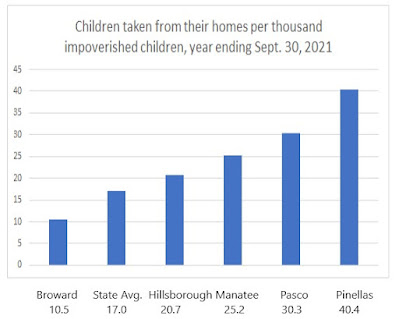
The rate at which children were torn from their homes in large Florida counties
where sheriff's offices are in charge of child abuse investigations.
  Note that even if Pinellas County has now cut removals in half,
it's still above the state average and well above Broward County.

Hey, remember when the Sheriff of Pinellas County, Florida, Bob Gualtieri, whose office is responsible for child abuse investigations in the county, insisted that his officers never, ever needlessly take children from their homes?  Remember how he said his officers followed a Florida Department of Children and Families framework for investigations “to a T”?   Remember how he insisted on this even though Pinellas tears apart families at one of the highest rates in Florida, even when rates of child poverty are factored in? 

Less than two months ago, he said this to the Florida news site Florida Politics 

“We will always make the decision that is in the best interest of the children, regardless of what others may want, and that includes removing them from harmful situations when required. All of our removal decisions are reviewed by a judge and routinely upheld. We will continue to act to protect vulnerable children.” 

Later, Gualtieri bragged about refusing requests from the former “lead agency” running foster care in the county, Eckerd Connects, to please stop taking so many kids.  And he did all this knowing that Eckerd was placing the children in situations so horrible that Gualtieri himself was launching a criminal investigation. 


But then, the miracle:  As Florida Politics reports, according to a press release from the Florida Department of Children and Families, thanks to the brilliant leadership of the Florida Department of Children and Families (bet you didn’t see that coming) in just two months they’ve cut the number of children taken from their families in Pinellas and neighboring Pasco County by 50%!
 

There are two possible explanations for this: Either all of a sudden, child abuse in these counties declined by half  -- or, month-after-month year-after-year until now, the Sheriffs tore apart families needlessly, Eckerd was complicit and DCF turned a blind eye. 

If the data are correct, it is a small, encouraging first step - though it would still mean Pinellas County is tearing apart families at a rate above the state average, even when rates of child poverty are factored in.  

DCF Secretary Shevaun Harris deserves credit for being the first person in that job since George Sheldon to at least have the courage to admit that wrongful removal is a problem and take some steps to deal with it.  (We’ll see if she still has that kind of courage when the Miami Herald and the Tampa Bay Times come after her – as they will the next time there’s a high-profile death of a child “known to the system” in these counties.) 

But it’s not nearly enough.  The DCF press release is not a testament to sudden success but to horrifying long-term failure – by Eckerd Connects, by the sheriffs and by DCF itself. 

Think of what that press release really means: Hundreds, perhaps thousands of children needlessly traumatized, possibly for life, after being taken from everyone they know and love due to Gualtieri’s knee-jerk take-the-child-and-run approach and the failure of others in the system to stop it.  Many of those children were taken from homes that were safe or could have been made safe only to be abused in foster care.  Others were placed in conditions so horrible that, as noted above, Gualtieri himself has launched a criminal investigation. 

Gualtieri may claim that it was only all of a sudden that other agencies gave him alternatives to taking away all those children.  The press release seems to suggest as much – thanks to the magnificent leadership of DCF, of course.   But Gualtieri is also the one who demands no excuses from others.  As he put it when talking about Eckerd: “You don’t whine about it. … You figure out a way to make it happen." So why didn’t he take the initiative and build the necessary infrastructure of prevention to “make it happen”?  Why didn’t he show the same leadership as his counterpart in  Broward County, where the sheriff understood the problem and did something about it.  Broward tears apart significantly fewer children than Pinellas or Pasco. 

As for DCF, it effectively admits that poverty was confused with neglect in the part of the press release in which it brags that it 

Launched a direct referral process to Hope Florida – A Pathway to Prosperity and Care Navigation for the Sheriff’s Offices, providing assistance to 272 families who faced economic barriers in open child dependency cases. 

There should be no such thing as “economic barriers in … child dependency cases” because poverty is not neglect.  And again, why did Gualtieri and his counterpart in Pasco County wait for DCF – why didn’t they do this themselves? 

A failure of the judiciary 

The press release also illustrates the failure of the Florida judiciary.  Recall how Gualtieri justified his take-the-child-and-run approach by saying what bad family policing agencies always say: 

All of our removal decisions are reviewed by a judge and routinely upheld. 


Yet now we know that, at least half the time, those decisions almost certainly were wrong.  This further illustrates the need for Florida judges to start wielding gavels instead of rubber stamps – and it illustrates the urgent need for Florida to institute the model of high-quality family defense that has allowed other communities to dramatically reduce needless foster care with no compromise of safety.
 

A failure of journalism 

And finally, there is another factor: journalistic malpractice by the most powerful media organization in the region, the Tampa Bay Times. 

Imagine how much better off hundreds of children would be now had the Times news side not ignored or downplayed the issue of wrongful removal.  How many children would have been spared the hideous conditions of Eckerd “care” had the Times editorial board, under former Editorial Page Editor Tim Nickens, crusaded to reduce entries into foster care instead of to increase them?  (By the way, Nickens also cited the fact that the judges kept rubber-stamping removals as some kind of proof they were justified.) 

And again, will DCF Secretary Harris have the guts to stand up to the Times, and the Miami Herald, when they come after her?

Monday, January 17, 2022

NCCPR in the Daily Montanan: The audit proves it: Montana is the child removal capital of America, and that’s bad for children

Auditors for the Montana Legislature have now made clear that Montana’s “child welfare” system is not about children and does not promote their welfare.  Perhaps now, thanks to a performance audit of the Child and Family Services Division, lawmakers will face up to the harm done by Montana’s dubious distinction, child removal capital of America.  

The audit reveals that Montana’s extreme outlier status does not keep children safe, and it reveals that the all-purpose knee-jerk excuse from CFSD – it’s drugs, you know – doesn’t hold up to scrutiny. 

But the report is mistaken in suggesting that if everyone just got the paperwork in order and understood the “practice model” things would change.  Saving Montana children from their saviors requires much more.

Read the full column in the Daily Montanan

Wednesday, January 12, 2022

NCCPR news and commentary round-up, week ending Jan 11, 2022

● Well what do you know, families DO have Fourth Amendment rights when the family police knock at the door – at least in Pennsylvania, according to a decision by that state’s Supreme Court.  The Imprint has a story, and The Volokh Conspiracy blog and Community Legal Services of Philadelphia have the details. 

● Speaking of things you may have thought children and families already had: Colorado Newsline reports that the state is considering legislation to require lawyers for children in family policing proceedings to behave like lawyers and fight for what the child wants, instead of pushing for whatever the lawyer happens to thinks is best, even if that means fighting against her or his own client.  Twenty-eight states now require this, though the mandate is not always enforced.  Florida Politics reports on a similar bill in that state, but sponsors will have to overcome the demagoguery of Florida's CASA program in order to get it passed.

● The attempt to use family policing to destroy Native American culture didn’t end with the horrible institutions known as “boarding schools.”  It was followed by a systematic campaign of forced adoption into white homes, spearheaded by, among others, the Child Welfare League of America.  The Philadelphia Inquirer tells the stories of some of the survivors.  Even one who was raised by loving white parents still bears deep scars: 

“You’re an Indian! You’re an Indian!” one of her cousins would taunt. “No, I’m not!” [she] would scream back, a denial that still embarrasses her and causes her pain. 

● There is still another study documenting the confusion of poverty with “neglect” this time in Britain. 

● The Western New England Law Review has a superb summary of the research showing the enormous harm to children caused when they are taken from domestic violence survivors (on grounds that the parent “allowed” the child to “witness domestic violence”). 

The article interweaves compelling case examples and a mass of research.  It also includes an excellent discussion of the dynamics of domestic violence, what makes it hard for a survivor to leave such a relationship (including the enormous role of poverty) and what courts – and the rest of us – should be asking concerning whether family policing agencies are genuinely making reasonable efforts to help them, as federal law requires.  Although it is specific to Massachusetts it applies everywhere.  And it is only about one-fifth the length of a typical law review article. 

For more on this topic see NCCPR’s summary of expert testimony and the outstanding reporting of USA Today Network Florida journalists. 

● Using data from NCCPR’s comparisons of entries into foster care and child welfare spending as well as other federal data, The Tennessee Tribune compares outcomes in Alabama, which reformed thanks to an innovative lawsuit settlement emphasizing family preservation to Tennessee which endured one of those typical settlements of one of those typical McLawsuits churned out by the group that calls itself Children’s Rights.  Guess which state is spending less but getting better results. 

● Foster-care panic is like a fire. It’s not a good idea to add gasoline.  But that is exactly what the child welfare “ombudsman” is doing in Maine.  I have a blog post documenting in detail how Maine’s child welfare ombudsman is dangerously wrong.

Thursday, January 6, 2022

Maine’s child welfare ombudsman is dangerously wrong

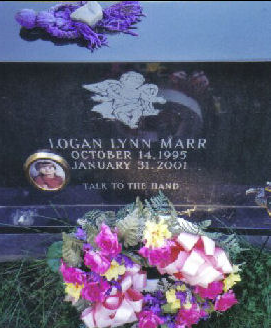
Maine's first child welfare ombudsman, Dean Crocker, understood
the lessons from the tragic death of Logan Marr, who was taken
when her family poverty was confused with "neglect" and killed
in foster care.  The current ombudsman, Christine Alberi, does not.

● In a classic example of trying to make policy-by-horror-story, her latest report uses a tiny, non-random sample of cases she chose herself to justify sweeping conclusions that all boil down to: Take away more kids and don’t send them back!  That is making all Maine children less safe. 

● She is wrong about domestic violence, she is wrong about truancy, she is wrong about “alternative response,” she is wrong about false reports and she is wrong to call for more institutionalization of children.  Most of all she is wrong to ignore the enormous harm of needless removal. 

● At a time when the entire child welfare field finally is coming to grips with issues of poverty and race, she puts out a report that mentions neither. In the entire report the word "poverty" does not appear even once.

● For the sake of Maine's most vulnerable children, any legislation to give her more power and staff should also include a requirement that she use objective evaluators and base policy recommendations only on a statistically valid random sample of cases.  The office also needs a more representative Board of Directors. 

● But ultimately, we all need to be the ombudsman.  In Maine and elsewhere, the ombudsman’s power is fed by secrecy.  For starters, Maine should join the many states in which child welfare court hearings are open. 


How could a state like Maine, a state that once almost got child welfare right, keep careening full-speed backwards.  How is it that no one has stopped a foster-care panic that has undone reforms that once were a national model; a panic that has made all of the state’s children less safe? 

There are many reasons, and I have discussed them on this blog and elsewhere before.  But one reason is the state’s child welfare “ombudsman,” Christine Alberi.  She issues reports with shamefully shoddy methodology that throw gasoline on the fires of foster-care panic.  Judging from Alberi’s latest report, she has never, ever encountered a case in which she believes a child was wrongfully taken.  At a time when almost everyone else in the field is discussing the confusion of poverty with neglect, Alberi has managed to issue a 20-page report that never once even uses the word poverty.  Also missing: The fact that even in an overwhelmingly white state, there is evidence of racial bias in Maine child welfare. 

Unfortunately, Alberi’s approach is not unusual.  As in many states, legislators in Maine effectively delegated responsibility to hold the child welfare system accountable to one person – an “ombudsman” or “child advocate.” 

Back in 2007, on this blog, I wrote about the typical behavior of people filling such posts: Investigate horror stories and jump to conclusions based on those horror stories that boil down to: Take away more kids.  

Though ombudsmen generally have no formal powers aside from the ability to investigate and report their findings, their influence is enormous.  That’s because in systems more secret than the CIA, they get to see everything – or at least a lot more than everyone else outside the child welfare agency sees.  (It doesn’t actually have to be that way, as I’ll explain below.)  So almost the entire view of the system seen by journalists and lawmakers is whatever the ombudsman wants them to see – and very little more.  It’s like trying to figure out who and what is in a large room by looking through a pinhole. 

In report after report Alberi zeros-in on what she views as poor decision-making at two key stages of the process: The decision to remove children from the home and the decision to return them home.  But by poor decision-making, she never seems to mean that it was a poor decision to take away a child. 

The ombudsman’s report defies common sense 

Common sense tells us there will, in fact, be a lot of poor decision-making at these points.  But common sense also tells us that, for reasons noted above, the bad decisions will go in all directions.   It is ludicrous to think that, in a system filled with underprepared overloaded workers rushing from case to case all of the errors would go in only one direction. 

Yet any reader of Alberi’s latest report who took it at face value would have to conclude just that.  Because, as Alberi tells it, the only mistakes made by Maine child welfare caseworkers are to leave children in dangerous homes and return them there. 

She is dangerously wrong. 

The errors go in all directions, and all of these errors harm children.  

● Wrongful removal inflicts profound psychological trauma.  Although DHHS caseworkers almost always mean well  - as does Alberi by the way – the trauma when a child is torn from everyone loving and familiar in Maine is just as severe as when it happens on the Mexican border.  

● Wrongful removal places children at serious risk of abuse in foster care itself, where independent studies find rates of abuse far higher than agencies such as DHHS admit in official statistics.  

● And all the time, money and effort wasted on false allegations, trivial cases and poverty cases is, in effect stolen from finding children in real danger.  In short, the foster-care panic encouraged by Alberi’s whole approach actually makes more likely the very failings Alberi cites. 


Alberi’s latest report draws her sweeping conclusions from a tiny sample of cases – the 84 her office chose to accept in 2021.  But Maine caseworkers investigated nearly 12,000 cases in 2021.  While it is reasonable to draw conclusions based on a sample, 84 is a far smaller number than, say, the typical “case reading” done to assess agency performance when such agencies are the subjects of class-action lawsuits.
 

Even worse, this is not a random sample.  Rather it is those cases Alberi and her assistant personally deemed worthy of investigation – and the criteria for choosing a case can be startlingly subjective.  They include, for example, “the demeanor and credibility of the caller.”  Really?  Suppose your child had just been torn from your arms and you were desperate for help.  How would you be doing demeanor-wise? 

Another criterion: “The degree of harm alleged to the child.”  But an ombudsman who doesn’t even mention poverty is unlikely to consider a case in which a child was taken because of poverty – such as Logan Marr -- to be terribly harmful.  Rather the focus will be on the much smaller percentage of cases that allege sexual abuse or serious physical abuse. 

And so, based on this tiny, skewed sample, Alberi offers broad, sweeping conclusions and examples in which, in every single case, she concludes, the error was to leave a child in the home or return a child to the home.  It should be clear that this is absurd on its face.  

Alberi’s whole approach is so absurd it leads me to write a sentence I never thought would appear in this blog: In some respects, Todd Landry is right. 

Landry runs the Office of Child and Family Services within Maine’s Department of Health and Human Services.  His hiring is, frankly, inexplicable.  He had a horrible track record when he ran child welfare in Nebraska – under his leadership that state was worse than Maine, tearing apart families at one of the highest rates in America, and his callousness could be astounding. 

But Alberi’s methodology is so absurd even Landry sees through it.  In his office’s response to the Alberi, he writes:


Rather than a random sample, a case review begins with self-selected inquiries and is often complaint driven. … 

A source of disagreement for a number of reports relates to the Ombudsman’s finding or recommendation that involves bringing children into State care or keeping them in care for a longer period of time. While OCFS recognizes the perception that children are safer when removed, the evidence overwhelmingly shows that removing a child from their home has the potential to inflict harm or trauma. In addition, there is little research to support the belief that, in general, children who enter state custody are safer than they would be if they had remained in the home with efforts undertaken to address safety concerns. There are numerous scholarly articles regarding the potential harm of removal. 

As I said, on this Todd Landry is right.  When you look at the typical cases OCFS and its counterparts across the country handle, not the tiny, self-selected sample used by Alberi, the research shows children typically fare better in their own homes, even when agencies don’t have much help to offer.  

Alberi’s examples 

All of this still gives Alberi a huge benefit of the doubt: It assumes that Alberi is right about those 84 cases.  But often we have no way to know that.  In summarizing 40 of the 42 cases (out of the 84) that Alberi says raised “substantial issues,” she offers only a short paragraph on each one.  Sometimes that’s enough to make clear that in the specific case, Alberi is right – the child should not have been left in the home.  (If one believes, as I do, that the errors go in all directions then of course there will be such cases.)  Others are less clear.  One summary, in its entirely states: 

A parent had significant mental health issues and the inability to protect the children from domestic violence. Throughout the case, despite the fact that the parent was engaged in treatment, the treatment was not effective. Providers were not objective and recommendations in a psychological evaluation were not implemented. After a significant period in state custody, trial placement began and then it was discovered that the parent was still in a relationship with the perpetrator. Trial placement was not ended. In general, the parent’s level of treatment did not match the severity of the illness. The risk to the children remained high. 

Note first that there is no allegation that the children themselves were abused.  Rather they witnessed domestic violence.  When children are taken for that reason the trauma for the child is actually worse than other forms of removal. That’s why taking children for that reason is illegal in New York City as a result of a class-action lawsuit. (NCCPR’s Vice President was co-counsel for plaintiffs.)  One need only read the outstanding investigative journalism from USA Today to see how much such removals hurt children – and discourage battered women from leaving their abusers and seeking help. 

Thus, an objective ombudsman would have questioned why the children in this case were removed at all. 

Now, let's go through this paragraph sentence-by-sentence.  

Throughout the case, despite the fact that the parent was engaged in treatment, the treatment was not effective. 

Alberi offers no evidence for this, but even if true, there is more than one approach to therapy – why not recommend trying another? 

Providers were not objective and recommendations in a psychological evaluation were not implemented. 

How do we know providers were not objective? Because they didn’t do what Alberi thinks they should have done?  As for “psychological evaluations,” like so much else child welfare agencies and their subcontractors do, they can be cookie-cutter and unreliable.  Maybe in this case the providers were right and whoever did the “psych eval” was wrong.  Maybe it’s Alberi who is “not objective.”  We don’t know, and nothing in Alberi’s single paragraph tells us. 

After a significant period in state custody, 

That should have been the red flag here – why were the children taken, apparently for witnessing domestic violence, when that is so enormously harmful to children? 

trial placement began and then it was discovered that the parent was still in a relationship with the perpetrator. 

This shows only Alberi’s lack of understanding of the dynamics of domestic violence.  There are all sorts of reasons this might happen – including, by the way, poverty.  Why didn’t authorities act to remove the abuser by arresting him and jailing him? 

Trial placement was not ended. In general, the parent’s level of treatment did not match the severity of the illness. The risk to the children remained high. 

Risk of what?  Presumably witnessing domestic violence again.  That is a serious and real problem.  But removing children for that reason can be even worse.  One expert calls taking away children under these circumstances “tantamount to pouring salt into an open wound.”  But Alberi seems to want OCFS to adopt a policy that boils down to: Please pass the salt. 

It is possible that there is a reasonable explanation for all of this, and a detailed look at the case file and interviews with all involved would reveal that yes, in this case there was no other option but removal.  But we don’t know that based on Alberi’s one-paragraph summary.  And it would be a huge mistake for media and lawmakers to simply take Alberi’s word for it. 

A bizarre call to institutionalize more children 

Alberi also does not seem to be up on the research about institutionalizing children in so-called residential treatment centers.  So I’ll summarize it.  It doesn’t work.  Period. Full stop. 

There is nothing that residential treatment does that can’t be done better using Wraparond programs that bring whatever help a child needs directly into his own home or, when genuinely necessary, a foster home. 

One of Maine’s biggest successes was its significant reduction in the use of this worst possible option.  Yet Alberi apparently wants to reverse course.  At one point she writes: 

There are not enough therapeutic foster homes, not enough high-quality residential treatment facilities, and a general lack of mental health resources for both young and old.  [Emphasis added.] 

But “high-quality residential treatment” is an oxymoron – it doesn’t exist.  Get the children who don’t need to be in foster care back into their own homes, emphasize wraparound services and there will be plenty of good, safe, therapeutic foster homes for the children who really need them.  Maine already has proven it. 

The differential response obsession 

Alberi seems oddly obsessed with a program that barely exists in Maine and soon won’t exist at all.  Differential response, known in Maine as “alternative response” in Maine is one of the most-studied approaches in child welfare, it involves diverting low-risk cases to agencies that offer voluntary help.  At any time if that agency thinks the case is too serious they can send it back to caseworkers for a full-scale investigation.  More than two-dozen studies have found that this approach safely reduced foster care.  But in state after state, it’s become a convenient scapegoat after high profile fatalities.  But generally, once the system caves in and gets rid of differential response the bashing of the program stops. 

But even though  OCFS is phasing out the program; indeed it barely exists, Alberi is still bashing it. 

Here again, I’m sure there are indeed high-risk cases that have been wrongly diverted to differential response.  But at noted study after study shows this is far from the norm and that differential response reduces the trauma of needless foster care with no compromise of safety.  

The fact that Alberi continues to beat this nearly dead horse is still another indication of how profoundly she seems to believe that child welfare agencies must be police forces, constantly harassing and surveilling families and taking away their children. 

Wrong about truancy 

At one point,  Alberi writes that  “truancy of children as a sign of risk is underestimated.”  That’s because truancy generally isn’t a sign of risk.  Oh, I’m sure Alberi has horror stories, but she seems unaware of the comprehensive landmark study by the highly-respected Vera Institute of Justice – a study that included yes, a representative random sample of cases. 

That study found that having agencies like OCFS pursue “educational neglect” allegations – i.e. truancy – does far more harm than good.  Truancy is not, in fact a “gateway allegation” – some kind of sign of more serious evil afoot.  Indeed, the Vera report recommended that if truancy must be part of a child protective agency’s portfolio it should be handled through – differential response. 

Wrong about unsubstantiated reports 

At one point Alberi writes: 

When [multiple encounters with OCFS] result in unsubstantiated assessments or [alternative response] referrals, the lack of child abuse and neglect findings is mistakenly thought to be evidence of safety. … It is not well understood that the existence of many reports and assessments alone elevates the risk to children. 

No, what is not understood by Alberi is that false reports almost always are just that – false.  They are so flimsy they don’t even rise to the minimal level required for an OCFS caseworker to check the “substantiated” box on the form.  By Alberi’s logic there is no such thing as a false report: Call it in often enough, harass a family with enough false allegations and, by the Alberi standard, you must assume the child is at high risk. 


Many reports do not elevate the risk to the children (except to the extent that they may increase stress on the family).  Rather, they are a form of self-fulfilling prophecy.  Precisely because Alberi and so many others encourage workers to believe that “where there’s smoke there’s fire” workers become predisposed to check the “substantiated” box.  Multiple unfounded reports elevate not the risk of child abuse but the risk of spurious conclusions and system involvement.
 

In child welfare, where there’s smoke there’s usually just smoke.  And nobody can see clearly through smoke. 

But what about that whole section – sorry, one paragraph – about prevention? 

“But you don’t understand,” I can imagine Alberi saying, “I’m for prevention.”  Sure.  Have you ever known anyone to say they’re against prevention?  And, after all, Alberi devoted one entire paragraph of her report to saying prevention is a good thing. She even concludes the one paragraph with: “The fact that services and resources for families are minimally discussed in this report should not discount their importance.” 

But, of course, that’s precisely what devoting one token paragraph to some general concept of prevention in a 20-page report does.  All the more so in a report that doesn’t mention poverty and portrays a system that only errs by keeping families together. 

Even the lip service paid to prevention doesn’t say what kind of prevention she has in mind.   But given that Alberi can’t even bring herself to mention poverty it’s likely she has in mind only the kind of prevention that makes the helpers feel good – lots of “counseling” and “parent education,” instead of what’s needed most: Concrete help to deal with problems like housing, childcare, and other issues of poverty. 

It doesn’t look like OCFS gets this either. Their response emphasizes the vastly overhyped federal Families First Act – which allows federal funding for only a few, very limited types of prevention – mostly of the counseling and parent education variety. 

What to do instead 

Unfortunately, Alberi is treated with enormous deference by some lawmakers and media.  So there has been one proposal after another to give her office even more power.  There are better options: 

● Ideally, everyone should be the ombudsman – and yes, that can be done.  Everyone should be able to see how the state child welfare system really works in every case.  For starters, Maine could open court hearings in child welfare cases.  More than 40% of America’s foster children live in states where these hearings are open and none of the fears offered by opponents – who also are the people who don’t want us to see what really goes on -- has come to pass.  In addition, there should be a strong rebuttable presumption that most records are open.  There is a detailed discussion of how this would work, without compromising children’s privacy in NCCPR’s Due Process Agenda. 

As soon as courtroom doors open and legislators, journalists and citizens can sit in on the day-to-day process, they will see for themselves what the typical cases are like.  They will see how often the crucial issue is poverty and how often that poverty is confused with neglect.  They also will see the kind of mistakes Alberi highlights.   But once we see that the errors go in all directions and those errors are related – wrongful removal overloads systems so workers have less time to find children in real danger – it changes completely our understanding of how to fix it. 

It is within the Legislature’s power to do this.  Of all the comments I’ve heard or read concerning Maine child welfare in more than 20 years, perhaps the weirdest was this from a Maine State Senator: 

“By law, the department can’t share a lot of information, so our ability to provide oversight is limited.” [Emphasis added.] 

By law, you say?  Hmmmm. And what is it that legislators enact, repeal and amend? 

Now, in fairness, it’s possible that this lawmaker was referring to a federal law, the Child Abuse Prevention and Treatment Act.  Perhaps DHHS told him CAPTA made it impossible for the agency to share information. 

But there are two problems with that: 

-- CAPTA has lots of wiggle room.  A state that passed a law allowing legislators themselves to see records, for example, should have no problem with CAPTA.  And there is no question that CAPTA allows open courts. 

-- The penalty for ignoring CAPTA is almost nil – the forfeiture of a very small amount of federal funding – so small that the costs of complying with CAPTA may be greater than the costs of ignoring it.  

● Failing that, at least reform the ombudsman’s office.  As I said, most ombudsmen operate like Alberi.  But there are exceptions. Maine’s first ombudsman, Dean Crocker, was one. He understood that the errors go in all directions and he supported the reforms that helped make Maine, briefly, a child welfare leader.  He even wrote a guest post for this blog.  Another was Kevin Ryan, who ran New Jersey’s Office of Child Advocate.  Even when dealing with horror stories, Ryan’s office turned out careful, nuanced reports.  But he also realized that just focusing on the horror stories was inherently distorting. 

So he decided to review a random sample of cases.  And to ensure objectivity he recruited reviewers from two groups, one with a mentality much like Alberi’s, the other more attuned to issues of poverty.  They then had to reach consensus:  That consensus – yes, the system errs, in all directions.  

The Maine Legislature should require that the Maine ombudsman’s office take the same approach – examine a random sample of cases each year and examine enough of them to be representative.  A panel of experts, diverse not only in race and class but in viewpoints, should be named to review the cases and issue reports. 

The ombudsman should be barred from drawing systemic conclusions based on self-selected individual cases. 

-- The Board of Directors for the ombudsman’s office should be reconstituted to include representatives from all of the groups that have a stake in keeping Maine’s children safe: The board should include one of the sate’s leading family defense attorneys, one its leading child abuse prosecutors, a parent who lost children to the system, a foster parent, a grandparent or other relative providing kinship foster care, a former OCFS caseworker, the director of a domestic violence shelter, leaders of civil rights organizations for Black, Latinx and Native American communities in Maine, at least one leader of an anti-poverty organization, and at least two current or former foster youth. 

-- Every member of the Board and every staff member should be required upon appointment/hiring to watch the PBS Frontline documentary “The Taking of Logan Marr” and to read the letter Logan’s mother Christy sent to the foster mother who ultimately would kill Logan. 

The context 

A retreat from reform is tragic anywhere, but especially in Maine since, as I noted at the outset, Maine is a state that almost got child welfare right. 

In 2001, After five-year-old Logan Marr was taken from her mother when the mother’s poverty was confused with neglect only to be killed by a foster mother who also had been a supervisor for OCFS, lawmakers and media refused to accept the usual pat answers about licensing, training, etc.  They zeroed-in on the appallingly high numbers of children the state routinely took away. 

A new governor, John Baldacci, brought in new leadership that rebuilt the system to emphasize safe, proven approaches to keeping families together.  Foster care numbers declined significantly.  When children had to be taken, as noted earlier, far fewer were institutionalized and far more were placed with relatives.  The reforms became a national model. 

But another new governor, Paul LePage, slashed the agency budget and demanded a return to the take-the-child-and-run approach.  He doubled down after two deaths of children known-to-the- system in rapid succession in 2018.  That started the foster-care panic – the sharp sudden increase in the number of children torn from their families. 

But the deaths didn’t stop.  Of course they didn’t.  A foster-care panic often is followed by more child abuse deaths because workers are so overloaded with false allegations, trivial cases and poverty cases that they don’t have time to investigate any case properly.  So they make terrible errors – yes, in all directions.  

Yet with another new governor in office, Janet Mills, and four more deaths in rapid succession in 2021, lawmakers and Maine’s child welfare establishment still didn’t learn.  They doubled down again.  

Partly that’s because the Mills administration chose Landry to run child welfare.  Partly it’s because, between term limits for lawmakers and consolidation in the news media, a lot of institutional memory has been lost.  Maine has largely forgotten the lessons from the death of Logan Marr and the time when, relatively speaking, Maine was a child welfare leader. 

Nevertheless, it puzzled me that even in Maine, lawmakers could so easily be taken-in by an approach that had so demonstrably failed over and over.  Now I understand. 

Everyone is paying way too much attention to Christine Alberi.

And here’s the thing: Had Alberi and her office been around when Logan Marr first was taken, and had her mother, Christy, called looking for help, I’ll bet Alberi would have turned her down. 

She probably wouldn’t have liked Christy’s demeanor.