News and commentary from the National Coalition for Child Protection Reform
concerning child abuse, child welfare, foster care, and family preservation.
Not a lot of stories this week, but two of them are
blockbusters:
● In all the time I’ve followed child welfare – more than 45
years now – I’ve probably read hundreds of stories about foster children
trapped in all sorts of hideous makeshift placements. But here’s what sets last week’s stories in The
Philadelphia Inquirer apart. They
got the solutions right. One of the
stories summed it up this way:
Advocates say what’s needed now is to address the
short-term glitches while pursuing the long-term vision of supporting more
families at home — not backsliding into the era when congregate beds were
ample and eagerly filled by a system that saw removing and institutionalizing
kids as an easy fix. [Emphasis added].
That summary is in what reporter Samantha Melamed herself
called the “TL;DR
version.” But I hope you’ll resist
the temptation and read
the full story.
● The Inquirer’s own editorial
about this is all over the map.But its
conclusion suggests that, in mainstream media, Prof. Dorothy Roberts has opened
the “Overton Window”:
Dorothy E.
Roberts, a scholar on race and gender at the University of Pennsylvania Carey
Law School, has called for dismantling America’s child welfare system, arguing
that it largely punishes Black families for being poor. Studies show Black
children continue to be taken from their mothers at a higher rate than white
children in similar circumstances.
Roberts’
suggestion may seem extreme, but it’s understandable. Something must give when
children are dying, being abused, and sleeping in government office buildings
because there is no other place for them. Additional disruptions caused by the
pandemic have exposed a child welfare system that too often does more harm
than good. It is in desperate need of repair, and there’s no time to waste.
[Emphasis
added.]
● Think you know everything about the Trump Administration’s
ghastly exercise in calculated cruelty when thousands of children were torn
from their families at the Mexican border?Trust me, you don’t.In a
masterpiece of investigative journalism for The Atlantic, the result of an 18-month investigation,
Caitlin Dickerson reveals that it was worse than we ever could have imagined.I have a blog post on whether this story will
help more Americans make
the connection.(It’s the connection
Joyce McMillan of JMac for Families makes here:
● Alan Detlaff, dean of the Graduate College of Social Work
at the University of Houston and co-founder of upEND, makes the connection on the
Community Legal Services of Philadelphia How
Is That Legal?Podcast. He also tells a story about his own days as a
“child protective services” investigator.
When his agency investigated cases jointly with the police, the cops
would ask him to go in and question the parents first. Why? Because police have to inform parents of
their rights; but the family police don’t.
● And speaking of Joyce McMillan, check out video
of her testimony in Geneva before the United Nations Committee on the
Elimination of Racial Discrimination.
A word of advice to
any journalist contemplating entering the National Magazine Awards competition
in the Reporting category – and I say this with the utmost respect: If you’re
not Caitlin Dickerson of The Atlantic, you probably shouldn’t
bother. Dickerson’s masterpiece of in-depth reporting on the Trump Administration’s policy of
family separation at the Mexican border is that good.
It took 18 months
of reporting, more than 150 interviews, and a lawsuit to obtain relevant
documents.Yes, it’s nearly 30,000 words
– the longest article The Atlantic has published in its 165-year history.But it’s also, to use that awful word from
blurbs about thrillers: unputdownable.
You may think you
know everything about that ghastly exercise in calculated cruelty. Trust me,
you don’t.Dickerson reveals that it was
worse than we could have imagined.“It’s
been said of other Trump-era projects that the administration’s incompetence
mitigated its malevolence,” Dickerson writes.“Here, the opposite happened.”
You may think you’ve
heard so much about what happened that you no longer can be shocked or brought
to tears. Perhaps.But consider just one
of the many “little picture” examples Dickerson cites as she tells the story of
this exercise in mass child abuse:
Remember the audio leaked
to ProPublica of desperate children crying for their parents at a detention
center?
Now consider this
from Dickerson’s story, as she describes how, month after month, parents had no
idea where their children were:
One woman, Cindy
Madrid, only located her 6-year-old daughter, Ximena, after recognizing
Ximena’s voice in the audio released by ProPublica, which was played during a
news broadcast shown in the South Texas detention center where Madrid was being
detained.
But even as this
story rekindles feelings of despair over what was done to thousands of children
in our name, and fury at those who did it, it also rekindles the frustration a
lot of us felt at the time about the failure to make the connection.Any regular reader of this Blog knows which connection.
The very
fact that this story reveals so much about the sadistic glee that some in the
Trump Administration seemed to take in tearing apart families makes it harder
to understand one simple fact:People
with only the best of intentions are doing the same thing to hundreds of
thousands of children right now.
Take almost any
example from Dickerson’s story, and there is a comparable example from the
American system of what is called “child welfare” – or as it should be called,
family policing.Whether the people
tearing a child from the arms of a loving parent have an ID that says “Child
Protective Services” or one that says “Border Patrol,” the anguish experienced
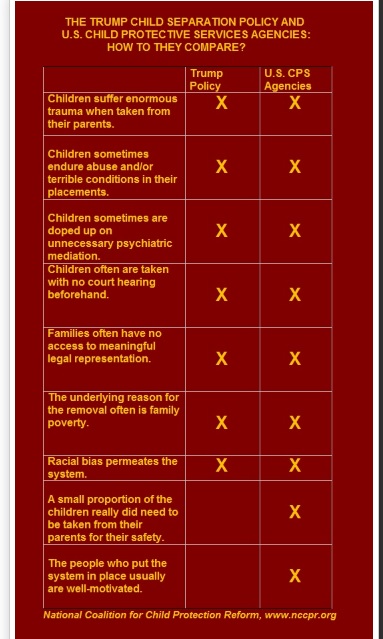
by the children isthe same.While Trump’s family separation policy was
underway, we even prepared this handy chart comparing how the two systems work:
But we wall
ourselves off from that anguish in two ways: First by convincing ourselves it’s
somehow different if the people taking the children mean well. But also by demonizing the parents.
More than 50 years
of what’s been aptly called “health terrorism” persuaded many Americans that while the
parents at the border are innocent victims, the parents who lose their children
to CPS agencies all must be beating and torturing their children.A very few of them are.But most have far more in common with
impoverished refugees than with those depicted in the horror stories that fuel
health terrorism.The Atlantic
itself contributed to the demonization of families caught up in the traditional
American family policing system in a 2018 story (to which I will not link).
That’s why the same
scenes that prompt us to draw back in horror when they play out at the Mexican
border make too many of us cheer when they happen in our own backyards.The family police revel in their middle-class
rescue fantasies and celebrate – yes, celebrate – when these overwhelmingly poor
disproportionately nonwhite families are torn apart forever.
But the children
taken by the family police are shedding the same sorts of tears as those taken
by the Border Patrol – for the same reasons.
Dickerson’s story
also reveals how little those who don’t encounter family policing every day
know about how it really works.
At one point,
Dickerson cites one of the few people who comes off well in her story, a U.S.
Attorney who tried to reunite the families:
He was outraged.
In no place in the American criminal-justice system, he reportedly testified,
would it be considered either ethically or legally permissible to keep children
from their parents for punitive purposes after their legal process is
completed. “We wouldn’t do that to a murderer,” much less a parent facing
misdemeanor charges …
Wanna bet?
Technically, he’s
partly right.But only because family
policing is part of the civil, not criminal legal system.
Is it not “keeping
children from their parents for punitive purposes” if children are held in
foster care even after their parents jump through every hoop the family police
agency imposes on them, just because they can’t afford to pay the ransom the agency has imposed?(Agencies don’t use that term, of course, they call it “child support”
to reimburse them for the cost of “caring” for the children.)Since it doesn’t help the children and it
doesn’t even help the agency – collection efforts cost more than what’s
collected – how is this anything but punishment?
And don’t forget
all the victims of the “war on drugs” who were released from jail sentences
they often never should have had to serve, only to find their children gone –
forever – because under the odious Adoption and Safe Families Act, CPS agencies can seek termination of
parental rights for no other reason than the passage of a specified amount of
time. (This also applies to families detained and/or deported by immigration authorities.)
For more examples of just how much the American family policing system can get away with, see NCCPR's Due Process Agenda.
Similarly, in
exposing the horror of the huge institutions in which children taken at the
border were warehoused, the story states that:
Large-scale
institutions had long since been eliminated from the domestic child-welfare
system because they were found to be traumatizing and unsafe.
The worst way to
respond to the Atlantic story would be to say: At least an outraged public ultimately
was able to put a stop to it.Because
the needless separation of families has never stopped.It began long before Donald Trump – in fact, its roots are in slavery – and it continues to this day. So as you read Caitlin Dickerson’s brilliant
reporting, keep in mind the reminder from Joyce McMillan of JMac
For Families that’s at the
top of this post: They separate children at the border of Harlem, too.
The city can make smarter choices that will reduce the
number of kids placed in foster care, which will reduce strain on the system —
and save kids from having to sleep in conference rooms.
We’ve all heard the adage that goes: “The definition of
insanity is doing the same thing over and over and expecting a different
result.” A classic example of that adage is Philadelphia’s approach to the
welfare of its children.
In 2016, Philadelphia closed its only juvenile psychiatric
residential treatment facility — Wordsworth — after a 17-year-old died in a
fight with staff. The city opened another in 2020, but that facility soon lost
its license due to “multiple child right violations,” according to the state.
Now, the city is asking providers to bid for a contract to create another
facility.
So, the plan is to build an institution to replace the
abusive institution that replaced another abusive institution. Meanwhile,
because Philadelphia still is taking too many children from their homes, there
are not enough foster homes, so the children are held in conference rooms.
Once touted as a model institution, the Glen Mills School was closed after the Philadelphia Inquirer exposed widespread abuse.
The Philadelphia
Inquirer zeros in on real solutions
Here’s something I
never thought I’d see in a story about children trapped in night-to-night
placements because family policing agencies (a more accurate term than “child
welfare” agencies) had no place else to put them:
Advocates say
what’s needed now is to address the short-term glitches while pursuing the
long-term vision of supporting more families at home — not backsliding into the era when congregate beds
were ample and eagerly filled by a system that saw removing and
institutionalizing kids as an easy fix.
For as long as I’ve
been following family policing – and that’s more than 45 years now - I’ve been
reading stories exposing the horrors inflicted on children forced to endure days,
sometimes months in makeshift placements such as family policing agency
offices, hotels, hospital wards, jails – even parked cars.
As I recall, every one
of those stories got the solutions wrong.Oh, there might be a token paragraph somewhere about how “prevention” is
a really good thing.But that part about
“not backsliding into the era when congregate beds were ample and eagerly
filled by a system that saw removing and institutionalizing kids as an easy fix”?Never!
Instead, the
reporters would accept as gospel the party line from the “residential treatment”
industry. It’s always some version of: “See, we need to build more places to
institutionalize kids!” Or, “See? We told you you shouldn’t have shut down our hellholes
sorry, therapeutic communities!”
It would have been
easy for The Philadelphia Inquirer to fall into the same trap.After all, Philadelphia has made significant
progress in reducing the number of children torn from their families.But Philadelphia now has a serious problem
with children staying night-to-night in family police agency conference rooms,
among other awful places. Workers sum up
the conditions there as “chaos.” And
Philadelphia either shut down or pulled kids out of several institutions in
recent years – because the institutions themselves were so abusive.
But perhaps because
colleagues of reporter Samantha Melamed exposed horrific abuse in some of those
institutions, such as Glen Mills (which is now
closed) and Devereux, she wasn’t
ready to accept the idea that the answer is to reopen them, or build new ones.
Yes, the story
includes the usual claim from a residential treatment trade association
representative, whining that, now that the city has “reduced capacity” (by
refusing to warehouse all those children in hellholes) it’s “destabilized the
industry” making it hard to find placements for children with “really complex
or sophisticated behavioral health needs.”
But instead of
simply accepting this claim at face value, Melamed broadened her source
base.For starters, she explained
Philadelphia’s longstanding dismal status as a child removal outlier:
Now, the city is
part of a national and statewide push to stop institutionalizing kids, spurred
on by the federal Family First Prevention Services Act. That shift comes amid a
widespread recognition that abuses happen in those institutional settings, too
— and with startling frequency. It’s also an acknowledgment of racial
disparities: Black children account for 13% of Pennsylvania youth, but 35% of
those in foster care and two-thirds of those in state juvenile-justice
placements …
In the
child-welfare system, Community Legal Services of Philadelphia’s Kathleen
Creamer said the city needs to double down on preventing family separations.
Already, she
noted, Philadelphia DHS has reformed its process for screening and
investigating abuse allegations, and increased funding for legal aid for
families. It also begun holding rapid-response meetings to enlist extended
families to help kids in danger of being removed. She said that work now needs
to go even further, reallocating some of the millions that would be spent on
group homes or foster care to properly fund the supportive services that can
help families working to stay together.
“The question
is, what’s the policy solution for this?” she said. “The policy solution is to
stop separating so many families. We don’t have good placements for them, so
let’s actually try to work with the family.”
The residential
treatment typically responds by saying something like: Even if you have enough
families, what about all those children with “really complex or sophisticated
behavioral health needs”?
But even when
residential treatment centers are not hellholes, there is no evidence that they
can meet “really complex or sophisticated behavioral needs.”On the contrary, the evidence is overwhelming
that residential treatment is a failure.
In contrast,
Wraparound services, in which anything a child needs is brought right into the
child’s own home, or, when placement is genuinely necessary, a family foster
home, do work.There is nothing
residential treatment does that Wraparound doesn’t do better and at less cost.
How does it work? differently
for every child – that’s the point.So
the best way to understand Wraparound is to let one of its pioneers, Karl
Dennis, give you an example:
But perhaps the
best indication of why building more institutions won’t work comes in this part
of the Inquirer story, the ultimate example of the adage that the
definition of insanity is doing the same thing over and over and expecting a
different result:
Wordsworth,
Philadelphia’s lone juvenile psychiatric residential treatment facility, was
shut down by the state in 2016 after 17-year-old David Hess died in a fight
with staff. A replacement opened in 2020 — then quickly lost its license, too,
due to what the state said were “multiple child right violations.” (The city
last year invited two new providers to negotiate contracts for yet another
replacement, but it’s not clear when such a facility may open.)
What if, at the
same time, Philadelphia built on its progress to date and reduced its rate of
removal to, say, that of New York City?That would be well under half the Philadelphia rate.What if Philadelphia then said to the foster
parents in those now-empty homes: Take in the relatively few children who
really need placement – and we will bring into your home whatever help the
children – and you – need to cope with those “really complex or sophisticated
behavioral health needs” and make the placement work?
Would that mean that
no Philadelphia child ever again would have to spend even one night in an
office or some other awful makeshift placement?Probably not.But it would happen
to a hell of a lot fewer children than endure it now.
Just two items of interest this week, one of which I’d
missed when it was published in May:
● A federal judge refused to dismiss a lawsuit against the
University of Pittsburgh Medical Center, alleging that UPMC drug tests pregnant
women and their newborns without consent, reports the results to the family
policing agency and, even if it’s no more than a false positive result for
marijuana, the agency automatically investigates.
“Averments set form in the amended complaint allege that
[Allegheny County Children Youth and Families] used UPMC as a form of ‘cat’s
paw’ to undertake inquiries and to administer drug tests on UPMC’s labor and
delivery patients without their consent, and then to use reports of those
ostensibly private and confidential medical inquiries and ‘provision and
uncertain’ test results as a predicate to launch unwarranted and
unconstitutional child abuse investigations.”
This case has significant implications well beyond Pittsburgh.And it touches on multiple vital issues in
family policing, including the harm of the so-called Child Abuse Prevention and
Treatment Act and the dangers of “predictive analytics” algorithms in “child
welfare.”I’ve updated
our in-depth examination of the case on this blog.
● On the matter of algorithms, we have a full update of our report on predictive analytics, Big Data is Watching You.
Four major corporate landlords filed thousands of
evictions while federal moratorium orders were still standing, using aggressive
tactics to force out tenants at the height of the pandemic, according to a new
investigation by a House subcommittee. …
An email from an executive at [one major Texas landlord],
for example, advised a property manager and regional manager in San Antonio to
harass a tenant by towing her car, replacing her air conditioning unit with a
nonworking unit, knocking on her door “at least twice a night” and even
calling child protective services on the tenant if any children were present.
(The committee referred its findings to the Texas Department of Family and
Protective Services.) [Emphasis added.]
The referral will do no good, of course, because, though
false reports are illegal in Texas, anyone can evade the law by making the call
anonymously, something that won’t change until anonymous reporting is replaced with confidential
reporting.
● NPR and The Marshall Projecthave
a follow-up to their groundbreaking stories about family policing agencies
swiping foster youth’s Social Security benefits.And Cal
Matters reports on California counties that continue this odious practice.
● Even when it works right, the vastly overhyped Family
First Act won’t do much good.But, as
Mississippi Today reports, that state is managing to screw up what
little opportunity there is.
● In Arizona, KJZZ
Public Radio reports on a lawsuit demanding the standard of proof be raised
before someone is blacklisted in that state’s central registry of alleged child
abusers.
● Last week’s round-up reported on an innovative plan in
some Wisconsin counties designed to help families with the housing they need to
reunify with their children.One
of the counties voted it down.
● NBC
News reports that two senators are launching an investigation of some of
America’s largest residential McTreatment chains.The good news: They’ve included one scandal-plagued
nonprofit chain, Devereux.
That’s important because too often reporters assume that if we could just get
rid of the for-profit players everything would be fine.The bad news: The investigation appears based
on the implicit premise that, with enough regulation, residential treatment can
be fixed.But
it can’t.
● And finally: Pope
Francis set an example for the entire North American family policing
establishment this week by apologizing for one of that establishment’s worst
sins.Every one of the big, mainstream
“child welfare” groups has so much to apologize for, not just in terms of what
was done decades ago, but what they continue to do today.But don’t expect them to follow the Pope’s
example anytime soon.
That’s not what the
recent article in the online publication Parent Map is called, of course. The actual title is “What do Do If You Are Mistakenly
Accused of Child Abuse in a Hospital Emergency Room.” But the authors should have made clear the
advice only applies if the “You” in that headline is a white, middle-class
person.
Between them the co-authors,
a doctor and a lawyer, have five sets of
“look-at-all-my advanced -degrees!” initials after their names. It begins with what happened to one of the
authors, Katheryn Goldman, DMD, MPH,
ABD:
My 9-year-old
daughter was jumping on her bed. She bounced off, and I wound up taking her to
the emergency room. She got two small stitches under her eye. Just a week
later, two of our sons were engaged in some rough horseplay. Oops! Off to the
emergency room I went again. Thankfully, no stitches were needed on the
4-year-old’s head. Both times, we were treated by the same nurse in the same
examining room! I could sense that she looked at me with a tad of justifiable
suspicion. That’s why I made sure that in both instances the children told the
nurse what had happened. I did not want to give the impression that the kids were
being coached in any way.
This article is not
the worst of its kind. One pediatrician / author has practically made a career out of writing
this sort of essay.
But at no point do Dr.
Godman and her lawyer co-author, Daniel Pollack, MSW, JD, so much as
acknowledge that the kid gloves, anyone-can-have-an-oops treatment is reserved
for the white middle class.
Then comes a claim
that, for some hospitals, is demonstrably false. They write:
Simply because a
child gets injured and is treated at an emergency room does not mean that Child
Protection Services (CPS) will become involved. The hospital contacts CPS only
when staff suspect maltreatment.
A Marine Corps pilot and his wife are suing the County of
San Diego after Child Welfare Services took their seven-month-old son from
their home for more than a month after the boy head-butted his mother as he
played after breastfeeding.
According to the story, the hospital apparently didn’t
believe the infant was abused but
submitted a hotline referral to the county as required
when an infant is injured and admitted to the hospital.
California law does not require this - it's simply a
hospital policy that makes every parent who brings in an infant with an injury automatically
suspect.
Similarly, when Children’s Hospital of Philadelphia
reported City Councilmember David Oh as a potential child abuser after one of
his children was injured as he taught the child martial arts, Oh says the
hospital social worker explained that she “typically reports injuries children
suffer in all sports.”
By the way, Councilmember Oh’s child was interviewed
separately and told the social worker what happened – just like Dr. Goldman’s
children. But somehow, the result was
different.
And these are just the hospitals that will say it out
loud.
Remember, no doctor, nurse, or other mandated reporter
will get in trouble for making a report that turns out to be false. They can face huge penalties for failure to
report if, later, it turns out there really was abuse. So even in the absence of a formal policy
that creates a huge incentive to report any injury, especially to the youngest
children.
But not only does the Parent Map article mislead on this
point, at no point does it mention the slew of studies showing that, where a report isn’t automatic, medical
personnel are far more likely to call the family police if the family is not
white.
Now let’s consider some advice the authors offer
concerning lawyers:
Even though things are happening fast in the ER,
depending on the allegations, you may want to have an attorney present with
you during any interviews with a CPS investigator. Under many circumstances — but not all — you
may be inclined to proactively grant CPS access to your child. While you may
have the authority to deny that access in some states, such a denial may cast
you in a negative light. This is a judgment call to quickly consult an
attorney about. [Emphasis added.]
Is it really necessary to point out the problem with this
advice? Poor people generally don’t have
a lawyer on speed dial. And with
extremely rare exceptions, the government isn’t going to provide one,
either. In some states, impoverished
families have no right to a lawyer at all.
In the rest, except for a few pilot programs, they’re only guaranteed a
lawyer after the family police have decided to haul the family into court.
Even then, it’s not the kind of lawyering the authors of
the Parent Map article have in mind.
attorneys who represent parents or children have very high
caseloads, in some jurisdictions, as high as 300 cases per attorney. Parents
and youth consistently reported quick interactions with their attorneys, and many reported not knowing the
name of their attorneys. Parents are routinely told to plead and accept case plans as the quickest
way to get children back home and end system involvement.
Of course there’s nothing wrong with giving advice that
applies only to white middle-class families – provided it comes with a warning
label. The very fact that the authors
saw no need to place such a label on their story, or even acknowledge that
racial and class bias exist in the family policing system, is part of the
reason we have such a system in the first place.