Showing posts sorted by date for query Hornstein. Sort by relevance Show all posts

Sunday, June 21, 2026

How North Carolina’s performative outrage over child abuse deaths is making everything worse


The North Carolina State Capitol, where performances are likely to resume this week

During a legislative hearing about the failures that contributed to the death of Dominique Moody, a six-year-old in North Carolina, State Rep. Allen Chesser said: 

“There’s a pattern here. A child dies and the Department of Health and Human Services investigates, finds a lack of oversight, poor decision-making, and poor management. The local Child Protective Services Office is put on a corrective action plan and the state takes over for a little while, but fundamentally, nothing changes.” 

He’s right. But that’s not the only pattern that follows such tragedies – it’s not even the worst.  The worst pattern is the one he’s a part of, the one playing out right now: Lawmakers pound tables, fulminate, and issue outraged press releases. They demand the ritual sacrifice of the child welfare agency chief, the firing, and maybe criminal prosecution of anyone who came anywhere near the case. And, of course, no such grand performance is complete without exploiting the child’s memory by putting the child’s name on some largely pointless (or worse) law. 

All this makes everything worse – because, almost always, the real cause of tragedies like the death of Dominique Moody is an overloaded system. In Mecklenburg County, where Dominique died, workers are carrying more than double the number of cases they should. That means workers rush from case to case, making terrible errors in all directions – leaving some children in danger even as they take other children needlessly from homes that are safe or could be made safe with the right kinds of help. 

The system is not overloaded because North Carolina is a cesspool of depravity, where suffering like that endured by Dominique is the norm. On the contrary, in 2025, of all the North Carolina children torn from their families and thrown into foster care, 83% did not involve even an allegation of physical or sexual abuse. In 61% of cases, there was not even an allegation of any form of drug abuse. Far more common are cases in which family poverty is confused with “neglect.” Indeed, nearly one-third of entries into North Carolina foster care were due to homelessness or inadequate housing. That’s well over twice as many as were taken for physical and sexual abuse combined. 

That helps explain the mountain of research showing that, in these typical cases, children left in their own homes do better in later life even than comparably-maltreated children placed in foster care. One study found that the intrinsic toxicity of forced family separation is so great that foster youth are more than four times more likely to die by age 20, and the most common cause of death is suicide. All that is before we even reach all the other studies showing high rates of abuse in foster care itself. 

It is these false reports, trivial cases and poverty cases that overload workers, leaving them less time to find the next Dominique Moody before it’s too late. So when lawmakers do little more than shout the equivalent of “off with their heads!” it makes everything worse, and it makes all vulnerable children less safe. 

With the threat of dismissal and even criminal prosecution over their heads, the result almost always is a foster-care panic, a sharp, sudden increase in the number of children thrown into foster care. That only further increases caseloads. 

As for the proposed law with Dominique’s name on it, which already has passed the North Carolina House of Representatives unanimously, it’s going to increase caseloads even more. The bill’s main feature is a so-called “escalation team” which would add an extra level of review – meaning an extra push to remove a child or fail to reunify a family, in a whole slew of circumstances, including a prior placement in foster care or “three or more reports to Child Protective Services in a 12-month period.” This in a state that already reunifies families at one of the lowest rates in the country; less than half the national average. 

So, attention angry ex-spouses, aggrieved neighbors, vengeful landlords or anyone else with a grudge against a North Carolina family: When this bill becomes law, you can make those anonymous reports three times and voila! You’ve vastly escalated the chances of tearing the family apart! You’ve also contributed to vastly increasing caseloads for overloaded workers. 

Children would be far better off if North Carolina created a de-escalation team, to re-examine the case of every foster child and see if they really need to be in foster care and to re-examine typical cases and see if the case is really a poverty case. That would reduce caseloads and give workers time to investigate every case with care. 

It could get worse still if North Carolina buys into a proposal from North Carolina professor (and occasional LinkedIn troll – see below) Emily Putnam-Hornstein to add so-called “predictive risk modeling,” in which an algorithm “advises” caseworkers concerning who to investigate and which children to take away.

Prof. Emily Putnam-Hornstein on LinkedIn. She subsequently deleted her profile there.

Consider what keeps happening when objective evaluators look at the model she co-designed for metropolitan Pittsburgh. 

● Independent evaluators found it was racially biased. 

● So did the ACLU. 

● The Associated Press reports that the Biden Justice Department investigated whether it discriminates against the disabled. (We don't know what happened to this, but we presume the Trump Administration dropped it.)

● A family suing over removal of their children, because of the parents' disabilities, said the caseworker told them their children were being taken because “the machine has labeled you high risk.” 

● In her landmark book, Automating Inequality, Prof. Virginia Eubanks called the algorithm “poverty profiling.” 

● And, in describing another of their proposed algorithms, even Putnam-Hornstein’s co-author said “Yes, it’s big brother…” but she argued we should use it anyway. When you begin a sentence with the words “Yes, it’s big brother…” the only ethical way to end the sentence is: “…so we won’t do it.” 

There is more about the dangers of Putnam-Hornstein’s approach in this NCCPR publication. 

If scapegoating workers won’t work, and a poverty-profiling algorithm won’t work, what will? We list a series of solutions here. But two changes are key: 

● Zero-in on ameliorating the worst effects of poverty. Study after study has shown that even small amounts of concrete help go a long way to reducing abuse and neglect. 

● As the North Carolina Advisory Committee to the U.S. Commission on Civil Rights recommended, provide every family with high-quality interdisciplinary legal representation, an approach proven to safely reduce foster care, not by getting “bad parents” off, but by finding alternatives to the cookie-cutter “service plans” often dished out by child welfare agencies. 

Rep. Chesser says the problem is “the inaction.” That’s one problem. The other problem is action that makes everything worse. Lawmakers should learn what really works, even if it doesn’t make a good press release. 

NCCPR’s written statement to the North Carolina Advisory Committee to the U.S. Commission on Civil Rights was cited more than a dozen times in the Committee’s report. You can read the full statement here.

Tuesday, October 29, 2024

NCCPR in The Imprint: There’s No Silence on Child Deaths, But the Conversation Has Changed

In a recent column, Emily Putnam-Hornstein and Sarah Font claimed that “there remains strong resistance among child welfare scholars, advocates and national leaders to discussing maltreatment fatalities.” 

I have followed these issues for nearly 50 years, first as a reporter and for the past 34 as an advocate. I coordinate one listserv for grassroots family advocacy organizations and another for professionals in the field, and I participate in the discussions of three other advocacy coalitions. We talk about fatalities all the time. It’s just that people like Font and Putnam-Hornstein don’t like what organizations such as mine have to say. So they cherry-pick data to try to make a case for a surveil-and-remove approach that has failed for decades. Sometimes they even contradict themselves. …


Read the full column in The Imprint

Tuesday, October 8, 2024

NCCPR at the Kempe Center Conference: Attn: Family Police: Children's "well-being" is none of your damn business!

 This is the text of the NCCPR’s presentation at the 2024 Kempe Center International Virtual Conference: A Call to Action to Change Child Welfare


What the cover says 

How many times have we heard it or read it? “Safety, permanency, well-being.”  It’s practically the slogan of everyone in the family policing establishment, from the federal government’s Administration for Children and Families to the smallest county family police agency.

We hear family police agencies even claiming they want a “child and family well-being system.” In a truly Orwellian touch, San Diego County California even makes its family police part of its new “Department of Child and Family Well-being.”

            And yet, when it comes to safety, permanency and well-being the family police have managed to screw up all three.

            Family police is a term I will use throughout this presentation, since it’s when it comes to an agency with the power to march into any home in America, search it top to bottom, stripsearch children, walk right out with them and consign them to the chaos of foster care, that is a vastly more accurate term than “child protection” or “child welfare” agency.

            And it’s important to draw a distinction between that one element of government – the family police – and government as a whole.

            I am a lifelong tax-and-spend liberal and proud of it. I’m old enough to have cast my first vote in a presidential election for George McGovern and my last vote in a contested presidential primary – 2020 -- for Elizabeth Warren.  I think government can play a huge, constructive role in promoting the well-being of children.

            But the family police cannot.

            After all, they’ve screwed up stuff that’s a lot easier to define.

Monday, September 2, 2024

Predictive analytics: The Project 2025 of child welfare

“Yes, it’s Big Brother.  But we have to have our eyes open to the potential of this model.”

-- Rhema Vaithianathan, co-designer of child welfare “predictive analytics” algorithms, discussing the idea of assessing children’s risk of abuse – while they’re still in the womb.

The Lincoln Project is a group of disaffected Republicans appalled by what has happened to their party. They’re probably best known for their ads.  One that’s gotten a lot of attention is their vision of what would happen if the near-total ban on abortion envisaged by the Heritage Foundation’s Project 2025 becomes reality.  Among the proposals: a massive increase in “abortion surveillance.” 

In the Lincoln Project ad, a father and daughter are pulled over by a police officer and ultimately arrested, the father for trying to take the daughter across the state line for an abortion, the daughter for “evading motherhood.”  (And just to be clear, some states already are trying to do things like this.) 

Have a look at the ad and then I’ll explain what all this has to do with child welfare: 


Among the striking features of the ad: the creators’ understanding of how the data we routinely surrender every day can be turned into an Orwellian nightmare of omnipresent surveillance.  Fortunately, something like this would only be supported by certain elements on the far right.  Liberals would never stand for it, right? 

But that brings us to the Great Exception of the Left: the fact that some of my fellow liberals (though many fewer than in decades past) will discard everything they claim to believe about civil liberties as soon as somebody whispers the words “child abuse” in their ears.  It’s one reason there is so little due process in what should be called family policing. 

Consider the quote at the start of this post.  It’s from a Boston Globe story in 2015, the early, heady days of the movement to bring Orwellian hyper-surveillance, what amounts to computerized racial profiling, to child welfare in the form of “predictive analytics” algorithms.  

We were told algorithms would indicate who is most likely to abuse a child so the family police agency (a more accurate term than “child welfare” agency) could swoop right in!  Big, centrist media – news organizations such as The New York Times, which now are appalled by Project 2025 -- swooned over it in 2015 and beyond.  (Almost the lone exception: a prescient warning from Prof. Virginia Eubanks in her book, Automating Inequality, excerpted in Wired. Many more, on the left and right, are opposed now.) 

At the time, the focus was on models like the Allegheny Family Screening Tool (AFST), used by  screeners in metropolitan Pittsburgh when they receive reports alleging “neglect.” Without even a pretense of informed consent, AFST harvests vast amounts of data originally surrendered, voluntarily or unknowingly, for entirely different purposes.  Then it coughs up a “risk score” – an invisible “scarlet number” -- to determine the urgency of sending out an investigator.  The questionable means by which it was sold, the questionable claims about how it would work, and the many problems that have arisen are outlined in detail, with sources, in our publication Big Data is Watching You. 

In the years since, some reliably blue states and localities rushed to adopt algorithms. Illinois, Los Angeles and Oregon all later backed away, in the first two cases after spectacular failures.  But blue-leaning metropolitan Pittsburgh presses on, even after an independent evaluation found problems with racial bias and, the Associated Press reports, the U.S. Department of Justice is investigating whether AFST is biased against the disabled. 

But the designers of AFST are proposing ever more dangerous algorithms. Even in 2015 and before, they had bigger plans, plans that sound remarkably like something out of that Lincoln Project ad. 

The Pittsburgh algorithms stamp an invisible "scarlet number
"risk score" on children. Once there, it can never be erased,
That Boston Globe story included a reminder that the co-designer of AFST, and prominent advocate of taking away more children, Emily Putnam-Hornstein had written as far back as 2011 that “prenatal risk assessments could be used to identify children at risk of maltreatment while still in the womb.” (Recall the officer in the video asking the daughter: “What are you, about eight weeks pregnant?”) 

“Prenatal risk assessments” are what Putnam-Hornstein’s co-designer, Vaithianathan, was talking about when she said: “Yes, it’s Big Brother.  But we have to have our eyes open to the potential of this model.” 

Yes, we do, but not in the way Vaithianathan has in mind. 

Pittsburgh has moved ahead with a model, called “Hello, Baby,” that stamps that invisible scarlet number risk score on every child, if not quite in the womb then immediately upon birth. Proponents say it’s only to target prevention, not policing.  That is the case – for now. But, just as  Vaithianathan says, and as is discussed in detail below, “We have to have our eyes open to the potential of this model.” 

Technically “Hello, Baby” is voluntary, but good luck taking advantage of the extremely limited opportunity to opt out – right in those first days after your child is born when, after all, it’s not like you have anything else to think about.  (Ever notice how often, when a corporation forces you to opt out of something it’s because they know you won’t want to opt in.) 

Once infants are branded with those scarlet numbers, they can never be erased.  If they’re labeled as being at high-risk of abuse as infants, it increases the chances that their own children will be labeled at high risk of abuse. If ever these “high-risk” children, as adults, are accused of child abuse, the “Hello, Baby” risk score could raise his AFST score, making it that much more likely their own children could be torn from their arms. (Again, authorities in Pittsburgh say they’ll never, ever do such a thing – but, as Vaithianathan says …) 

Among those most at risk: anyone who actually has been in foster care – since, no matter what the algorithm, having once been in foster care is likely to increase the “risk score” as a potentially abusive parent. 

But even this isn’t enough for Putnan-Hornstein and Vaithianathan. They’re pushing still another algorithm, the  Cross Jurisdiction Model Replication project.  

Like “Hello, Baby,” CJMR generates a risk score for every child at birth. Unlike “Hello, Baby” there is no opt-out at all.  And while with AFST the developers bragged about not explicitly using race (while using poverty), and with “Hello Baby” they claimed (falsely) that they weren’t using poverty, this time there’s no more let’s pretend.  The use of race and poverty as risk factors is out in the open. 

But fear not, say Putnam-Hornstein and Vaithianathan, as noted above, unlike AFST these algorithms are only to target prevention. The places that adopt them would never, ever use them as a tool to investigate families.  They promise!  

Right.  After all, to think these data would be abused is like imagining that a big company like Facebook would sell data without consent.  Oh, yeah, that.  Well, OK, but that’s private industry.  Let’s try again: 

The notion that all that “Hello, Baby” and CJMR data would be misused is like imagining a police force would misuse juvenile records that are supposed to be sealed.  Oh, yeah – that. 

And when a child “known to the system” dies and demagogic politicians condemn the family police agency for not using all that data, you can be sure that agency will stand firm and never, ever change its policy and use algorithms like “Hello, Baby” for investigations! 

The people who want us to believe that are the same people who repeatedly used questionable claims to sell their algorithms in the first place.  And that’s not the only problem. 

The co-designer of the Pittsburgh algorithms and the CJMR project, algorithms that supposedly have no racial bias problem, Putnam-Hornstein, denies the field has a racism problem in the first place. She demeans Black activists and takes pride in being part of a group that defends a self-described "race realist" law professor who hangs out with Tucker Carlson. She has said "I think it is possible we don’t place enough children in foster care or early enough" and signed onto an extremist agenda that proposes requiring anyone reapplying for public benefits, and not otherwise seen by "mandatory reporters," to produce their children for a child abuse inspection.  

She’d even taken to spewing weird personal attacks like this one against her betters on LinkedIn(!) – before deleting and replacing her profile.  (LinkedIn has rules about this, by the way.)


Would you trust an enormously powerful algorithm in these hands?  In fact, it’s too powerful for anyone’s hands. 

To see why, take another look at that Lincoln Project video.  But instead of a police officer pulling over a car, imagine a caseworker at the door of a newborn and her family: “The algorithm says you’re high risk,” she says to the mother.  “So we’re taking your baby.” 

Here’s the moral of the story: When you begin a sentence with “Yes, it’s Big Brother …” the only ethical way to end that sentence is: “… so we’re not going to use it.”

Wednesday, December 27, 2023

NCCPR family preservation news and commentary round-up for the year 2023, Part Two

For part one, which illustrates how the horror stories go in all directions, click here.

OVERVIEWS OF FAMILY POLICING FAILURE

● To begin, take a step back, see – and hear – how the family policing system really works in this report from NPR, featuring perspectives from JMAC for Families and NCCPR: 

IF YOU DON'T SEE MORE, CLICK THE LINK BELOW TO READ THE FULL POST:

Sunday, December 3, 2023

“The machine has labeled you as high-risk”

Is Pittsburgh’s “child welfare” predictive analytics algorithm running amok? Inquiring minds (at the US Dept. of Justice) want to know! 

The Allegheny Family Screening Tool slaps an invisible scarlet number "risk score"
on every child whose parents or other caretakers have been accused of neglect.

(For a comprehensive examination of the dangers of this kind of computerized racial profiling, see our publication Big Data Is Watching You.)

 The most highly touted, most far-reaching example of computerized racial profiling in family policing (more accurate terms than “predictive analytics” in “child welfare”) is the one in Pittsburgh.  Called the Allegheny Family Screening Tool (AFST) it slaps an invisible scarlet number “risk score” between 1 and 20 on any child who is the subject of a hotline call alleging neglect.*

 In response to allegations of bias, the designers and supporters of AFST offer three defenses:  1. The algorithm is used only at the screening stage, to decide which allegations are most in need of investigation.  2. The investigators can’t be biased by this because they don’t even know the risk score.  3. The algorithm doesn’t tell investigators when to tear children from the arms of their families and consign them to foster care; that’s left to humans. 

We’ve always known that the claim about workers not knowing the risk score was b.s.  They may not know the precise risk number but if they’re told to rush out and investigate a particular family, they know the predictive analytics algorithm, known as the Allegheny Family Screening Tool (AFST), has labeled the family “high risk.”  So of course that’s going to bias the investigator.

But now we know about a case in Pittsburgh that is calling into question all the claims about AFST’s supposed lack of bias, and about who -- or what -- makes the decisions.  And the U.S. Department of Justice is doing some of the questioning.  These revelations come in a story from the American Bar Association’s ABA Journal.  That story builds on outstanding reporting by the Associated Press. 

Both stories center on Andrew and Lauren Hackney, who followed their doctor’s advice and took their infant to the ER when the baby wasn’t eating enough.  They believe the hospital called the Allegheny County family police agency, which immediately took away the child.  

Here’s where we find out who’s really calling the shots, the humans or the algorithm.   According to the Hackneys’ lawyer 

when the Hackneys asked their caseworker what they could do to get their daughter back, “the caseworker said, ‘I’m sorry. Your case is high-risk. The machine has labeled you as high-risk.’” [Emphasis added.] 

That was the first the Hackneys knew about AFST.  

As for why the machine labeled them high-risk – nobody knows.  Allegheny County brags that the data elements in AFST are public, but they don’t say how much weight they give to each factor or even if it counts for or against a family.  And they don’t say what led to the risk score in a given case. 

The Hackneys and their lawyer suspect that the algorithm, and the humans who may be slavishly following it, discriminated against them because of disabilities.  As the ABA Journal story explains: 

Lauren Hackney has attention-deficit/hyperactivity disorder that can cause memory loss, and Andrew Hackney has some resultant damage from a stroke. 

That’s why the Justice Department is involved. In this case, and at least two others, they are investigating whether, in Pittsburgh, humans and machines alike violated the federal Americans with Disabilities Act. 

The ABA Journal article quotes two experts on disability law and family policing, Prof. Robyn Powell of the University of Oklahoma School of Law and Prof. Sarah Lorr, co-director of the Disability and Civil Rights Clinic at Brooklyn Law School.  They say that 

Not only are some of the criteria [used in the AFST algorithm] explicitly disallowed … pointing to disability-related factors, but long-standing racial biases also are implicitly included. 

“The ADA explicitly says that state and local government entities cannot discriminate based on disability, and within that requirement is the idea that you cannot use screening tools or eligibility criteria that would [point to] people with disabilities,” Powell says. 

And in Colorado, where at least one county is using a similar algorithm, family defender Sarah Morris says 

“All this does is launder human biases through the mirage of some kind of transparent nonbiased machine calculation.” 

Notwithstanding the specific comments allegedly made by the caseworker in the Hackney case, a co-designer of AFST, Emily Putnam-Hornstein still claims that the risk score is just one of many tools and it’s “advisory only.” 

But even if that’s true, should we trust the “advice” of an algorithm designed by someone who denies the field has a racism problem, demeans Black activists, and takes pride in being part of a group that defends a self-described "race realist" law professor who hangs out with Tucker Carlson. 

She has said: "I think it is possible we don’t place enough children in foster care or early enough" and signed onto an extremist agenda that proposes requiring anyone reapplying for public benefits, and not otherwise seen by "mandatory reporters," to produce their children for a child abuse inspection.  And she helped design another algorithm that explicitly uses race as a risk factor.  (Designers of that one say it’s only supposed to be used to target “prevention.”) 

It's been almost two years since the machine said the Hackneys’ infant was “high risk.” She’s still in foster care.

*-In Pennsylvania, the state runs the child abuse hotline but counties do everything else.  Counties are allowed to screen most “neglect” allegations but not allegations of abuse or “severe neglect.”

Thursday, October 5, 2023

Analysis of Drake et al. “Racial/Ethnic Differences in Child Protective Services Reporting, Substantiation and Placement, With Comparison to Non-CPS Risks and Outcomes: 2005–2019”

This post will be a little more dense and assume more prior knowledge on the part of readers than most.  That’s because it’s meant specifically for those who have read a study concocted by a who’s who of family policing’s “caucus of denial” – those who claim that, somehow, child welfare is magically immune from the racism that infects every other aspect of American life. 

I’ve taken to calling this caucus the Scooby Gang, because of this slide that Prof. Deadric Williams uses in his lectures to characterize “scholars” like them. 

One of the members of the Scooby Gang, Brett Drake, has been on something of a grand tour touting their latest study.  This post is here now because, at this moment, he is scheduled to try to sell his claims at the Kempe Center’s virtual international conference.  And he’ll be taking the act to the University of Pennsylvania later this month. 

This analysis gives Drake et al. every benefit of the doubt, despite reason to question the underlying data used in the study – something I will discuss later.  But let’s assume, for the moment, the raw data are correct. 

The heart of their argument is this: Disparities in the rate of family police involvement (a more accurate term than “child welfare” involvement) are no greater, and slightly lower, for Black families than disparities in other aspects of American life over which the family police claim to have no control,* such as poverty, low education, infant mortality, very low birthweight, etc. Therefore “child welfare” isn’t racist. 

To which the only logical response is: Huh??? 

It’s not even clear what they’re getting at.  At first, it seems like just a regurgitation of the usual: “It’s not race, it’s poverty!” trope that family police apologists have been using ever since racism in family policing finally started to get the public attention it deserves.  (Before that, the family policing establishment denied they ever took children because of poverty.) 

But if that’s their argument, and they are saying disproportionate substantiation of allegations against Black families and removal of Black children is valid because they also are disproportionately more likely to be poor, have less access to quality healthcare and education, etc., then what they are saying is: poverty equals neglect and we should take away people’s children because of it.  

That’s bad enough, but it ignores all the studies showing racial bias over and above the class bias. 

It also dances around the fact that racism has something to do with all those other factors.  And it’s quite a dance. 

Here’s what they write: 

Some may argue that because all harm indicators included here (e.g., infant mortality, very low birthweight) are influenced by racism, they are not objective and cannot be used as benchmarks. Our argument is different; we argue that these indicators are external to CPS and thus, cannot be caused by racially biased CPS decision-making. Thus, if mandatory reporters or CPS caseworkers systematically targeted Black children with overreporting or overintervention, disparities in CPS contact should be observably larger than disparities in external indicators of risk and harm (regardless of the ultimate cause of those disparities). 

On the contrary.  This shows only that, as the authors admit, all those other factors are “influenced by racism” and so is CPS decision-making!  If society as a whole is racist, why wouldn’t there be disparities across the board?  

A high bar for determining racial bias 

The 15 authors also set up a straw man by saying their study disproves the idea that “if mandatory reporters or CPS caseworkers systematically targeted Black children…”  That suggests a very high bar for judging behavior as racist:  By this standard, anything less than a caseworker changing into a white sheet and hood to go burn a cross after work isn’t racism.  As even this overwhelmingly white group of authors should know, that’s not how racism works. 

In light of this it’s worth circling back to a complaint the authors have about a study co-authored by abolitionist scholar Prof. Alan Dettlaff. They write: 

Only when [the authors] added a caseworker risk assessment score to the model did the coefficient for Black race become larger and statistically significant. 

But, uh, that’s the whole point.  Caseworker decisions are biased.  So, the Scooby Gang’s complaint about Prof. Dettlaff’s study is that only when they checked to see if caseworkers were biased did they find that caseworkers were biased! 

The authors do a lot of chest-thumping about how the legacy of racism is a really bad thing and “racial inequity is real and pervasive in our society and must be addressed far more aggressively” [emphasis added].  Both claims imply that racism itself is a thing of the past, however.  And, they emphasize, family police agencies really can’t be expected to do anything about all these other bigger problems.  They also say this: 

To assert that these patterns, and the poverty and chronic stress they perpetuate, would have no impact on behavioral and psychosocial functioning among the individuals and families in those neighborhoods is to reject decades of scientific consensus on human development.

In other words, past racism led to conditions that make Black people bad parents, and since the family police can’t be expected to fix any of that, we just have to go on taking away Black children. 

Of course, there’s another possible conclusion: If you admit that a “legacy” of racism causes poverty that in turn causes stress that in turn causes some parents to lash out, and you admit that the solution is to deal with poverty, and you admit that family police can’t deal with the actual problem – which, again, you now admit is poverty – isn’t that a case for, um, abolition? 

At a minimum, it might be worth asking members of the Scooby Gang what exactly they have done to make sure racial inequity is addressed “far more aggressively.”  How many members of Congress have they met with about this?  What legislation have they proposed?  Have they taken part in any protest marches lately – or at least since 1963? Have they at least written to their legislators?  If this is the centerpiece of the problem, shouldn’t it be the centerpiece of their work? 

The track record of several of the authors isn’t exactly reassuring.  Two of them, Sarah Font and Emily Putnam-Hornstein, are part of a group that did indeed send a letter – a letter rushing to the defense of a self-proclaimed “race realist” law professor who pals around with Tucker Carlson.  Putnam-Hornstein’s Twitter feed has become the child welfare equivalent of Fox News and her prized predictive analytics algorithm is reportedly under investigation by the U.S. Department of Justice for bias against the disabled.  Font co-authored a paper that labels every accused a “perpetrator” – even after they’ve been found innocent, and she’s condemned the Indian Child Welfare Act.  Another co-author, Richard Barth, is following in Putnam-Hornstein’s footsteps, while turning the whole concept of “evidence-based” on its head. 

B.S. in, B.S. out 

Drake et al.’s second claim is that once reported and screened in for investigation, workers are no more likely, and possibly a little less likely, to “substantiate” an allegation and place a child in foster care when the family is Black than when the family is white.  I question whether this is reliable based on all the potential flaws in the database they use, something I’ll discuss below. 

But if, in fact, that’s true there is a more likely explanation: 

We have seen that mandatory reporters are far more likely to assume a child is “at risk” of “abuse” or “neglect” if the child is Black.  Hotline screeners, who may well be able to infer race from things like street address and other information from a caller, are likely to do the same.  So if they are reporting and screening in a vastly larger proportion of bullshit reports on Black families than on white families, it makes sense that at later stages of the process, even biased caseworkers might not substantiate the same proportion of reports on Black children or remove the same proportion of Black children. 

Here’s a hypothetical example: 

For every 100 screened-in reports about Black families, 90 are bullshit.  Twenty are “substantiated” – ten because they’re real, ten because the workers are biased. 

For every 100 screened-in reports about white families “only” 80 are bullshit – because the threshold for calling in a report on a white family is higher.  So 20 are substantiated, all of them real.

The substantiation rate is the same, but that doesn’t mean there’s no bias. 

The limits of NCANDS 

Finally, a note about the database the Scooby Gang used for this study. 

They use a database known as NCANDS for National Child Abuse and Neglect Data System.  This is a voluntary database, and I am aware of no checks on what individual states report and how they report it.  NCANDS is the only national source for data on reports and substantiation.  

But for foster care entries, there is another, less unreliable database, known as AFCARS, Adoption and Foster Care Analysis and Reporting System.  Providing information to that database is mandatory, and there are specific definitions states are supposed to follow. 

In 2021, NCANDS reported 156,576 entries into foster care.  But AFCARS reported 206,812.  The fact that these figures are so different should be at least a huge yellow flag when it comes to drawing sweeping conclusions based on NCANDS data.  Studies of single states, if the states are known for maintaining relatively reliable or at least consistent data, might be more valid than this deeply flawed attempt at a national comparison.  

*-In fact, family policing often makes these outcomes worse, so in that sense family police agencies do have control over them.

Wednesday, October 4, 2023

It’s Not “Just Poverty” – It’s UNjust Poverty


This morning, I gave a presentation with the above title
At the Kempe Center International Virtual Conference:
A Call to Action to Change Child Welfare
Here is the text of that presentation


Have you heard? Poverty is confused with neglect!

            At long last, almost 50 years after scholars like David Gil and Leroy Pelton pointed it out people are getting the message.  People are starting to realize that the two biggest problems in what the child welfare establishment likes to call “child welfare” but should be called family policing are the confusion of poverty with neglect and the racism that permeates the system.

            Fortunately, having finally realized this, the child welfare establishment has apologized for the enormous harm they have inflicted on generations of impoverished children through hyper surveillance of their families, needlessly consigning millions to the chaos of foster care, and so overloading the system it’s that much harder to find the few children in real danger.

            Nah, just kidding.  The family policing establishment has spent huge amounts of time and energy that could have been devoted to say, easing poverty, and devoted it to churning out excuses for their failure and claims that amount to: well, o.k., maybe it’s poverty, but it’s not just poverty.

            In this presentation, I will examine the claims that it’s not just poverty, and discuss why usually those claims are wrong and, even when they’re right, they’re irrelevant.


Wednesday, September 27, 2023

Child welfare’s “Scooby Gang” is getting desperate

This is a picture from the Twitter feed of Prof. Deadric Williams, during one of his lectures at the University of Tennessee.  As he explains “This is a slide I use to describe scholars looking for variables to account for the ‘racial gap’ in a given outcome.” 


In “child welfare,” or as it should be called, family policing, the Scooby Gang is getting desperate.  As the work of genuine scholars, such as Prof. Dorothy Roberts undermines the foundations of the family policing surveillance state, the Scooby Gang falls back on all it has left: misrepresenting what their betters have to say, and invoking horror stories. 

In a previous post, I documented the desperate efforts of a charter member of the Scooby Gang, former University of Maryland School of Social Work Dean Richard Barth, to use his increasingly shrill Twitter feed to stand the whole concept of “evidence-based” on its head.  

Now, he’s sunk even lower – to the level of Emily Putnam-Hornstein, the foremost evangelist for using “predictive analytics,” or, as it should be called, computerized racial profiling, in family policing.  She has turned her Twitter feed into the “child welfare” equivalent of Fox News -  devoting it almost exclusively to horror stories about child abuse deaths.  (You can read all about her and her track record here.)  

Putnam Hornstein claims she’s “sharing abuse and neglect deaths since advocates ignore.” That is demonstrably false.  We “advocates” pay constant attention to child abuse fatalities.  To cite just one example, two NCCPR Issue Papers are devoted almost exclusively to the topic, and you’ll find it discussed in scores of posts to this blog.  It’s just that we say things with which Putnam-Hornstein disagrees. 

Things like this:

There is irony in Putnam-Hornstein’s Foxified approach, since the rate of child abuse fatalities has remained the same for decades, even as the family police surveillance state has reached such gargantuan proportions that more than half of all Black families will be investigated.  So every Putnam-Hornstein tweet is, in effect, a refutation of the approach she and the rest of the Scooby Gang have championed. 

But exploiting horror stories while falsely claiming others ignore them is a great excuse to distort the entire debate while trying to maintain a veneer of “scholarship.” 

And now, Barth has joined in: 


 Retweeting Putnam-Hornstein, he cites a horror-story case and says it “doesn’t fit the abolitionist, neglect deniers argument that “neglect is really just poverty” that has been trumped up by [child welfare services] authorities. 

I know of nobody who has ever made the argument that all neglect is just poverty.  We’ve absolutely said that the confusion of poverty with neglect is rampant – because it is -- but we’ve never denied the existence of those very rare horror stories. (In contrast, Barth has denied that there is any racial bias in family policing.)  If you still don’t understand this, Prof. Barth, be sure to attend my virtual presentation on this very topic at the next Kempe Center International Conference (Oct. 4 at 9:30 a.m. e.t.) [UPDATE: ICYMI, Prof. Barth, the text is here.]

Or did I miss it somewhere?  If so, Prof. Barth, please provide a link, or at least a citation, to where anyone with whom you disagree has said that all neglect is “just poverty.”  

Of course, Barth and Putnam-Hornstein aren’t the only ones who link to horror stories.  We do it, too, concerning abuse in foster homes and institutions.  But there’s one key difference.  Six years ago, I offered a deal:  As long as people like the Scooby Gang keep invoking horror stories, the rest of us have to remind people that the horrors go in all directions. But, I wrote, while I will not unilaterally disarm, I am prepared to accept a mutual moratorium on the use of horror stories to “prove” anything. 

Instead, the Scooby Gang has doubled down – because horror stories are all they’ve got.  

At a minimum, the descent into fearmongering argues for excluding Barth and Putnam-Hornstein from any serious scholarly discourse on family policing. 

And actually using a so-called “predictive analytics” algorithm designed by anyone who behaves this way should be unthinkable.

Wednesday, May 31, 2023

NCCPR news and commentary round-up, week ending May 30, 2023

--Colorado makes it incredibly difficult for impoverished parents to get their children back – and incredibly easy for foster parents with enough money to keep any child they damn well please.  That’s the upshot of this investigation from 9News in Denver.  Foster parents have carte blanche to intervene in a case – and play the bonding card – if they have a child in their “care” for just three months.  And if they do, the odds are nearly four in five that the child is never going home. 

--“What’s really frightening is that it happens a lot. What was unique was our ability to hire an attorney,” said Joshua Sabey about why he and his wife were able to get their children back after they were falsely accused of child abuse.  They told the Associated Press that's why they're suing in an attempt to force more accountability for all families forced to confront the family police.  And AP made a point of looking not only at what happened to this white, middle-class family but also at the experiences of families who are neither, with comment from Joyce McMillan and Prof. Dorothy Roberts. 

--In Los Angeles, the family policing agency – which takes away children at one of the highest rates among big cities – is known as the Department of Children and Family Services.  But, as the Stop LAPD Spying Coalition explains in a new report, DCFS Stands for Dividing and Conquering Families. 

Particularly interesting is the section on the bias built into the two methods DCFS uses to assess “risk,” Structured Decision Making and, in some offices, a predictive analytics algorithm co-developed by Emily Putnam-Hornstein.  She also co-developed the Pittsburgh algorithm that is now reportedly under investigation for bias by the U.S. Department of Justice. 

But if there’s one thing Putnam-Hornstein and her colleagues really are good at, it’s p.r. So while the algorithm used to label some families “complex risk cases” now the families are labeled as in need of “enhanced support.” 

--Want to see a classic example of “health terrorism”? Check out the fear and smear campaign a Texas group is waging against some good legislation in that state, a bill to replace anonymous reporting of suspected child abuse and neglect with confidential reporting, and how two news organizations got suckered.  I have a blog post about it. 

--The Imprint reports that the Texas Legislature passed another excellent bill - it would provide the equivalent of Miranda rights for families facing the family police. It also would put some limits on "hidden foster care" in a state which may abuse this practice at the worst rate in America.  

--That puts Texas ahead of New York, where The New York Post reports on the fight for similar legislation.

--A 12-year-old Native Alaskan girl in foster care says she wants to commit suicide.  What could be better for a child like that than to ditch her in a hospital for a week, all alone, without telling her family, or anyone else, where she is?  As the Anchorage Daily News reports that is exactly what Alaska’s family police agency did.  That’s not unusual. But this time a judge was so outraged that he refused to let the agency hide its incompetence behind confidentiality. 

But the judge got one thing wrong: He blamed a lack of staff at the family police.  But there are more than enough family police in Alaska – or there would be if they would stop tearing apart families at one of the highest rates in the nation.  Alaska also is a state in which nearly three-quarters of Native families will be investigated by the family police. 

--Every few years Child Trends takes on the Herculean task of trying to figure out exactly how much every state spends on “child welfare,” where that money comes from and what it’s spent on.  Because it’s so arduous, it takes awhile. So the latest report, just released, covers 2020.  But spending doesn’t change much year to year, so, like its predecessors, this report is likely to be a useful snapshot.  NCCPR will be using it in the next few weeks to update our Rate-of-Spending index.

Monday, April 3, 2023

From the people who brought you AFST: The most dangerous "child welfare" algorithm yet


 ● It aims to stamp a scarlet number risk score on EVERY child at birth.

● There is no opportunity for any family to opt-out or deny the use of their personal data.

● It’s literally computerized racial profiling: race and ethnicity are explicitly used to rate the risk that a child will be harmed.

● Developers say: Don’t worry, the data will be anonymized – but the promise is unenforceable.

First there was the Allegheny Family Screening Tool (AFST), an algorithm that uses a mass of data, mostly about poor people and disproportionately about nonwhite people, to cough up what amounts to a “scarlet number” risk score.  When the county’s child abuse hotline receives a report alleging neglect, the score is used to guide screeners in deciding which children will have to endure the trauma of an investigation. 

Key features of its implementation include: 

● Ethically challenged ethics reviews.

● No informed consent – or any consent - for the use of the data as a policing tool.

● Deceptive marketing.

● Evaluations almost always done by the developers or commissioned by Allegheny County.

 When, finally, independent researchers got to evaluate it they found racial bias.  That same algorithm now is reportedly under investigation by the U.S. Department of Justice for possible discrimination against disabled families. An Associated Press story and an analysis by the American Civil Liberties Union make clear just how much havoc the Pittsburgh algorithm can cause.  

Hello, Baby 

None of that stopped the county from moving ahead with the even more dangerous “Hello, Baby” algorithm.  This algorithm stamps the scarlet number on every child at birth, regardless of whether the parents have been accused of anything – unless the family, in the days immediately after birth, takes advantage of one obscure chance to opt out.  One of the ethics reviews of AFST said it was OK in part because it was not applied to every child at birth.  When they created, Hello, Baby, an algorithm that does just that, the county got around this by commissioning a friendlier ethics review.  It’s no wonder the county resorted to an even more deceptive marketing campaign to sell it. 

The county promises that Hello, Baby will be used only to target “preventive services.”  Even if they keep this unenforceable promise, the services are likely to be delivered by mandated reporters of child abuse and neglect, who go in knowing an algorithm has labeled the family high-risk. 

CJMR 

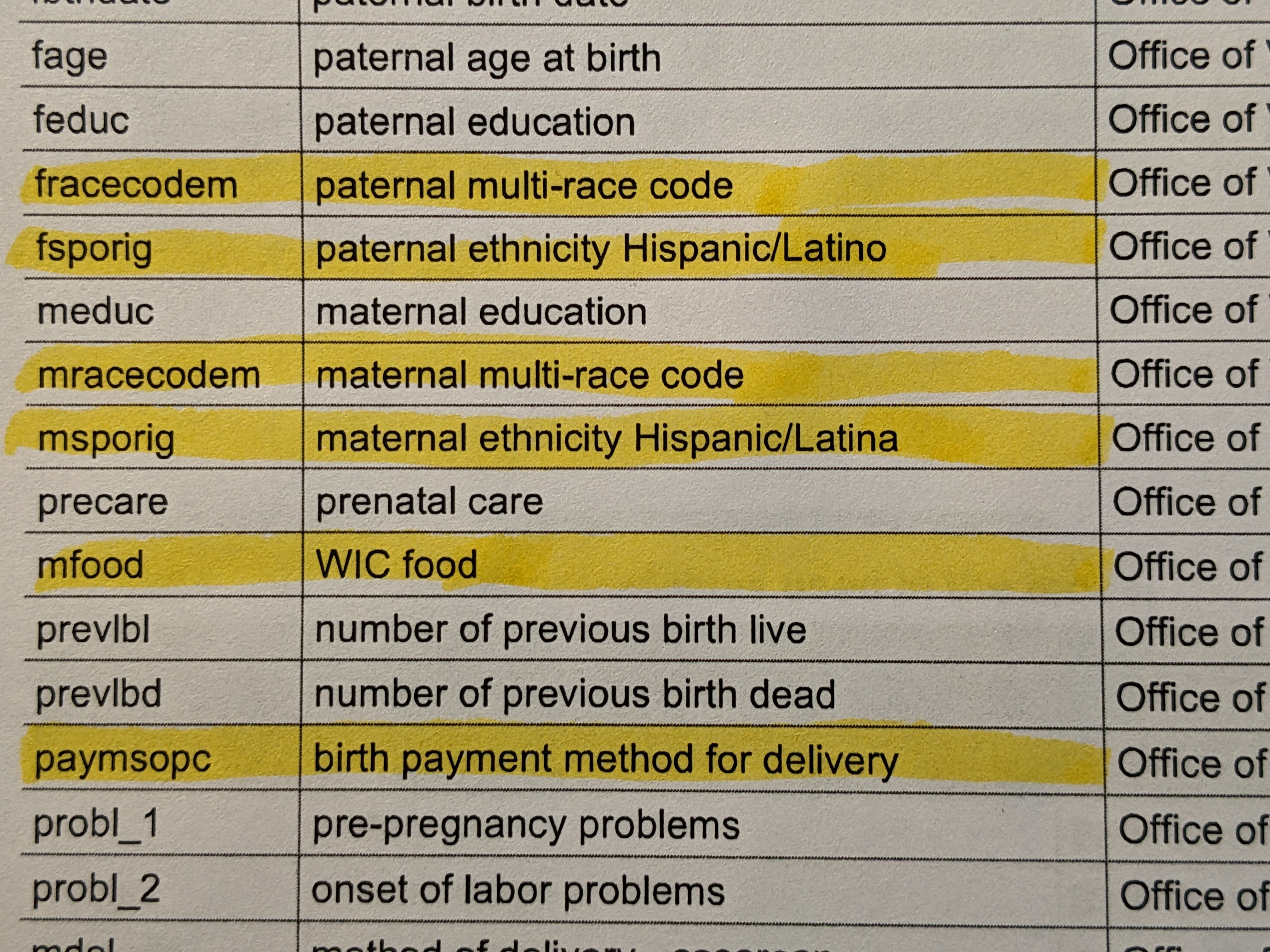
Some of the data variables in the Cross Jurisdiction Model Replication Project

And now comes the next all-too-logical progression.  The same team that brought us AFST and Hello Baby, are part of the team offering up the most Orwellian algorithm yet: the Cross Jurisdiction Model Replication project. 

Like “Hello, Baby,” CJMR generates a risk score for every child at birth. (The developers claim this is ok because, they say, in effect, the number is invisible. More about that below.) Unlike Hello, Baby there is no opt-out at all.  And while with AFST the developers bragged about not explicitly using race (while using poverty), and with Hello Baby they claimed (falsely) that they weren’t using poverty, this time there’s no more let’s pretend.  The use of race and poverty is out in the open. 

Data variables include: 

● Paternal multi-race code

● Material multi-race code

● Paternal ethnicity Hispanic/Latino

● Maternal ethnicity Hispanic/Latino 

As for poverty, data variables include: 

● “WIC food” (that is, use of the Supplemental Nutrition Program for Women, Infants and Children).

 ● “Birth payment method for delivery” (in other words, whether it was paid for by Medicaid, the health insurance program for poor people).

And sure enough, the developers say, it works!  How do they know?  If this all weren’t so dangerous the answer would be laugh-out-loud funny: They know it works, they say, not because the algorithm was good at predicting actual child abuse, but because, in many cases, it was good at predicting whether a child would wind up in foster care! 

But like everything else in family policing, the reasons children wind up in foster care are arbitrary, capricious, cruel – and subject to racial and class bias.  As is so often the case with these algorithms, they are less prediction than self-fulfilling prophecy. 

So really guys, you didn’t need to bother!  We already know that if you’re poor and especially if your poor and Black or poor and Native American your kids are more likely to wind up in foster care; in fact, we’ve been trying to tell you why that’s a huge problem for years. 

With CJMR there’s no way to protect your family from government agencies taking your most basic,
and in some cases, most private data, and turning it against you.  There is no chance for informed consent or any kind of consent.  And, of course, there is nothing to show this actually prevents child abuse.
 

But don’t worry, the developers say.  All of this is OK because the data are anonymized.  That scarlet number risk score on your child is invisible, so no problem!  The purpose of the algorithm, the developers say, is not to target individuals, but to target communities.  The documents touting the algorithm are pretty vague, but they appear to be suggesting that if enough “high-risk” babies are from the same neighborhood that would be a good neighborhood for concentrating preventive services. 

But since poverty itself is commonly confused with “neglect” we already know where the “high-risk” neighborhoods are – they’re the neighborhoods where poor people live.  So all you need to do is find those neighborhoods – and send money.  Not a lot of money either, since we know that remarkably small amounts of cash are enough to significantly reduce what family police agencies call “neglect.” 

But for America’s giant child welfare industry of helping professionals, that spoils all the fun.  

This was best explained decades ago by Malcolm Bush in his book Families in Distress: 

“The recognition that the troubled family inhabits a context that is relevant to its problems suggests the possibility that the solution involves some humble tasks … This possibility is at odds with professional status. Professional status is not necessary for humble tasks … Changing the psyche was a grand task, and while the elaboration of theories past their practical benefit would not help families in trouble, it would allow social workers to hold up their heads in the professional meeting or the academic seminar.” 

So it should come as no surprise that some of the biggest enthusiasts for scarlet number algorithms also are push a narrative of false complexity on a problem that really isn’t all that complex. 

That’s best case. Worst case, they just want a rationale for taking away more kids. 

The co-designer 

And that brings us to the co-designer of all these algorithm projects, Emily Putnam-Hornstein.  An algorithm can be only as unbiased as its designer, and Putnam-Hornstein has revealed increasing devotion both to tearing apart more families and to minimizing the racial bias problem in family policing has a racism problem.  She has: 

● Declared that "it is possible we don’t place enough children in foster care or early enough.” 

● Called for forcing every parent reapplying for “public benefits” who has a child not otherwise seen by a mandated reporter to produce the child for a child abuse inspection in exchange for the financial aid. 

● Not merely disagreed, but demeaned the work of Black activists. 

­● Taken pride in being part of a group that rushed to defend what it says is the right of a self-proclaimed “race realist” beloved by Tucker Carlson to rant about the inferiority of Black people – without one word condemning the content of those rants. 

● Abandoned even the pretense of scholarly discourse on her Twitter feed, devoting it almost exclusively to lurid accounts of child abuse deaths. 

So when Putnam-Hornstein helps design and promote an algorithm that explicitly uses race and income to determine “high risk” for child abuse, and when developers or users of that algorithm say, in effect, “Trust us, we’ll always keep the data anonymized,” that’s not good enough. 

In fact, given that we already know how to target communities for prevention, the CJMR can serve no real purpose unless agencies using the algorithm stop anonymizing the data and use it to target individual families – and that’s what’s likely to happen as soon as there is a highly-publicized death of a child “known to the system” (like the ones in Putnam-Hornstein’s Twitter feed) in a state or locality that adopts the CJMR.  

The only thing stopping that is a family police agency’s equivalent of a pinky-swear.